


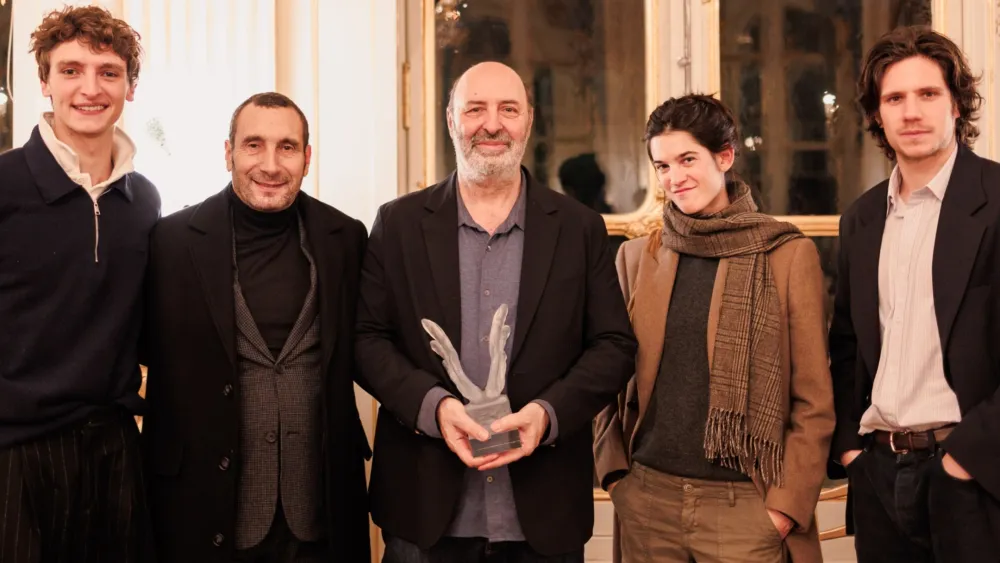
Flanked by his closest collaborators, director Cédric Klapisch collected this year’s French Cinema Award at a warm, familial ceremony at France’s Ministry of Culture on Jan. 15.
Joined by his longtime screenwriter Santiago Amigorena and his emblematic actor Zinedine Soualem — key creative partners for more than three decades — along with the cast of his latest feature, “Colors of Time,” Klapisch was celebrated for a career that has consistently looked beyond national borders.
Launched by Unifrance in 2016, the French Cinema Award honors a figure whose work has helped carry Gallic cinema worldwide. Past recipients include Isabelle Huppert, Juliette Binoche, Virginie Efira, and filmmakers Olivier Assayas, Rebecca Zlotowski, and Olivier Nakache and Éric Toledano. Klapisch, however, doesn’t just promote his films abroad: his work is defined by movement and global exchange, crystallized in the critically and commercially adored “Spanish Apartment” series, which across three features and an Amazon series follows an extended clan across three continents.
Accepting the prize, Klapisch pointed to travel as a central artistic catalyst, noting that a promotional tour for 2002’s “Pot Luck” — the first in the series — directly inspired its follow-up, “Russian Dolls.”
“Some journeys give birth to new films,” he said. “Travel is a fundamental part of my cinema. That’s the reason I made ‘Pot Luck’ — and why I’m standing here today.”
Raised in Paris, Klapisch launched his career with an MFA at NYU’s Tisch School of the Arts, an experience he said left a lasting mark.
“I began my adult life in the U.S., and today I honestly wonder whether young French people still feel the same pull to go there,” he added. “It’s less obvious now. Meanwhile, something new is happening: major American actors and directors are coming to France. That simply didn’t exist before. There’s been a reversal. Movement no longer flows in the same direction.”
Reflecting on what he called “a strange, pivotal moment” for the film business, Klapisch turned his focus closer to home. “There’s constant talk about box office numbers, admissions, and international circulation — and this is even more pronounced abroad,” he said. “But France is truly unique because of its system, and the CNC in particular. I will always defend the CNC. It must continue to exist. It supports cinematic creation. I’ve often said the CNC is a protected space where creation can happen, and I believe deeply in that model.”
Fittingly, CNC president Gaëtan Bruel was on hand to hear the praise, joining French Culture Minister Rachida Dati, Unifrance president Gilles Pélisson, and executive director Daniela Elstner in saluting Klapisch at this year’s Unifrance Rendez-Vous in Paris.
Daniela Elstner, Cedric Klapisch, Rachida Dati, Gilles Pélisson
Chloé Leclercq / Unifrance
