


We’re still four months from the U.S. national team competing in the 2026 World Cup on home ground, and already we’re learning the Americans’ pathway to the 2030 World Cup.
On Friday, CONCACAF, soccer’s governing body in this part of the planet, announced the qualifying framework for the next tournament.
Advertisement
The big takeaway: The ferocious qualifiers between the United States and archrival Mexico — from which “Dos a Cero” was born — are probably over.
Blame World Cup expansion. Because the tournament has swelled to 48 teams, the region now receives six automatic berths, twice as many as before. So CONCACAF’s traditional six-team final round, known as the “hexagonal,” no longer works.
Instead, the last stage will feature three four-team groups, with the winner and runner-up securing passage to the World Cup. The 2030 tournament will take place in Spain, Portugal and Morocco, with 100th anniversary matches also played in Argentina, Uruguay and Paraguay.
Unless something really strange occurs in CONCACAF’s earlier qualifying round, the U.S. and Mexico will not end up in the same final-round group. That means no more rambunctious showdowns before pro-U.S. crowds in MLS stadiums or monumental clashes in the thin air of Mexico City’s fabled Estadio Azteca.
Advertisement
The U.S. beat Mexico 2-0 in four successive World Cup qualifying cycles in Columbus, Ohio, before losing there in 2016. Five years later, “Dos a Cero” returned, but in Cincinnati.
The U.S. has never won a qualifier in Mexico.
Of course, the Americans and Mexicans will continue to clash in the Gold Cup, Nations League and friendlies — but unlikely with a World Cup berth at stake.
If all goes according to plan, the U.S., Mexico and Canada would headline each of the three final-round groups.
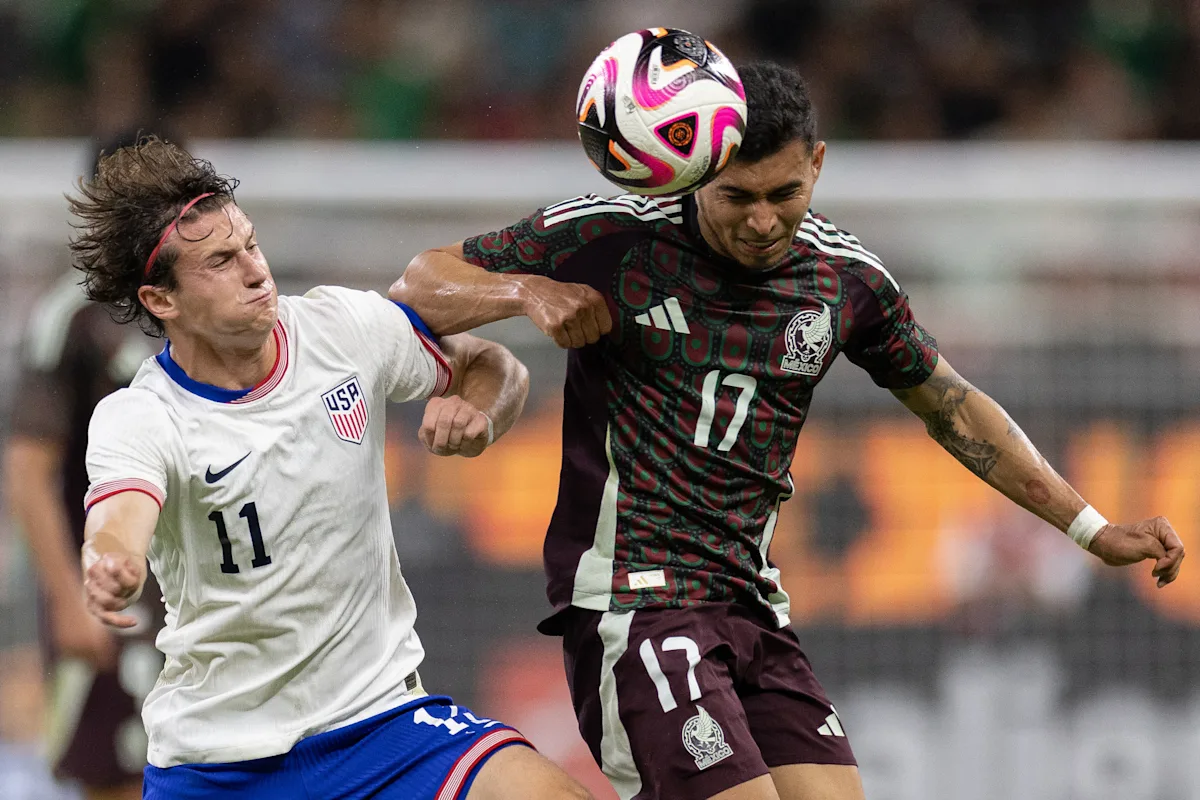
The U.S. vs. Mexico rivalry may soon lose its World Cup stakes.
(John Dorton/ISI Photos/USSF via Getty Images)
As host countries, none of those teams needed to qualify for the 2026 World Cup. Panama, Haiti and Curacao qualified in CONCACAF, while Jamaica and Suriname will compete in a six-team FIFA playoff next month.
Advertisement
Because of scheduling issues caused by the pandemic, CONCACAF did need to alter the 2022 World Cup qualifying format. Instead of a hexagonal, the confederation arranged an octagonal, with eight teams fighting for three automatic berths in the 32-team field. (Canada finished first, followed by Mexico and the U.S.)
The expanded World Cup, though, prompted greater changes.
For 2030, CONCACAF teams ranked from No. 14 to No. 35 will compete in two-leg playoffs (based on rankings) in September-October 2027. Those 11 winners will join the region’s top 13 ranked teams in the second round, held in late 2027 and early 2028.
Those 24 teams will be divided into six groups of four, with each team facing every other team in its group home and away for a total of six matches apiece. CONCACAF did not specify procedures for determining the groups, but based on typical FIFA rankings, the U.S. and Mexico would be atop separate groups and heavily favored to finish first.
Advertisement
In the current rankings, the U.S. is No. 15, Mexico No. 16, followed by Canada No. 29 and Panama No. 33. No other CONCACAF team cracks the top 50.
The group winners and runners-up in the second round will advance to the final stage in 2028-29. If both the U.S. and Mexico were to win their second-round groups, they would both almost certainly headline final-round groups. (CONCACAF, however, has not outlined group procedures.)
Should one slip up in that second round and finish second in group play, the U.S. and Mexico could end up in the same final-round quartet.
In which case, make your travel plans for Ohio and CDMX.
