


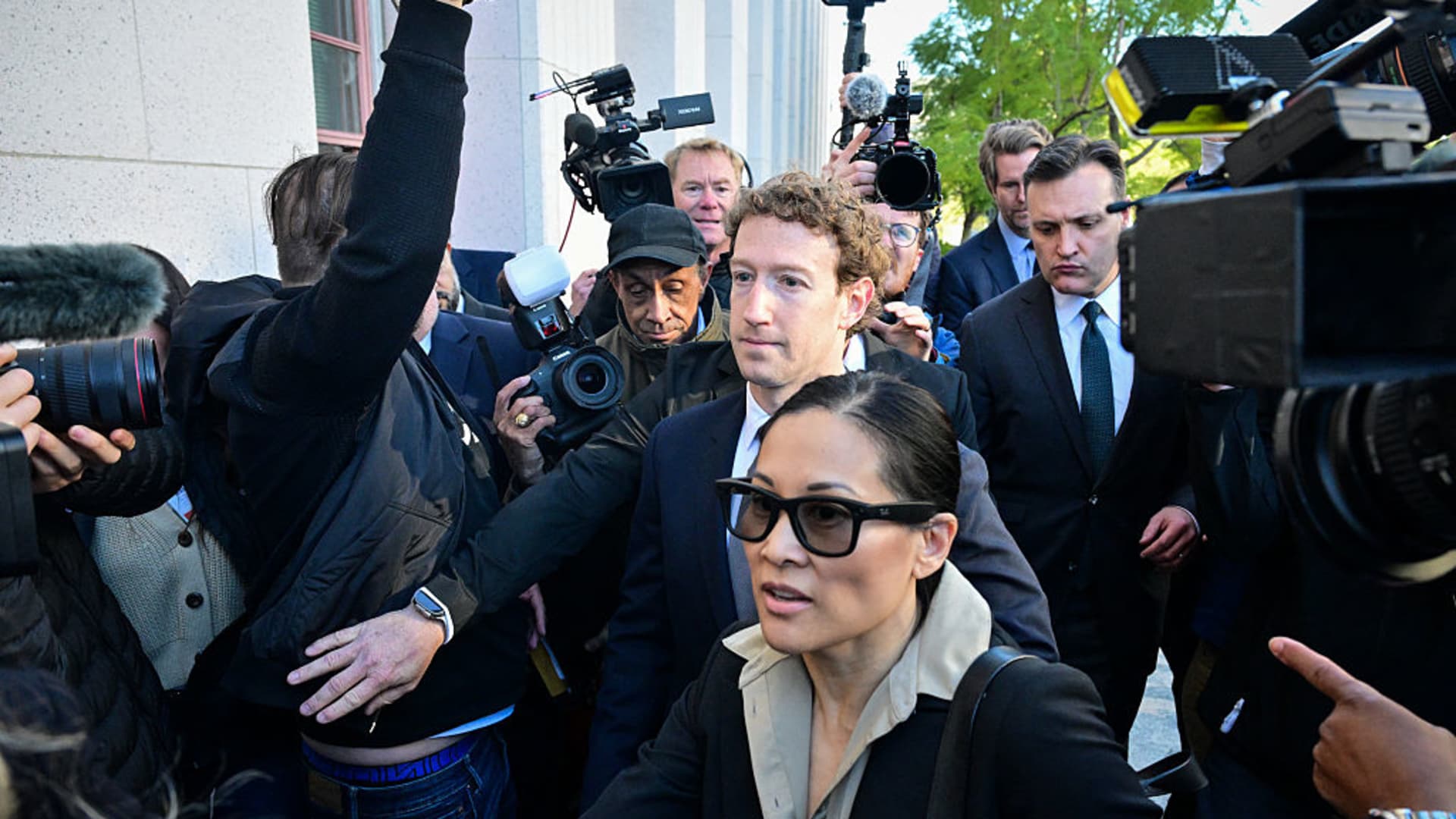
Meta CEO Mark Zuckerberg pushed back against the notion that the social media company made increasing time spent on Instagram a company goal.
Zuckerberg was addressing a 2015 email thread in which he appeared to highlight improving engagement metrics as an urgent matter for the company.
While the email chain may have contained the words “company goals,” Zuckerberg said the comments could have been an aspiration, and asserted that Meta doesn’t have those objectives.
The comments came during testimony in a landmark trial about social media and safety that’s being likened to the industry’s “Big Tobacco” moment.
The trial, which began in late January, centers on a young woman who alleged that she became addicted to social media and video streaming apps like Instagram and YouTube.
Lawyers later brought up evidence from Instagram chief Adam Mosseri, which included goals to actively up user daily engagement time on the platform to 40 minutes in 2023 to 46 minutes in 2026.
Zuckerberg said the company uses milestones internally to measure against competitors and “deliver the results we want to see.” He asserted that the company is building services to help people connect.
Meta CEO Mark Zuckerberg arrives to the Los Angeles Superior Court at United States Court House on Feb. 18, 2026 in Los Angeles, California.
Jill Connelly | Getty Images
Lawyers also raised questions over whether the company has taken adequate steps to remove underage users from its platform.
Zuckerberg said during his testimony that some users lie about their age when signing up for Instagram, which requires users to be 13 or older. Lawyers also shared a document which stated that 4 million kids under 13 used the platform in the U.S.
The Facebook founder said that the company removes all underage users it identifies and includes terms about age usage during the sign-up process.
“You expect a 9-year-old to read all of the fine print,” a lawyer for the plaintiff questioned. “That’s your basis for swearing under oath that children under 13 are not allowed?”
The company did not begin asking for birthdays at sign up until late 2019.
Zuckerberg later responded to questions about documents in which the company reported a higher retention rate on its platform for users who join as tweens. He said lawyers were “mischaracterizing” his words and that Meta doesn’t always launch products in development such as an Instagram app for users under 13.
Meta CEO and Chairman Mark Zuckerberg arrives at Los Angeles Superior Court ahead of the social media trial tasked to determine whether social media giants deliberately designed their platforms to be addictive to children, in Los Angeles, on Feb. 18, 2026.
Frederic J. Brown | AFP | Getty Images
During Wednesday’s session, a judge threatened to hold anyone using AI smart glasses during Meta CEO Mark Zuckerberg’s testimony in contempt of court.
“If you have done that, you must delete that, or you will be held in contempt of the court,” the judge said. “This is very serious.”
Members of the team escorting Zuckerberg into the building were pictured wearing the Meta Ray-Ban artificial intelligence glasses.
Recording is not allowed in the courtroom.
Lawyers also questioned whether Zuckerberg previously lied about the board’s inability to fire him in a courtroom on Wednesday.
If the board wants to fire me, I could elect a new board and reinstate myself,” he said, in response to remarks he previously made on Joe Rogan’s podcast.
During his interview with the podcaster last year, Zuckerberg had said he wasn’t worried about losing his job because he holds voting power.
Zuckerger said he is “very bad” at media.
The CEO walked into Los Angeles Superior Court just before noon ET Wednesday.
Meta CEO and Chairman Mark Zuckerberg arrives at Los Angeles Superior Court ahead of the social media trial tasked to determine whether social media giants deliberately designed their platforms to be addictive to children, in Los Angeles, on Feb. 18, 2026.
Patrick T. Fallon | Afp | Getty Images
Lawyers representing the plaintiff contend that Meta, YouTube, TikTok and Snap misled the public about the safety of their services and knew that the design of their apps and certain features caused mental health harms to young users.
Snap and TikTok settled with the plaintiff involved in the case before the trial began.
Meta has denied the allegations and a spokesperson told CNBC in a statement that “The question for the jury in Los Angeles is whether Instagram was a substantial factor in the plaintiff’s mental health struggles.”
Last week, Instagram’s Mosseri testified that while he thinks there can be problematic usage of social media, he doesn’t believe that’s the same as clinical addiction.
“So it’s a personal thing, but yeah, I do think it’s possible to use Instagram more than you feel good about,” Mosseri said. “Too much is relative, it’s personal.”
The Los Angeles trial is one of several major court cases taking place this year that experts have described as the social media industry’s “Big Tobacco” moment, because of the alleged harm caused by their products and the related company efforts to deceive the public.
Meta is also involved in a major trial in New Mexico, in which the state’s attorney general, Raúl Torrez, alleged that the social media giant failed to ensure that children and young users are safe from online predators.
“What we are really alleging is that Meta has created a dangerous product, a product that enables not only the targeting of children, but the exploitation of children in virtual spaces and in the real world,” Torrez told CNBC’s “Squawk Box” last week when opening arguments for the trial began.
This summer, another social media trial is expected to begin in the Northern District of California. That trial also involves companies like Meta and YouTube and allegations that their respective apps contained flaws that fostered detrimental mental health issues in young users.
WATCH: New Mexico AG Raul Torrez talks about his case against Meta
