


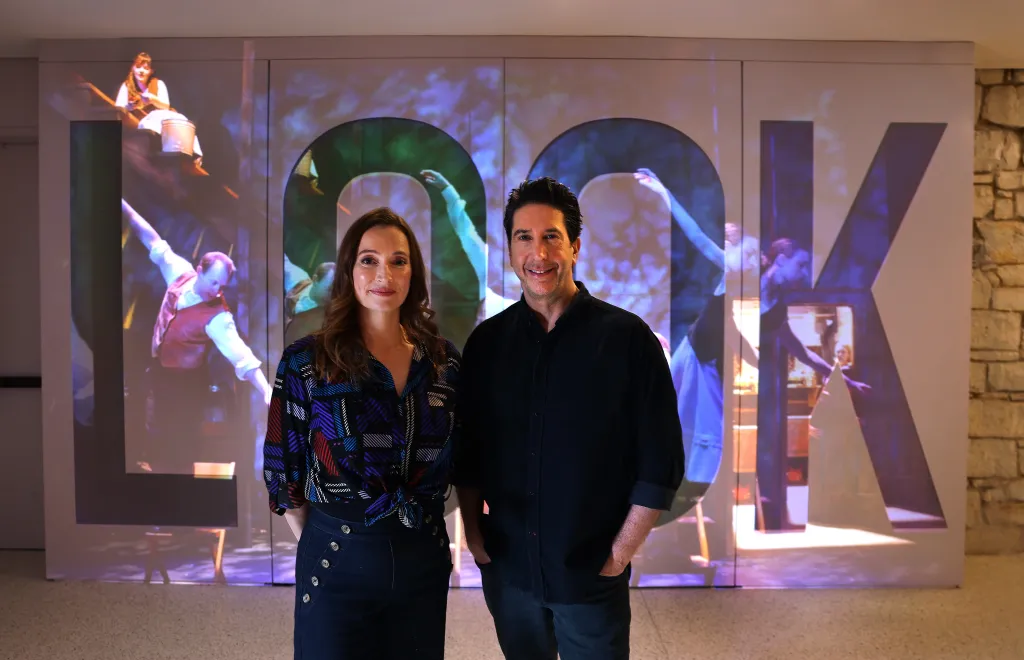
David Schwimmer, long a close friend of the Lookingglass Theatre, is re-engaged, reenergized and determined to coax the struggling Chicago theater company where he began his career back to life.
The 59-year-old actor, who shot to fame playing Ross on the hit sitcom “Friends,” has joined the Lookingglass board of directors, grabbed a spot on its finance committee, started taking meetings with everyone from the arts booster Lou Raizin to the mayoral candidate Alexi Giannoulias and brought in a fancy new website development team. He’s co-hosting an upcoming gala, dreamed up new Lookingglass merch, planned events with his longtime pal Billy Dec, walked into corporate boardrooms to raise money, and generally put himself out there in service of what can reasonably be called a major Lookingglass rebrand — with Schwimmer as the de facto chief marketing officer.
“I want to use whatever juice I have left,” Schwimmer said, clearly understating the amount of available juice, “to help boost the theater. I am doubling down.”
And it is not difficult for Schwimmer to book a meeting with a potential donor.
A reboot for the theater — Schwimmer calls it both a “relaunch” and a “bounce back” — certainly was necessary.
Lookingglass, founded by a highly talented group of Northwestern University graduates in 1988 and named after a student production of André Gregory’s “Through the Looking Glass,” brought something fresh and transformative to the then-grungy Chicago theater scene.
Before Lookingglass, Chicago theater was underpinned by the in-your-face acting style embodied by John Malkovich and Gary Sinise at the Steppenwolf Theatre, and by the improv-driven sketch comedy at Second City. The erudite Lookingglass, which featured famously good-looking actors and looked to such influences as the Pilobolus dance company and Cirque du Soleil, added a crucial third leg to the city’s cultural stool.
Its Northwestern University heritage gave it another advantage, too. The Evanston school’s performance and theater departments had a heritage of exploring non-dramatic texts like novels and narrative poems, with scholar-artists like Robert Breen and Frank Galati turning them into theater. One of Galati’s students, Mary Zimmerman, became both a MacArthur Foundation “genius” and a Lookingglass ensemble member and created some of its biggest hits, including an unforgettable 1992 adaptation of “The Arabian Nights,” as well as “Eleven Rooms of Proust” (2000) and “Metamorphoses,” a stunning retelling of the Greek myth that ran for a year at the now-defunct Ivanhoe Theatre on Chicago’s North Side and had a similar run at Broadway’s Circle in the Square, after first offering balm to grieving New Yorkers in the weeks following the Sept. 11 terrorist attacks.
Schwimmer was there from the start, directing “The Jungle” in 1990 at the Lakeview building that’s now Theater Wit. This was an adaptation of the 1906 novel about the meatpacking industry by Upton Sinclair; famously, Lookingglass actors hung by their heels, depicting the draining carcasses of the Chicago Stockyards. He acted, too, appearing in a 1998 adaptation of Fyodor Dostoevsky’s “The Idiot.”
But Lookingglass was hardly dominated by Schwimmer, a founding member along with Eva Barr, David Catlin, Thomas J. Cox, Larry DiStasi, Joy Gregory, David Kersnar and Andy White. In the 1990s and early 2000s, gifted early ensemble artists like Heidi Stillman (who created “Hard Times” and other famed shows), and Laura Eason emerged from its productions. Some left for New York or Los Angeles to become screenwriters and showrunners. Others remained, working on shows like “Metamorphoses.”
In 2003, Lookingglass Theatre landed a sweetheart deal brokered by then-Department of Cultural Affairs commissioner Lois Weisberg, a famous mover and shaker, to become the anchor tenant in the Water Tower Water Works, a prime location on Michigan Avenue, directly across from Chicago’s famed Water Tower and, at the time, the epicenter of the Midwest’s leading retail district. The rent was $1 a year over a 20-year lease, although it cost Lookingglass $8 million to outfit the theater and move in. And once arrived, it had to pay to run a historic venue to which you could not attach a marquee.
Lookingglass prospered in the heady Chicago cultural years of the early 21st century, welcoming Sasha and Malia Obama to its summer student program and scoring a big hit with the circus-fused “Lookingglass Alice,” among many other shows. Its board, and its best seats, became prestige perches among the affluent residents of the Gold Coast and North Shore. Its vibe was hip and classy.
But in the years approaching COVID, the theater began to suffer from an identity crisis. Its core ensemble had grown older, and busier. For the most part, the original members were newly unfashionably homogenous: caucasian, roughly the same age, educated at a private university. New ensemble members like J. Nicole Brooks and Anthony Fleming III had been added, and there were genuine successes as the profiles of the newcomers rose, but as the years went by, resources rarely matched the theater’s lofty ambitions. And its environs, the Magnificent Mile, ended up with troubles of its own as retail and restaurants began to struggle.
Director David Schwimmer at the Lookingglass Theatre in 1990. (Chuck Osgood/Chicago Tribune)
At the turn of the millennium, Lookingglass had fought its way into the top tier of resident Chicago theaters, turning the big five of Goodman, Steppenwolf, Court, Second City and Chicago Shakespeare into the big six. But unlike its peers, Lookingglass specialized in original, company-devised works, typically based not on familiar existing intellectual property but on unfamiliar or esoteric sources.
Inevitably, there was a high failure rate, especially as the company’s most talented members were attracted to more lucrative opportunities demanding their attention. COVID led to a closure of some 19 months, longer than most Chicago companies. Even after the very slow return, ever-diminishing financial resources meant that the number of productions was vastly reduced, as was their scale. The number of staffers was reduced.
The bloom appeared to have fallen off the Lookingglass rose. Questions were asked as to whether the company would even survive.
Questions were asked internally, too. “We had to ask ourselves what we wanted to hold on to, and what we were willing to let go,” Schwimmer said. “Nothing about who we were had really changed, but we had to adapt to a new and unfamiliar landscape.”
Schwimmer, of course, had been one of the group who departed for Los Angeles, landing the role of Ross Geller on “Friends,” the NBC Thursday night sitcom that made huge stars out of all its cast, who eventually made $1 million each per episode. “Friends” attracted audiences of a size unthinkable in the streaming era — more than 50 million Americans simultaneously tuned in to watch its final episode, “The Last One,” in 2004. In more recent years, “Friends” has found a new audience through online streaming, rediscovered by a new generation. This has led to what Schwimmer says is his new tactic when it comes to fundraising. “I say to people,” he said, “Why don’t you match what I am giving?”
That level of fame created a lot of attention for the actor with all the pluses and minuses, especially in regards to how an ensemble theater operates. Schwimmer has never wanted to be overly dominant, even if his longtime generosity to the company has been something of an open secret in Chicago’s theater community. “My challenge,” he said, “is always trying not to take too much of the spotlight, personally, and keeping the focus on the work.” Plus, he had moved to New York, had a kid and become very busy with post-“Friends” movie projects. “There was,” he said, “a chunk of time when I was less available. But I now have some space in my personal life where I can invest more. I think it is critical for me to step up in order to sustain this theater company.”
Schwimmer is working to boost the profile of Lookingglass’ young new artistic director, Kasey Foster, who says her goal is to return to “full seasons” of work, just as soon as the money is there. (Which is where Schwimmer comes in.)
The partners say they are planning new revenue sources beyond philanthropic giving, including renting out their large lobby (recently renovated thank to a grant from the State of Illinois) for private events; getting into the business of corporate training (long a lucrative sideline for Second City); and presenting shows from other producers in its intimate theater in an enviable location. Foster also says she wants to amp up touring of the theater’s biggest hits, such as Zimmerman’s “The Steadfast Tin Soldier.” And that she has high hopes for the next show, “White Rooster,” showcasing the relatively new ensemble member Matthew C. Yee. The next season, which will include a new Zimmerman project and J. Nicole Brooks’ play “Prince Hal,” about Mayor Harold Washington, is soon to be announced.
Schwimmer clearly sees the upcoming gala, slated for May 2 at The Wellsley in River North and themed around 37 years of Lookingglass’ costume designs, as the beginning of a new era. Foster notes that the company has just signed a new 20-year lease on its home and is finally in the final throes of getting a permitted marquee on Pearson Street above its new entrance. That will allow it to adequately advertise its offerings to a potential walk-in crowd, for the first time in 22 years. There are also eight new board members and a new donor wall in the theater.
“Who we are at our core has never changed,” Schwimmer said. “That means invention, collaboration and transformation.”
Usman Ally (front), Lauren Orkus, Douglas Hara and Louise Lamson in Lookingglass Theatre Company’s production of “Metamorphoses.” (Liz Lauren)
TIMELINE
1988: Founded by Northwestern University graduates after performing “Through the Looking Glass” on campus.
1991: Former Chicago critic Justin Hayford directs “Eurydice” for Lookingglass at the World Tattoo Gallery.
1997: Mary Zimmerman’s “The Arabian Nights” plays at the Steppenwolf Studio Theatre after an earlier production in 1992.
1998: Lookingglass produces Zimmerman’s “Metamorphoses,” which will play a long run at Chicago’s Ivanhoe Theatre (now a Binny’s liquor store) and then to Broadway’s Circle in the Square.
2003: Lookingglass moves into Water Tower Water Works; David Schimmer directs a high-profile adaptation of Studs Terkel’s “Race.”
2005: “Lookingglass Alice” bows. It will return several times.
2009: Schwimmer acts in Thornton Wilder’s “Our Town,” directed by Anna D. Shapiro and Jessica Thebus.
2012: Lookingglass collaborates with chef Rick Bayless on the upscale dinner show “Cascabel.”
2018: Zimmerman returns with “The Steadfast Tin Soldier.”
2020: The COVID crisis sparks a 19-month closure.
2025: Gov. JB Pritzker speaks in the Lookingglass lobby to herald a reopening and remodeling funded by a Rebuild Illinois grant; Atra Asdou’s “Iraq, but Funny,” is heralded for its central performance.
Chris Jones is a Tribune critic
cjones5@chicagotribune.com
