


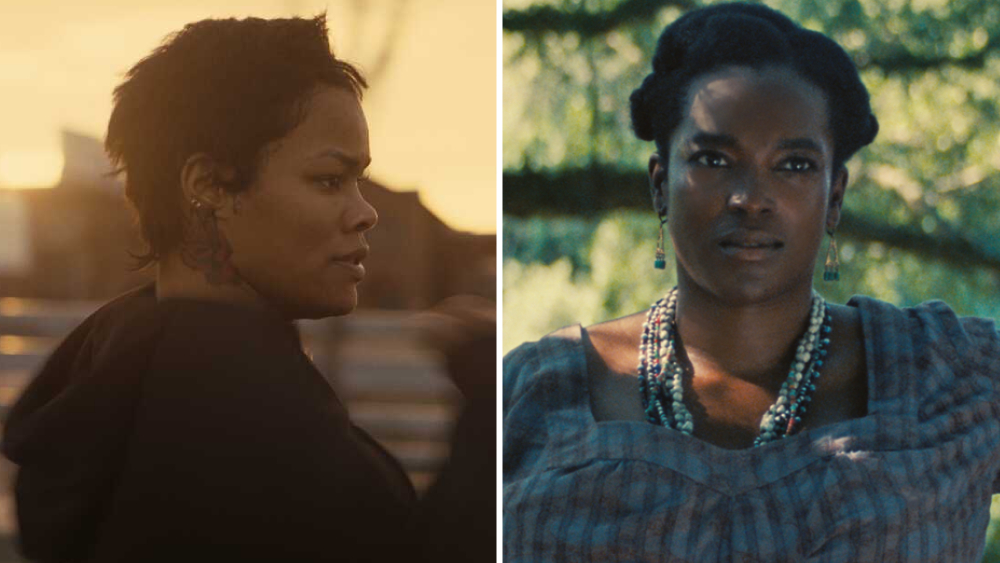
Once can be written off. Twice can be explained. Three starts to look like a trend.
The Academy Awards’ supporting actress race is quietly approaching that kind of tipping point. With Teyana Taylor and Wunmi Mosaku both in contention, the Oscars could soon deliver something that has never happened before: three Black women winning the same acting category consecutively. If Taylor wins for “One Battle After Another,” or Mosaku wins for “Sinners,” it would mark the first time in the Academy’s 98-year history that Black women have won best supporting actress three years in a row. They would follow the triumphs of Da’Vine Joy Randolph for “The Holdovers” and Afro-Latina Zoe Saldaña for “Emilia Pérez.”
In the context of Oscar history, it would carry enormous weight, since no Black actresses have ever won three consecutive years — in the same category — at any major entertainment ceremony, including the Emmys and Tonys. Currently in the Broadway realm, Kara Young has won two consecutive Tonys, most recently for “Purpose,” following her win for “Purlie Victorious: A Non-Confederate Romp Through the Cotton Patch.” Perhaps the three-peat streak can continue in this year’s Tonys race where theater hopefuls such as Samira Wiley (“Proof”), Anika Noni Rose (“The Balusters”) and Kristolyn Lloyd (“Liberation”) will be looking to contend.
The showings for Black actresses in the entertainment space have been dire. Since the first Academy Awards ceremony in 1929, more than 3,100 Oscar statuettes have been awarded. Only 20 are held by Black women — roughly 0.6% of the total. To put it in further context, the number of Black actresses who have won Oscars (10) is less than the number of nominations Meryl Streep has received throughout her career (21). It’s a blunt measure of how often the industry’s most premier honor has overlooked Black women, particularly in acting categories, which shape careers and cultural memory, and factor into production and promotional budgets for future projects.
To be clear, a three-peat in supporting actress would not erase that imbalance. However, it would signal something the Oscars have rarely managed: sustained recognition rather than a one-off “moment.”
I mean, look at how it all began.
Hattie McDaniel became the first Black acting winner when she won supporting actress for “Gone with the Wind” (1939) at the 12th ceremony. The next Black woman to win an acting Oscar wasn’t until 51 years later, when Whoopi Goldberg won for “Ghost” (1990). Another 11 years passed before Halle Berry became the first — and still only — Black woman to win lead actress for “Monster’s Ball” (2001).
That history helps explain why supporting actress has become a focal point. Of the 20 Black women who have won Oscars across all categories, 10 have been in the supporting actress category. In the last 20 years alone, the category has crowned eight of them, a run that reads like significant progress, but also serves as a reminder of how limited the pipeline has been elsewhere.
Teyana Taylor in “One Battle After Another.”
New York-born Taylor blazed onto the film scene with her breakout turn in the indie drama “A Thousand and One” (2023), before taking on the role of radical revolutionary Perfidia Beverly Hills in Paul Thomas Anderson’s political action epic. Thus far, she’s won 10 precursor awards, including the Golden Globe, the second-most among her competitors. Trailing her by only one is Mosaku, the Nigerian and British actor who plays the hoodoo-practicing Annie in Ryan Coogler’s vampire drama “Sinners.”
With the BAFTA and Actor Awards still to come, and final Oscar voting set to open on Feb. 26, the two are in a tight race alongside their fellow nominees, Amy Madigan from “Weapons” and the “Sentimental Value” duo Elle Fanning and Inga Ibsdotter Lilleaas.
The race is also unfolding alongside a broader awards-season story anchored by “Sinners,” which is leading the 98th Academy Awards with 16 nominations. Across those nominations, 10 Black artists are recognized, tying the all-time record for a single film producing the most Black nominees in Oscar history.
“Sinners” is also stacking firsts that help explain why a potential supporting actress streak would fit into a larger shift. Zinzi Coogler, one of the film’s producers and Ryan Coogler’s wife, is the first Filipina producer nominated for best picture and the third Black woman nominated in the category. In the crafts, Black and Filipina cinematographer Autumn Durald Arkapaw is the first woman of color nominated in the category. Production designer Hannah Beachler extends her legacy as the only Black woman ever nominated for and to win production design for “Black Panther” (2018), earning her second invitation to the ceremony.
And then there’s, of course, costume designer Ruth E. Carter, a name that has become the industry standard for record-making Black women. Her fifth nomination for “Sinners” makes her the most-nominated Black woman in Oscar history across any category, surpassing actress Viola Davis. In 2019, Carter became the first Black person to win a costume design Oscar for “Black Panther”; then, in 2022, she won again for the sequel “Wakanda Forever,” making her the only Black woman — actor, filmmaker or artisan — to have more than one Oscar in her possession.
Some other awards bodies have also been telegraphing a shift. The last five Golden Globe winners for supporting actress have been Black women: Ariana DeBose for “West Side Story,” Angela Bassett for “Black Panther: Wakanda Forever,” Randolph for “The Holdovers,” Saldaña for “Emilia Pérez” and Taylor for “One Battle After Another.”
Taylor arrives as a legitimate Oscar threat with the kind of adoration and critics reviews that make voters take notice. Mosaku arrives with something else: the full industry weight and love of “Sinners,” a film that has become both an awards-season juggernaut and a cultural moment.
It would be easy to treat a potential three-year supporting actress streak as trivia — the kind of stat that gets mentioned, applauded and filed away. But that 0.6% figure doesn’t allow for casual framing.
For nearly a century, Black women’s presence in the Academy’s official record has been disproportionately small, even as their influence on American performance, storytelling and style has been enormous. That’s what makes this season’s “firsts” both celebratory and instructive. They are still happening in a ceremony nearing its centennial, which means the barriers they represent remain. If Taylor or Mosaku wins on March 15, the Academy will do something it has never done. And the Oscars, for once, will not simply be offering a moment, rather confirming what we’ve known all along: Black women are great.
Final Oscar voting will take place from Feb. 26 to March 5. The 98th Oscars will be held March 15 and will air on ABC, hosted by Conan O’Brien. This week’s updated Oscar predictions are below.
Wunmi Mosaku in “Sinners”
©Warner Bros/Courtesy Everett Collection
Best Picture: “Sinners” (Warner Bros.) — Zinzi Coogler, Sev Ohanian and Ryan Coogler
Director: Ryan Coogler, “Sinners” (Warner Bros.)
Actor: Ethan Hawke, “Blue Moon” (Sony Pictures Classics)
Actress: Jessie Buckley, “Hamnet” (Focus Features)
Supporting Actor: Stellan Skarsgård, “Sentimental Value” (Neon)
Supporting Actress: Teyana Taylor, “One Battle After Another” (Warner Bros.)
Original Screenplay: “Sinners” (Warner Bros.) — Ryan Coogler
Adapted Screenplay: “One Battle After Another” (Warner Bros.) — Paul Thomas Anderson
Casting: “Sinners” (Warner Bros.) — Francine Maisler
Animated Feature: “KPop Demon Hunters” (Netflix) — Maggie Kang, Chris Appelhans and Michelle L.M. Wong
Production Design: “Frankenstein” (Netflix) — Tamara Deverell; Shane Vieau
Cinematography: “Sinners” (Warner Bros.) — Autumn Durald Arkapaw
Costume Design: “Frankenstein” (Netflix) — Kate Hawley
Film Editing: “F1” (Apple Original Films/Warner Bros.) — Stephen Mirrione
Makeup and Hairstyling: “Frankenstein” (Netflix) — Mike Hill, Jordan Samuel and Cliona Furey
Sound: “F1” (Apple Original Films/Warner Bros.) — Gareth John, Al Nelson, Gwendolyn Yates Whittle, Gary A. Rizzo and Juan Peralta
Visual Effects: “Avatar: Fire and Ash” (20th Century Studios) — Joe Letteri, Richard Baneham, Eric Saindon and Daniel Barrett
Original Score: “Sinners” (Warner Bros.) — Ludwig Göransson
Original Song: “Golden” from “KPop Demon Hunters” (Netflix) — EJAE, Mark Sonnenblick, Joong Gyu Kwak, Yu Han Lee, Hee Dong Nam, Jeong Hoon Seon and Teddy Park
Documentary Feature: “The Perfect Neighbor” (Netflix) — Geeta Gandbhir, Alisa Payne, Nikon Kwantu and Sam Bisbee
International Feature: “Sentimental Value” from Norway (Neon) — dir. Joachim Trier
Animated Short: “The Girl Who Cried Pearls” (National Film Board of Canada) — Chris Lavis and Maciek Szczerbowski
Documentary Short: “All the Empty Rooms” (Netflix) — Joshua Seftel and Conall Jones
Live Action Short: “Two People Exchanging Saliva” (Canal+/The New Yorker) — Alexandre Singh and Natalie Musteata
Projected winner leaders (films): “Sinners” (6), “Frankenstein” (3); “F1” “KPop Demon Hunters,” “One Battle After Another” and “Sentimental Value” (2)
Projected winner leaders (studios): Warner Bros. (10), Netflix (7), Apple Original Films and Neon (2)
