


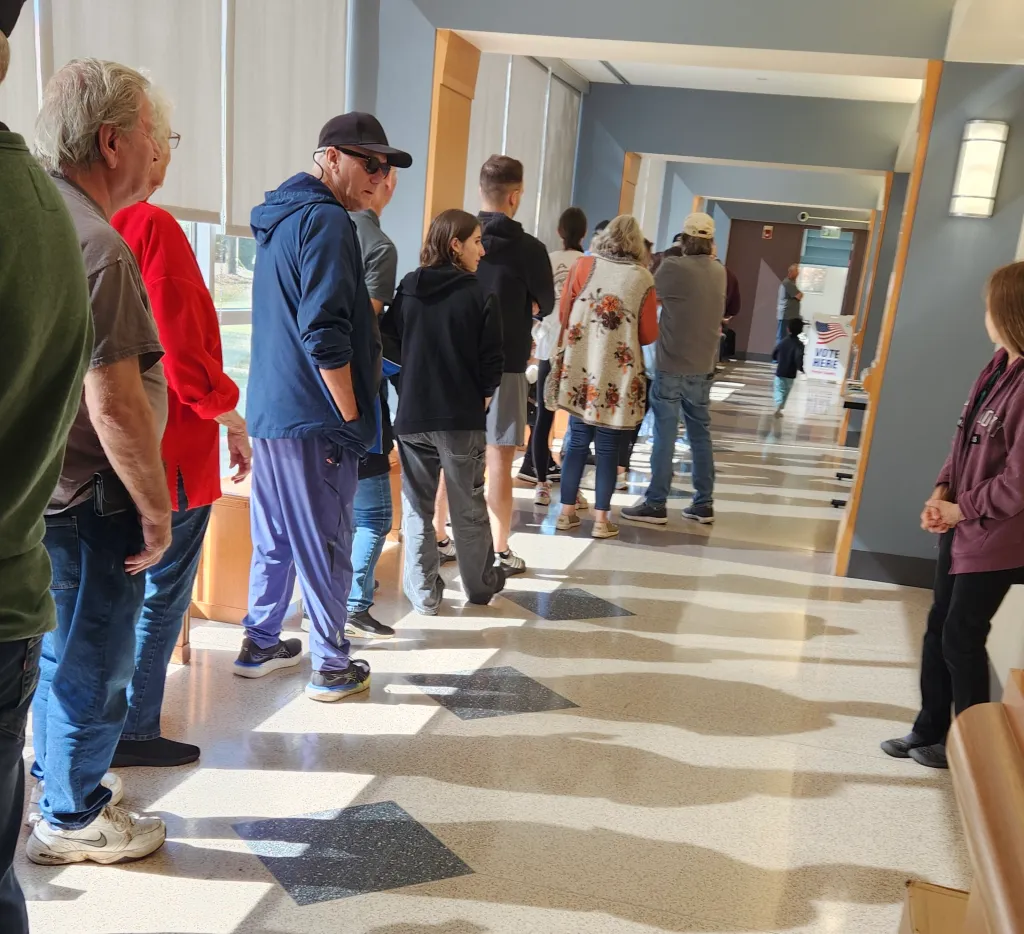
Indiana Republican legislators were able to reinstitute a year-long effort for a shorter early voting period by approving an amendment to an early voting bill in the Senate Elections committee.
Committee Chair Sen. Mike Gaskill, R-Pendleton, offered an amendment to Senate Bill 1359, which addresses scanning early voting ballots, to decrease early voting from 28 days to 16 days.
Gary Satellite Early Voting clerk Cindy Moore smiles while assisting a voter during the first Saturday of early voting at the Gary Public Library & Cultural Center in Gary, Indiana on Saturday, Oct. 26, 2024. (Andy Lavalley/for the Post-Tribune)
Gaskill said he proposed the amendment because “a shorter time for early voting will save money and also make it easier to administer the election.” Offering 16 early voting days would still give voters three weekends of early voting, he said.
“I am sure many of you have heard the argument, even here in the legislature, that it’s Election Day not election month,” Gaskill said.
Gaskill said the change in early voting would shift Indiana from having one of the country’s longest early voting periods to being in the middle range.
“I’m of the opinion that the shorter period is a compromise between folks that do have concerns about election integrity with a longer period of early voting,” Gaskill said. “It still puts us kind of in the middle of the pack of what other states do.”
The independent think tank MAP found that 14 states have early voting lasting more than 22 days. Other states have shorter periods, with eight states offering between 15 to 21 days of early voting and 22 states offering between 7 to 14 days of early voting.
State Sen. Fady Qaddoura, D-Indianapolis, said he opposed the amendment because it will impact working-class voters who may not be able to leave work on Election Day to cast a ballot.
“The more that we have flexibility, the more that we can allow people to participate,” Qaddoura said. “I’m very concerned that this is a reverse of a good policy. I will always be on the side of making it more convenient for voters to vote.”
State Sen. J.D. Ford, D-Indianapolis, said in the 2024 general election, 1.4 million people utilized early voting. Of the 1.4 million voters, 309,000 voters cast a ballot during the last two weeks of early voting, which the amendment seeks to eliminate.
“I think this is going to increase those lines and put some really heavy burden on our (county) clerks,” Ford said. “This is going to take away from working-class folks who need that time because they might have an inflexible work schedule or caregiving responsibilities or even transportation issues for that matter.”
State Sen. Greg Walker, R-Columbus, said he had concerns with the amendment because the Republican counties in his district have reported that 50% of ballots cast are cast during the early voting period.
Walker asked Gaskill how the amendment is germane to the underlying bill, which establishes rules for when election officials can scan early voting ballots. Gaskill said he talked with legislative attorneys who said the amendment was germane to the bill.
“I just feel like it’s a topic of conversation that would be standalone, but I’ll accept the judgment of our well,” Walker said.
Gaskill said he wouldn’t allow public testimony on the amendment because the committee had heard testimony on a similar measure to shorten early voting in the 2025 legislative session. The 2025 bill called for a 14-day early voting period. It passed the Senate Elections Committee but wasn’t considered by the full Senate.
The amendment passed the committee 6-3, with Walker joining the two Democrats on the committee in voting against the amendment. The bill passed 7-2, along party lines.
Lake County Board of Elections and Registration Director Michelle Fajman said she testified against the 2025 bill and she would’ve done the same if public testimony was allowed for the amendment.
In Lake County, during the 28-day early voting period across 11 locations, 88,980 voters cast a ballot in the 2024 general election, while 38,404 voters cast a ballot in the 2022 general election, Fajman said.
During the 2020 general election, 97,632 voters cast a ballot during the 28-day early voting period across 11 locations, Fajman said.
“Our county likes (early voting). We’d like to even expand it,” Fajman said. “This is not where we need to be making cuts.”
Early voting is a safe and effective way to cast a ballot, Fajman said. Compared to other states, Indiana has low voter turnout, Fajman said, and reducing early voting days won’t help increase voter turnout.
“Clearly, voters like this. I urge any voter who voted early to contact the legislature,” Fajman said.
Julia Vaughn, the executive director of Common Cause Indiana, said it was disappointing that a major change in early voting passed without public testimony.
“It’s a bad idea. Early voting is very popular in Indiana. This is not something that we need reduced, and we certainly don’t need it reduced without public testimony as session ends,” Vaughn said.
Residents, especially voters who cast a ballot during early voting, should contact senators to tell them to vote against this measure, Vaughn said.
akukulka@post-trib.com
