


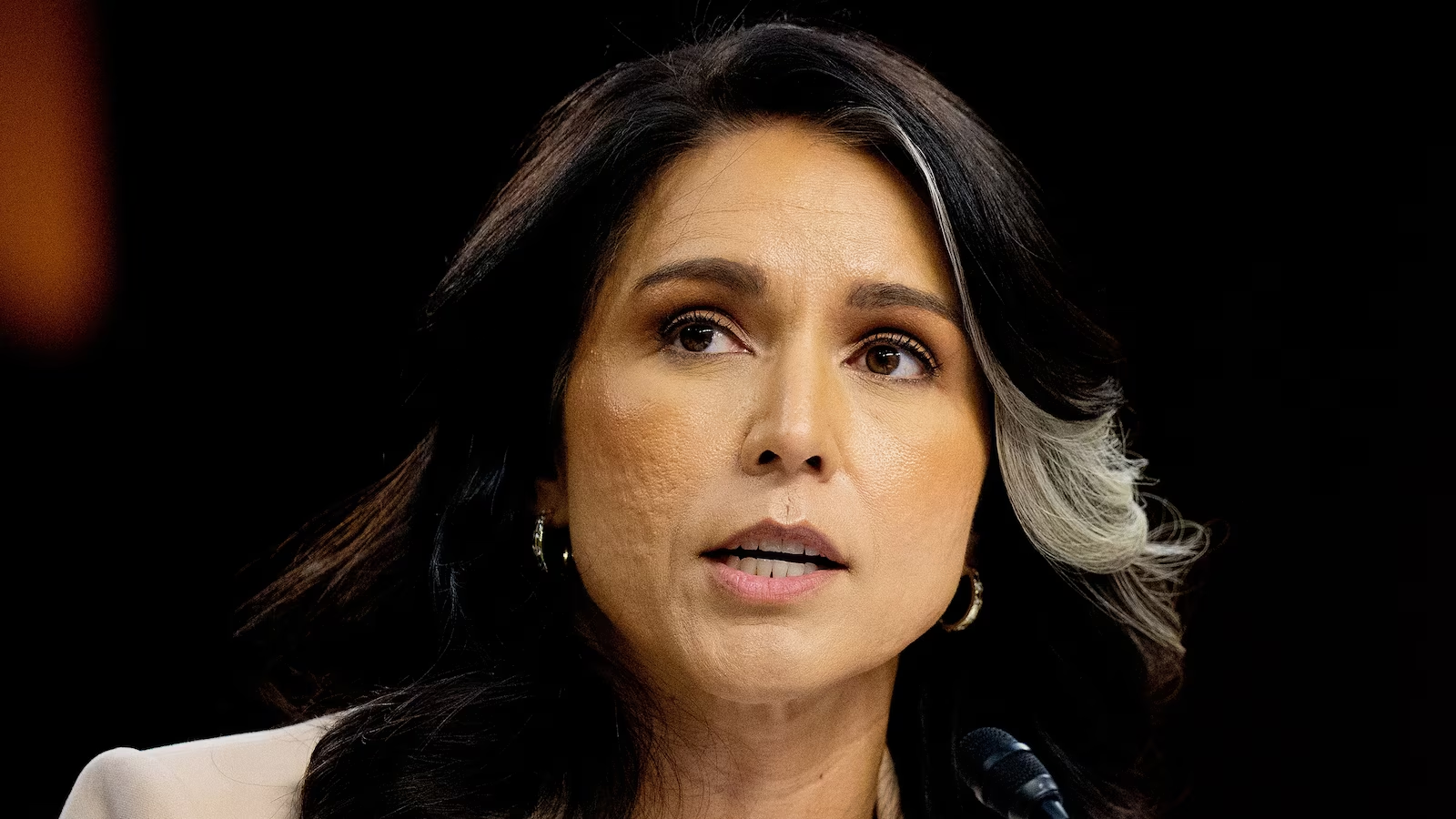
Director of National Intelligence Tulsi Gabbard is testifying before the Senate Intelligence Committee on Wednesday on worldwide threats — her most significant public appearance in months and her clearest opportunity yet to address the intelligence picture surrounding the war in Iran.
Lawmakers are expected to press Gabbard on the administration’s handling of the Iran conflict, homeland security concerns, election integrity and the broader global threat environment at a moment of rising tension.
She also heads into the hearing under fresh scrutiny after the resignation of Joe Kent, the administration’s top counterterrorism official, who stepped down Tuesday over his objections to the Iran war — the highest-profile administration official to resign publicly over the conflict.
Director of National Intelligence Tulsi Gabbard speaks during a Senate Committee on Intelligence Hearing, March 25, 2025 in Washington.
Andrew Harnik/Getty Images
An ODNI official told ABC News that Gabbard was not asked by the White House to fire Kent, pushing back on a report first aired by Fox News.
Kent’s resignation sharpened questions already hanging over the administration’s case for war — whether Iran posed an imminent threat to the United States.
In his resignation letter, Kent said he could not “in good conscience” support the war and argued that Iran posed “no imminent threat” to the nation, directly undercutting President Donald Trump’s repeated public justification for the conflict.
Trump has previously said Tehran posed an imminent threat and was “very nearly” in a position to strike.
Hours after Kent’s resignation became public, Gabbard moved to publicly back Trump’s authority to make that call.
In a post on X, she said the president, as commander in chief, is responsible for determining “what is and is not an imminent threat” and whether action is necessary to protect U.S. troops, the American people and the country.
She added that ODNI’s role is to coordinate and integrate intelligence, so the president has the best information available to inform his decisions, and said Trump had concluded Iran posed an imminent threat after reviewing the available intelligence.
Director of National Intelligence Tulsi Gabbard listens to a question as she speaks with reporters in the James Brady Press Briefing Room at the White House, July 23, 2025, in Washington.
Julia Demaree Nikhinson/AP
She did not directly address Kent’s allegations or mention him by name.
The moment is especially striking for Gabbard because few figures in Trump’s orbit spent more time warning about regime change wars, intelligence failures and the cost of Washington interventionism.
As a 2020 Democratic presidential candidate, she was so vocal in her opposition to war with Iran that she sold “No War With Iran” T-shirts.
In an exclusive interview with ABC News last year, she again spoke about diplomacy, military restraint and the human cost of conflict in terms that reflected a worldview she has carried for years.
In that interview, Gabbard said the stress of her first deployment in her mid-20s turned part of her hair white, and that she kept the streak as a reminder of the high human cost of war.
“War must always be the last resort, only after all measures of diplomacy have been completely exhausted,” she told ABC News in the interview.
This week’s hearings will also unfold against the backdrop of Gabbard’s broader and unusually quiet tenure. Before taking office, she was rarely far from public view, frequently appearing on television, podcasts and social media.
As DNI, that version of her has largely faded from public view.
In recent months, she has appeared mostly in glimpses, at major administration moments.
Gabbard, a lieutenant colonel in the Army Reserve and the first person in U.S. history to serve as DNI while in military uniform, appeared in uniform at Dover Air Force Base earlier this month during the dignified transfer of six American soldiers killed in a drone strike in Kuwait in the opening hours of the war with Iran.
Attorney General Pam Bondi, Vice President JD Vance, Director of National Intelligence Tulsi Gabbard, and second Lady of the United States Usha Vance attend a dignified transfer at Dover Air Force Base March 7, 2026 in Dover, Delaware.
Anna Moneymaker/Getty Images
She also heads into the hearing with other controversies still hanging over her.
Gabbard has drawn scrutiny for her role in the administration’s election integrity push, including her appearance outside the FBI’s operation in Fulton County, Georgia, in January, where federal agents seized election materials tied to the 2020 election, and her subsequent acknowledgment that she arranged a call between President Donald Trump and the agents involved. She has also faced continuing questions about her investigations into election security in Puerto Rico and Arizona.
ABC News previously reported that Gabbard arranged a call between Trump and FBI agents involved in the seizure of election materials in Fulton County, an unusual move given the sensitivity of the investigation. In Arizona, a senior administration official told ABC News that Gabbard was not on the ground but was still “working across the agency to ensure election integrity.”
United States Director of National Intelligence Tulsi Gabbard speaks on the phone outside the Fulton County Election Hub and Operation Center in Union City, Georgia, January 28, 2026.
Elijah Nouvelage/Reuters
The hearing is shaping up as more than a routine annual threat assessment.
It will be the clearest public test yet of how Gabbard explains the role she has carved out inside the Trump administration, and how she reconciles the anti-war politics that helped define her rise with the office she now holds at the center of a war she is being asked to defend.
