


I love a good fashion documentary, and there’s no mystery as to why the best ones, like “Unzipped” (1995) or “Valentino: The Last Emperor” (2008), tend to be organized around a single fashion season and a fabled designer’s creation of an indelible collection. (Remember how Isaac Mizrahi based his 1994 collection in “Unzipped” on a random TV viewing of the 1922 silent Eskimo documentary “Nanook of the North”? How could one forget?) That countdown structure allows us to see the creative process in bloom, and to experience all the backstage politics and drama of an approaching runway show. It’s a structure that also worked for the fashion-media documentary “The September Issue” (2009), and it’s been utilized in countless music docs as well. The formative film of the genre is probably Jean-Luc Godard’s “One Plus One” (1968), which documented the Rolling Stones recording “Sympathy for the Devil” (in between Godardian riffs on topics like Black revolution), a song that underwent so many changes in the studio that the result was one of the two or three most haunting movies about the creative process ever made.
But then we come to “Marc by Sofia,” Sofia Coppola’s benignly diverting 87-minute portrait of her longtime BFF (best fashion friend), the legendary designer Marc Jacobs. Jacobs is obviously a visionary talent, a creator of postmodern clothes so baroquely out there that they’re truly cinematic. And Coppola is such a gifted filmmaker that I went into the movie eager to see how she might dress up the by-now traditional template of a fashion documentary.
“Marc by Sofia,” however, turns out to be a surprisingly standard, not-all-that-enthralling entry in the genre. It presents a lot of tasty clips of Jacobs through the decades, going back to his 1980s days at the Parsons School of Design, but the heart of the movie is its chronicle of the 12 weeks in which he dreamed up and put together his 2024 spring show. We’re eager to behold the drama of Jacobs bringing that dream to life. But as Coppola presents it, the strange thing about the process is that it’s nearly drama-free.
Jacobs, at least in the movie, never gets riled or angry or stressed. And Coppola never gives us a clear sense of the fashion concept that’s driving the show. As the three months are counted down in a clockwork way (at one point, the film simply leaps from the 12-week mark to the six-week mark), there’s little detailed feeling for how the designs evolve, for what’s at stake, or for the personalities of Jacobs’ associates. By the end of “The September Issue,” you practically wanted to nominate Vogue’s creative director, Grace Coddington, for best supporting actress. There’s no one remotely like that here — and this is the fashion world. I’m sorry to put it this way, but there’s a drama-queen deficit in “Marc by Sofia.”
You’d think it might be filled by Jacobs himself, who’s the first to confess that he’s an obsessive personality. His sense of fabrics — their possibility and range — is so exacting that it’s nearly microscopic. It’s a kick to see him look over swatches of blue-gray material and talk about the precise texture he wants: something like wool that’s also transparent. He’s like a composer searching for the perfect chord. But the Jacobs we see in the old clips, sometimes with luxuriously long hair, was a lot more excitable than he is today.
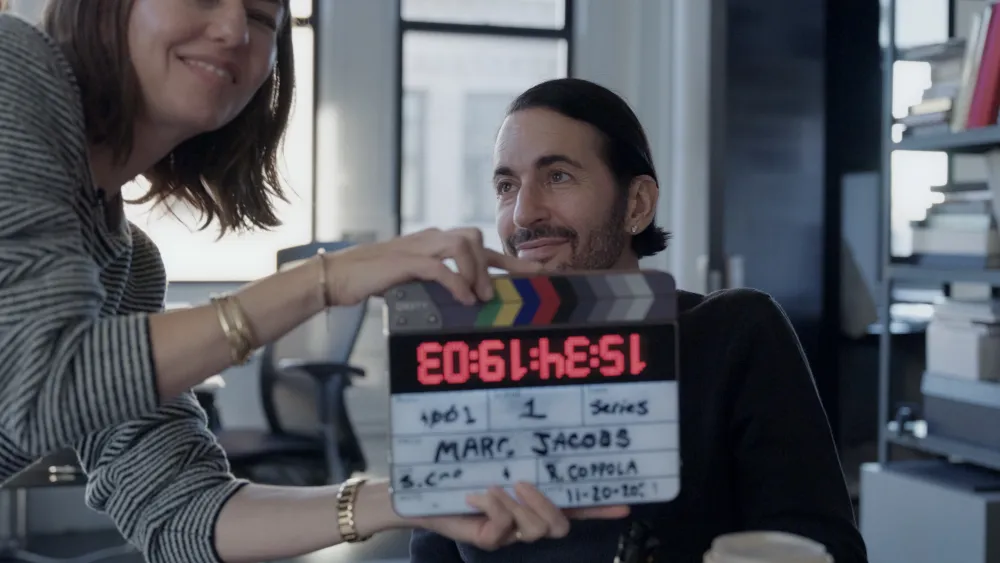
He’s a youthful 62 now, and as he sits before Coppola’s camera in a sprawling white-walled design studio, clad in his dark neutral cable-knit long-sleeved pullover, with his modified horn-rims and trim beard and hair oiled into a slicked-back pageboy, he keeps expounding on things, in a way that’s meticulously rational and rather abstract. He’s giving us his philosophy of creation, which is fine as far as it goes. But the film never fully dips into the aesthetic nitty-gritty of the spring show. And however much Jacobs may reference his obsessiveness, his demeanor is so steady and relaxed that he exudes nothing so much as the power of having done this dozens of times. What makes this show special? We want the answer, and the film scarcely provides it.
Jacobs’ backstory is certainly vital. He recalls the nearly mystic connection he felt, growing up, to Yves Saint Laurent, and he talks about other influences, from how mad he was for the films of Bob Fosse (notably “Sweet Charity”) to a great story about being seated at a dinner next to Vivienne Westwood, whom he idolized, the two of them bonding over their borderline secret fixation on the collage-of-history grandeur of Saint Laurent’s designs. But the film should have colored in the ironic way that Westwood herself changed everything — not just by introducing the transgressive aesthetics of punk to the fashion world, but by defusing that very transgression by making it a commodity. Jacobs himself was accused of that when he presented his 1993 Grunge Collection for Perry Ellis, which was so badly received by the critics that it got him fired from the label. In hindsight, though, he, like Westwood, was a brand rebel ahead of the capitalist curve.
Coppola pops up in the movie, notably in some clips from 1994, when she helped produce the guerrilla fashion show for X-Girl, the label co-founded by Sonic Youth’s Kim Gordon. Coppola and Jacobs have been friends for 30 years, and while I have no knee-jerk reaction against this kind of closeness between filmmaker and subject (Terry Zwigoff was able to make “Crumb” because he was friends with Robert Crumb), the relationship should be used in an illuminating way — to show us sides of the subject that might not otherwise reveal themselves. But if I didn’t know that Sofia Coppola had made “Marc by Sofia,” I’d guess that the director was some streaming-craftsman-for-hire steering clear of anything too dark or messy.
The film ends with the show itself, which unfurls at the Park Avenue Armory, a gorgeous red-brick 19th-century Upper East Side castle that, inside, resembles nothing so much as the world’s most industrial middle-school gymnasium. There’s a kind of set (a gigantic Claes Oldenburg-style folding table and chairs), which is appropriate, since everything about Jacobs’ designs for this show is…big. Models strutting in retro pouffy wigs (the models literally look like ’60s mannequins), shirts with giant buttons, leather pants that look four sizes too huge. It’s a surreal celebration of largeness, but after all the applause there is little sense of what kind of a splash it made. Instead, there is just Marc Jacobs chilling in his apartment the morning after, talking about the phenomenon he calls “post-art-done depression,” which he says always comes upon him. But, of course, he’ll rotate back to another creative moment. It’s all a big cycle, and I wish “Marc by Sofia” made it feel like more than another turn of the wheel.
