


Solicitor General D. John Sauer got a somewhat frosty reception from at least two key Supreme Court Justices — Chief Justice John Roberts and Associate Justice Neil Gorsuch — during oral arguments in the Supreme Court’s landmark birthright citizenship case Wednesday.
President Donald Trump attended the start of the proceedings Wednesday morning, making him the first sitting president to attend the high court’s arguments.
Trump is asking the justices to uphold his Day 1 executive order eliminating birthright citizenship under a novel interpretation of the 14th Amendment and requiring parents to prove their own legal status before citizenship is granted to their children.
Roberts noted that the Trump administration is relying on “very quirky” arguments, saying they are using “narrow exceptions” to claim that a much broader class of people should be ineligible for birthright citizenship.
“You know, children of ambassadors, children of enemies during a hostile invasion, children on warships, and then you expand it to the whole class of illegal aliens here in the country. I’m not quite sure how you can get to that big group from such tiny and sort of idiosyncratic examples,” said Roberts.
Gorsuch also remarked that the Trump administration seems to be relying on outdated “Roman law sources” and court precedents that do not work in their favor.
“I’m not sure how much you want to rely on Wong Kim Ark,” Gorsuch remarked about the landmark 1898 case that enshrined birthright citizenship.
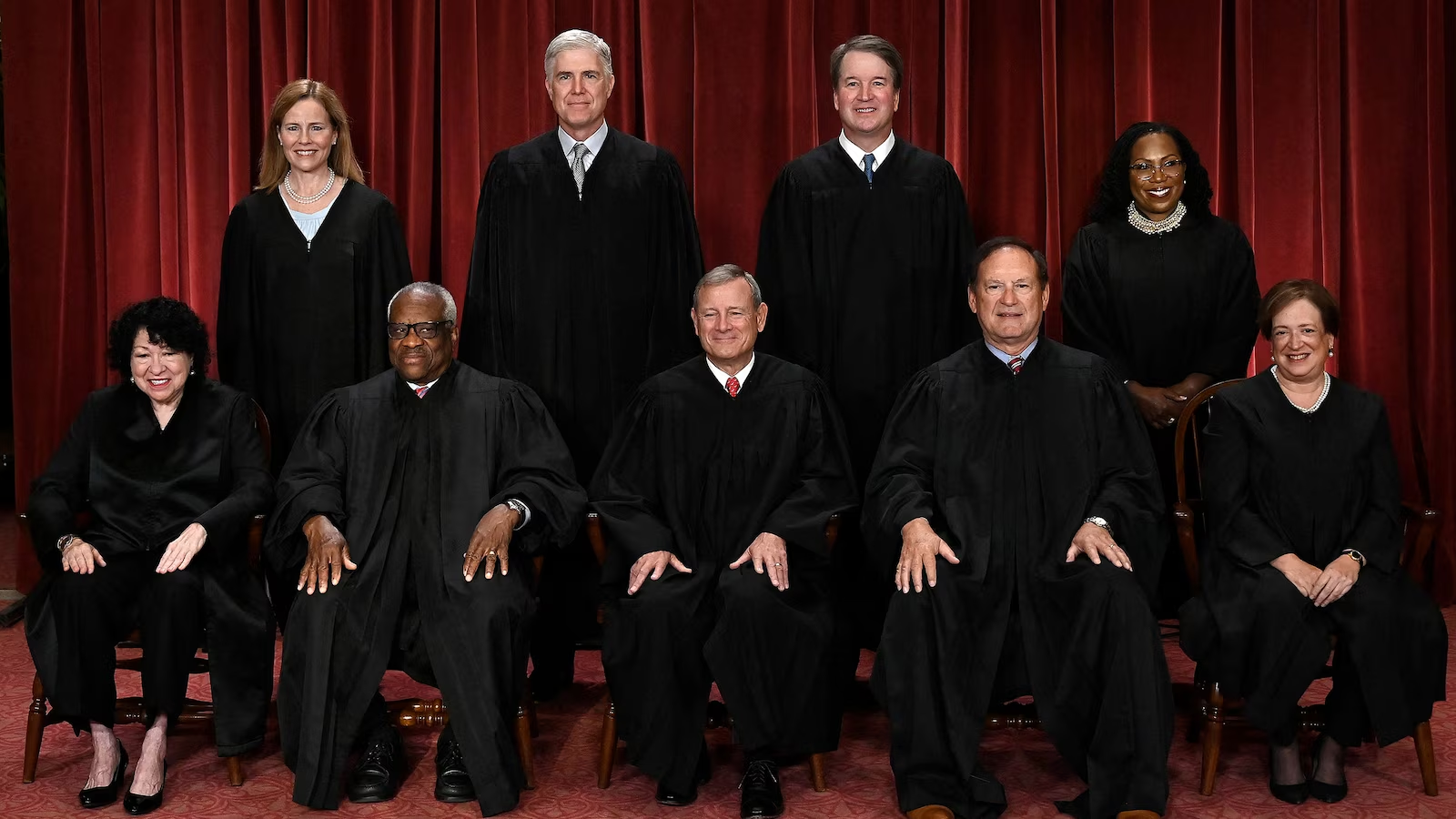
Justices of the Supreme Court pose for their official photo at the Supreme Court, Oct. 7, 2022. (Seated from left) Associate Justice Sonia Sotomayor, Associate Justice Clarence Thomas, Chief Justice John Roberts, Associate Justice Samuel Alito and Associate Justice Elena Kagan, (Standing behind from left) Associate Justice Amy Coney Barrett, Associate Justice Neil Gorsuch, Associate Justice Brett Kavanaugh and Associate Justice Ketanji Brown Jackson.
Olivier Douliery/AFP via Getty Images
Justice Elena Kagan similarly voiced concerns about the sources cited by the Trump administration.
“You’re using some pretty obscure sources to get to this concept,” she said.
Justice Samuel Alito initiated a discussion on “illegal immigration” by noting that it was “something that was basically unknown” at the time when the 14th amendment was adopted in the 1860s.
“What we’re dealing with here is something that was basically unknown at the time when the 14th Amendment was adopted, which is illegal immigration,” Alito said. “So how do we deal with that situation when we have a general rule?”
Sauer responded by agreeing with Alito, saying that “illegal immigration did not exist [then],” and “the problem of temporary visitors didn’t exist.”
Sauer pointed to “commentators” from 1881 to 1922 who, he claimed, were “uniformly saying the children of temporary visitors are not included.” He argued that this logic “naturally extends” to those who enter the country illegally.
Justice Elena Kagan challenged Sauer’s argument on immigration, saying his arguments in his brief did not focus on “illegal immigration.”
“Most of your brief is about people who are just temporarily in the country where there was quite clearly an experience of an understanding that there were going to be temporary inhabitants,” Kagan said. “And your whole theory of the case is built on that group.”
“You don’t get to talking about undocumented persons until quite later, and at much lesser … I think it’s like 10 pages to three pages or something like that,” she said.
Sauer began his arguments by arguing that the longstanding understanding of the 14th Amendment is incorrect.
“The citizenship clause was adopted just after the Civil War to grant citizenship to the newly freed slaves and their children whose allegiance to the United States had been established by generations of domicile. Here, it did not grant citizenship to the children of temporary visitors or illegal aliens who have no such allegiance,” he said.
In his opening statements, Sauer laid out one of the Trump administration’s key arguments about why birthright citizenship should not be extended to the children of undocumented immigrants, claiming that if it remains “unrestricted” it will continue to be a “pull factor for illegal immigration” and would “reward” immigrants who violate immigration laws.
“It has spawned a sprawling industry of birth tourism as uncounted thousands of foreigners from potentially hostile nations have flocked to give birth in the United States in recent decades, creating a whole generation of American citizens abroad with no meaningful ties to the United States,” Sauer said.
The Trump administration has often claimed that birth tourism — the idea that foreign nationals travel to the U.S. with the sole purpose of having a child here — poses a national security risk and undermines birthright citizenship.
Justice Roberts pressed Sauer to explain how common the problem is, but Sauer was unable to give a clear answer.
“No one knows for sure. There’s a March 9 letter from a number of members of Congress to DHS saying, ‘Do we have any information about this?’ The media reports indicate estimates could be over one million, or 1.5 million from the People’s Republic of China alone. The congressional report that we cite in our brief talks about certain hotspots, like Russian elites coming to Miami through these birth tourism companies,” Sauer said.
Sauer went on to claim that media reports indicate there are 500 “birth tourism companies” in China, prompting Justice Roberts to interject to ask if Sauer agreed that had “no impact on the legal analysis before us.”
“We’re in a new world now as Justice Alito pointed out, to where 8 billion people are one plane ride away from having a child who is a U.S. citizen,” Sauer added later.
In a statement Wednesday morning, ACLU Executive Director Anthony D. Romero addressed Trump’s attendance at the proceedings, saying Trump would “watch the ACLU school him in the meaning of the Constitution and birthright citizenship.”
“Any effort to distract from the gravity and importance of this case will not succeed. The Supreme Court is up to the task of interpreting and defending the Constitution even under the glare of a sitting president a couple dozen feet away from them,” he said.
Although the proceedings should provide a sense of how interested the judges are in Trump’s reinterpretation of the 14th Amendment, a ruling in the case isn’t expected until the end of June.
This is a developing story. Please check back for updates.
