


For all its ills, social media can also be an entry point for anyone interested in Chicago history and the city’s varied eccentricities.
This became apparent when the writer and photographer Cristen Brown recently posted a pair of cufflinks featuring what most might assume is the letter “Y” in a circle.
But for Chicagoans with a deeper awareness, the symbol is recognizable as something else: The Chicago Municipal Device, a graphic design that can be found dotted around the city, from building facades to lampposts to the occasional manhole cover.
Depending on your depth of knowledge, it is either an obscure if delightful artifact that has an insidery “if you know, you know” quality to it, or something you were never aware existed.
“Chicagoans are completely obnoxious about … well, everything,” Brown wrote in the caption accompanying her photo. “But especially our glorious municipal device. I made this pair of cufflinks for my husband a few years ago.”
If the name is tripping you up — “municipal device” sounds as if it could be a gas meter or something else mechanical — that’s because it’s using the less commonly employed definition of “device” meaning heraldry, such as a coat of arms. Or as Merriam-Webster puts it: “An emblematic design used especially as a heraldic bearing.”
A pair of cufflinks designed by Cristen Brown for her husband, feature the Chicago Municipal Device. (Cristen Brown)
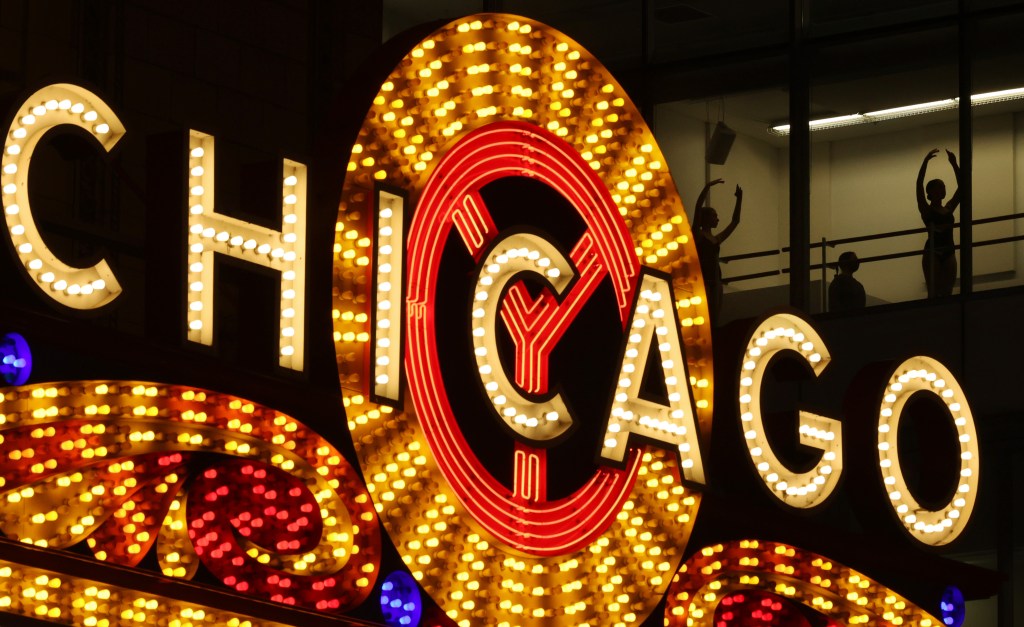
There’s something so perfectly humble-braggy and not immediately intuitive about calling it a device. Which is also what makes it so perfectly Chicago. It’s featured prominently, if sideways, on the Cook County flag (along with the iconic red stars that also appear on the city flag) and perhaps is most easily spotted — once you realize it’s there — in the marquee of the Chicago Theatre on State Street, especially when it’s lit up at night. The device can be clearly seen radiating like a sun behind the “ICA” of the word “CHICAGO.”
The origins of the Chicago Municipal Device date back to 1892, when the Tribune ran a contest a year ahead of the World Columbian Exposition. Dangling a $100 prize, the paper asked readers to choose the best city color, or combination of colors, to represent the idea of a unified Chicago. Even 134 years ago, the power of visual branding was ever-present.
The contest’s winner, a Danish architect and recent Chicago transplant named Alfred Råvad (sometimes spelled Roewad), suggested the color scheme of white and red. That was subsequently tweaked by the Citizens’ World’s Fair committee to white and terra cotta, to better reference the prevalence of the non-flammable clay-based building material used in the rebuilding of the city after the Great Chicago Fire of 1871.
But Råvad also added something extra to his submission: An idea for a graphic design which mimics the path of Chicago River — specifically where the main stem splits into two branches at Wolf Point, hence the “Y” shape — a shape which would eventually become known as the Chicago Municipal Device.
Here’s Råvad’s reasoning for creating a city logo: “I think it right to give a heraldic and graphic expression of Chicago, as it is and always will be divided by the river in three sides — North Side, West Side and South Side.”
“The idea is that people would create their own banners, flags, whatever, with this symbol in these colors,” says Robert Loerzel, a freelance journalist and historian and Tribune contributor. He frequently photographs his journeys around the city — recently posting a photo of the device he unexpectedly encountered on Western Avenue — and he has researched and written about the origins of both the Chicago flag and the device.
In its call for submissions, the Tribune noted that “Chicago’s unparalleled progress has been in no small degree due to the intense local pride of its citizens of all classes. ‘Shoulder to shoulder, close ranks’ has always been the watchword, and the consequence is a vast amount of justifiable civic pride which would doubtless welcome a chance to display itself in the display of a ‘municipal color.’”
Which is poetic hyperbole, Loerzel points out in a blog post: “Describing Chicagoans as a unified bunch was wishful thinking. The city’s factions often seemed to be at war with one another, whether it was moralists denouncing the people who frequented saloons and brothels, or captains of industry battling against unions.”
Alfred Jensen Roewad, the winner of a $100 prize in the Tribune’s contest for “municipal colors” to be displayed at the World’s Columbian Exposition of 1893, suggested terra cotta and white be displayed in banner and shield styles at the fair. Artist F.D. Millet took Roewad’s suggestions and in 1892 used them to create a flag using the same municipal colors. (Chicago Tribune)
Because the city’s divisions were (and still are) not only geographic but ideological, there was good reason to create a counter-narrative of unity ahead of the world’s fair. That’s because there had been some dispute as to where it should be based. Some people wanted it in what is now Grant Park. Others argued for Lincoln Park or Garfield Park. Ultimately, Jackson Park would win out.
“There had been a nasty fight over where it should be located, so part of this was about pulling Chicago back together,” says Patricia Morse, who has also written about the device. Her focus is in the history of Chicago’s South Side, and she writes for her own website in addition to a column for the Hyde Park Herald.
She suspects a desire to put the previous fractiousness to bed was why Råvad’s design was appealing. “It takes the different slides of the city and puts a circle around all of them, pulling them together and focuses on what made Chicago important, which at the time was the river.”
Morse first became aware of the device a few years ago when she was doing research on the fair. “I was helping give Friends of the White City tours of Jackson Park and where the fair was, so I was really immersed in that and looking for things that connected to it.”
A number of newspapers in town held similar contests, Morse says, including the now-defunct Chicago Inter Ocean, which published from 1865 to 1914. “They ran a contest for a figure that they called ‘Miss I Will’ that would symbolize Chicago for all the people coming to the fair. The fair was full of these metaphorical ladies; there was Britannia and Germania and so on.”
Morse describes Miss I Will in a blog post: “I learned about Miss I Will in the 1970s in the Eagle, a wonderful bar in Hyde Park. In the middle room, there were two large murals from the 1930s facing each other across the room. On the south wall was the 1930s skyline of New York with Miss Liberty front and center. On the north wall was the skyline of Chicago with Miss I Will looking like a chorus girl from the ‘Gold Diggers of 1933.’ Her marcelled hair was bottle blonde. She was smiling, close up, from somewhere out in the lake in front of the skyline of Chicago. I always liked the face-off. Turns out, she was invented for the 1893 Chicago World’s Fair.”
People ice skate past a Chicago Municipal Device on a light post in Millennium Park on Jan. 29, 2026. The symbol consists of a “Y” shape inscribed inside a circle. (Josh Boland/Chicago Tribune)
A version of the Chicago Municipal Device on the ceiling of Chicago City Hall. (Josh Boland/Chicago Tribune)
But it would be decades until Morse would learn about the Chicago Municipal Device. “Suddenly, you notice it’s on manhole covers, it’s in ironwork, it’s on old fire stations. The light posts in Grant Park have it, and those are relatively new.” Tribune archival photos from the early 20th century show the device in the logos of athletic association uniforms.
But you almost never see it on more contemporary buildings. Perhaps that’s because modern architecture rarely has the kind of adornments that might prompt a builder to consider including a Chicago Municipal Device somewhere in the external design. More than a century after its adoption, it’s become a niche interest.
Initially, the device only appeared on posters and advertisements before gaining more permanent traction. “In 1917, when the Chicago flag was adopted, they also passed an ordinance affirming this as the Municipal Device,” says Loerzel. Here’s how it is described: “The municipal device, for use by the varied unofficial interests of the city and its people, shall show a Y-shaped figure in a circle, colored and designed to suit individual tastes and needs.”
The ordinance also includes this detail: “All automobiles and other vehicles which are owned by the city, except those used by the commissioner of police, and the detective bureau of the department of police, shall be distinctly marked as the property of the city by painting or placing thereon in a conspicuous place, in such a manner that the same cannot be removed, the municipal device, together with the words ‘City of Chicago.’”
The device usually shows up as a “Y,” right-side up. But occasionally it’s inverted and there’s no definitive explanation, but some speculate that it is to represent the reversal of the Chicago River, which took place in 1900.
A Chicago Municipal Device symbol appears in a mosaic on the ceiling of the Chicago Cultural Center. (Josh Boland/Chicago Tribune)
A Chicago Municipal Device is part of the railing on the Franklin-Orleans Street Bridge, here on Jan. 30, 2026. (Josh Boland/Chicago Tribune)
“I think first and foremost, it’s just damn good design at its most basic level,” says Brown, who found inspiration for her husband’s cuff links by riffing on the old logo for the Chicago North American Soccer League club, which is indeed the Chicago Municipal Device.
“There probably are people who are like, ‘Why are there all these random “Ys” all over the city?’ But once you are introduced to it and you understand it, it becomes a friend that you start to recognize and the entire city just opens up like a giant scavenger hunt,” she says. “It’s simple, it’s eye-catching, it’s memorable, it’s versatile, it’s timeless. It’s as cool today as when they first introduced it. It also hits a lot of nerd points for people like me and that elevates it from just ‘This looks really cool’ to ‘This has all these connections to nerdly things.’ And when I say ‘nerds,’ I don’t mean that pejoratively; these are my people. And the nerdiest thing in the world is a map and that’s basically what this is. It’s a simplified map.”
Ultimately, she says, “it’s a very evocative symbol that you can unambiguously point to as being ours. When you see it, you can’t help but celebrate it. We’re all Chicago boosters, even as we recognize its imperfections and its warts. But we love our city and this is a symbol of that spirit.”
Morse echoes that sentiment.
“We are apparently the only city that has a device,” she says. “The people who voted for it in 1917 totally remembered the fair, so it was a celebration of the times we did good.”
Maybe we don’t do that enough.
“It’s this idea that we may fight with each other,” says Morse, “but when the world comes to us, we’re a unified Chicago.”
