


Indiana could see data centers exceed 20% of the state’s electricity usage, a new report from the Electric Power Research Institute found.
“The growth is coming,” said Tom Wilson, EPRI’s principal technical executive. “It seems to be the case in many parts of the country, and the regulators know about it, too. It’s been happening for a couple of years … and I think everybody’s planning to get ahead of the issue and take advantage of the opportunity.”
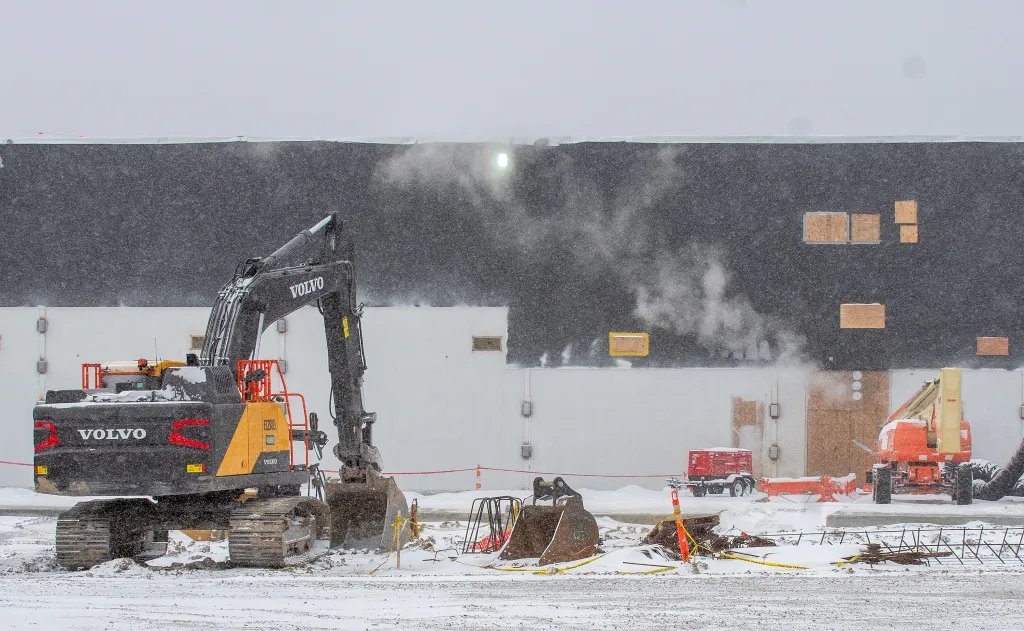
Heavy equipment sits outside a data center construction site on Royal Road in Michigan City on Friday, Jan. 23, 2026. (Andy Lavalley/for the Post-Tribune)
EPRI released its data center report on Feb. 26, according to a news release from the Palo Alto-based research organization. The report uses state-level data on operational capacity, construction in process and announced plans to develop scenarios for data center growth through 2030.
Some Indiana advocates reacted to the findings, expressing their fears for what data centers could bring and how it will affect residential customers.
The low-growth scenario assumes most projects under construction and one-fourth of those in advanced planning will be fully operational by 2030, according to the news release. The high-growth scenario assumes all projects under construction or in advanced planning, plus 30% of those in early planning, are fully operational by 2030.
EPRI’s study also looked at technologies to power electricity needs, finding that through current state and federal policies, natural gas dominates. If data centers sought 24/7 carbon-free energy, renewable and battery energy would be most common, and nuclear power would be added when possible.
“The reality is somewhere in the middle,” Wilson said. “We’re trying to give people an idea that there are a mix of solutions to be coming forward for generation.”
At the national level, data centers will consume between 9-17% of the U.S. electricity by 2030, according to EPRI, which is up from about 4-5%. The projections are also about 60% higher than those in its organization’s 2024 report.
Data centers don’t typically report their current power demand, Wilson said, so EPRI had to estimate when putting together the report. He added that Meta is the only large entity that reports their power demand. An $832 million data center is currently under construction in Michigan City; although the end user has not been announced, residents suspect it’s Google. Late last year, Amazon Web Services announced plans for a data center in Hobart as part of $12 billion investment across Northwest Indiana. Meanwhile, Lake County officials are considering a proposal from Sentinel Data Centers, a New York-based company with established data centers on the East Coast, to build a data center on 160 acres of land outside of Lowell.
“We had to rely on a variety of data sources to get that information,” Wilson said. “We also worked with industry resources, looked at data, construction and some scenarios of how fast U.S. demand might grow, and then we applied that to state numbers.”
Indiana will see more growth leading up to 2030 because more data centers are under construction statewide than seen before, Wilson said. The report finds that data centers could make up nearly 30% of the state’s electrical usage.
Going forward, Wilson expects to see more questions nationwide about if the supply chain can support this growth, including with the number of workers, turbines and transmission lines.
Peak capacity will have to increase to supply data centers, Wilson said, and utilities nationwide will need to be prepared.
“They’re going to want power every hour of the day, every day of the year,” he added. “If you have an inflexible demand, and you add it to your system, you have to raise your generating capacity.”
Ben Inskeep, program director for Citizens Action Coalition, said he was not surprised by EPRI’s report findings. He believes that 20% is a low estimate for data centers’ electric usage.
According to the State Utility Forecasting Group’s 2025 Indiana Electricity Projects report, about 66,000 out of 160,000 gigawatt hours of electric consumption in 2030 would be from data centers.
Data centers’ impact on residential customers still has yet to be seen, Inskeep said, but the Citizens Action Coalition is concerned with the growing prices of projects and if the costs will fall on consumers.
“There’s just a tremendous amount of uncertainty about what could happen with data centers,” Inskeep said.
Inskeep is also concerned with resources and the electrical grid’s capability to keep up with data center and residential customer usage
“The amount of power that is available to serve customers might be insufficient to meet this very large, sudden load growth,” Inskeep said. “The load is kind of outpacing the ability for developers to build new sources of generation.”
Inskeep believes that data centers can create “very sudden” impacts on the electrical grid that can destabilize it and create negative reliability for customers.
Ashley Williams, executive director for Just Transition Northwest Indiana, said in a statement that EPRI’s report confirms her “worst fears,” that data centers will eat up much of Indiana’s energy consumption in the next few years.
“This is energy that our communities and economy rely on every single day, but instead it’s being monopolized to feed the (artificial intelligence) arms race,” Williams said in her statement. “The impacts are palpable.”
Williams referenced how Northwest Indiana residents are struggling to afford their utility bills and how the U.S. Department of Energy ordered that the Northern Indiana Public Service Co. keep its R.M. Schahfer generating station operating. U.S. Secretary of Energy Chris Wright, on Dec. 23, issued an emergency order that would keep Schahfer operating, according to Post-Tribune archives. The order went into effect on Dec. 23 and ends on March 23, 2026.
According to Post-Tribune archives, the order was made to ensure Midwesterners “have access to affordable, reliable and secure electricity heading into the winter months.”
The order alters the timeline for decommissioning Schahfer, according to a previous NIPSCO statement, but compliance is mandatory, and NIPSCO’s long-term plan to transition to sustainable energy remains unchanged.
“Guided by our Integrated Resource Plan, NIPSCO and NiSource recognize the importance of reliable and affordable energy as we manage costs and adapt to changing regulatory requirements,” the statement said. “Our commitment to providing safe and dependable energy remains steadfast both now and in the future.”
According to Post-Tribune archives, NIPSCO plans to convert the Schahfer station into a natural gas plant as part of the plan to provide energy for data centers.
“This growing energy burden could lead to the buildout of even more costly and environmentally devastating infrastructure to power AI across Northwest Indiana,” Williams said in her statement. “Here in (Northwest Indiana), we already live in some of the most polluted zip codes in the nation, and we have fought too long and hard to be continually sacrificed for profit.”
NIPSCO responded to concerns with data center electricity usage, specifically with affordability and reliability for residential customers. In a Friday statement, the utility said its priority is protecting the affordability and reliability for existing customers.
Any data center development in NIPSCO’s service territory will be served through GenCo, “a first-of-its-kind model designed specifically to ensure that large, energy-intensive customers do not shift costs onto residents or local businesses.”
“Through this structure, data center customers fully fund the new generation and transmission infrastructure required to serve their operations and pay for use of the existing transmission system,” the statement said. “None of NIPSCO’s ongoing or planned investments to serve large load customers will be recovered from our other retail customers. In fact, our first data center agreement is expected to deliver more than $1 billion in direct savings for our customers over 15 years, which will appear as bill credits
“By isolating the cost of new growth to the customers driving that growth, the GenCo model ensures no adverse impact on the reliability or cost of service for current NIPSCO customers while supporting economic development and Indiana’s growing digital infrastructure needs.
“Additionally, for the announced Amazon deal, GenCo will be developing 3,000 MW of new dispatchable resources to support up to 2,400 MW of Amazon load, with all extra capacity and energy being offered into the wholesale energy market for the benefit of the broader electric grid.”
mwilkins@chicagotribune.com
