


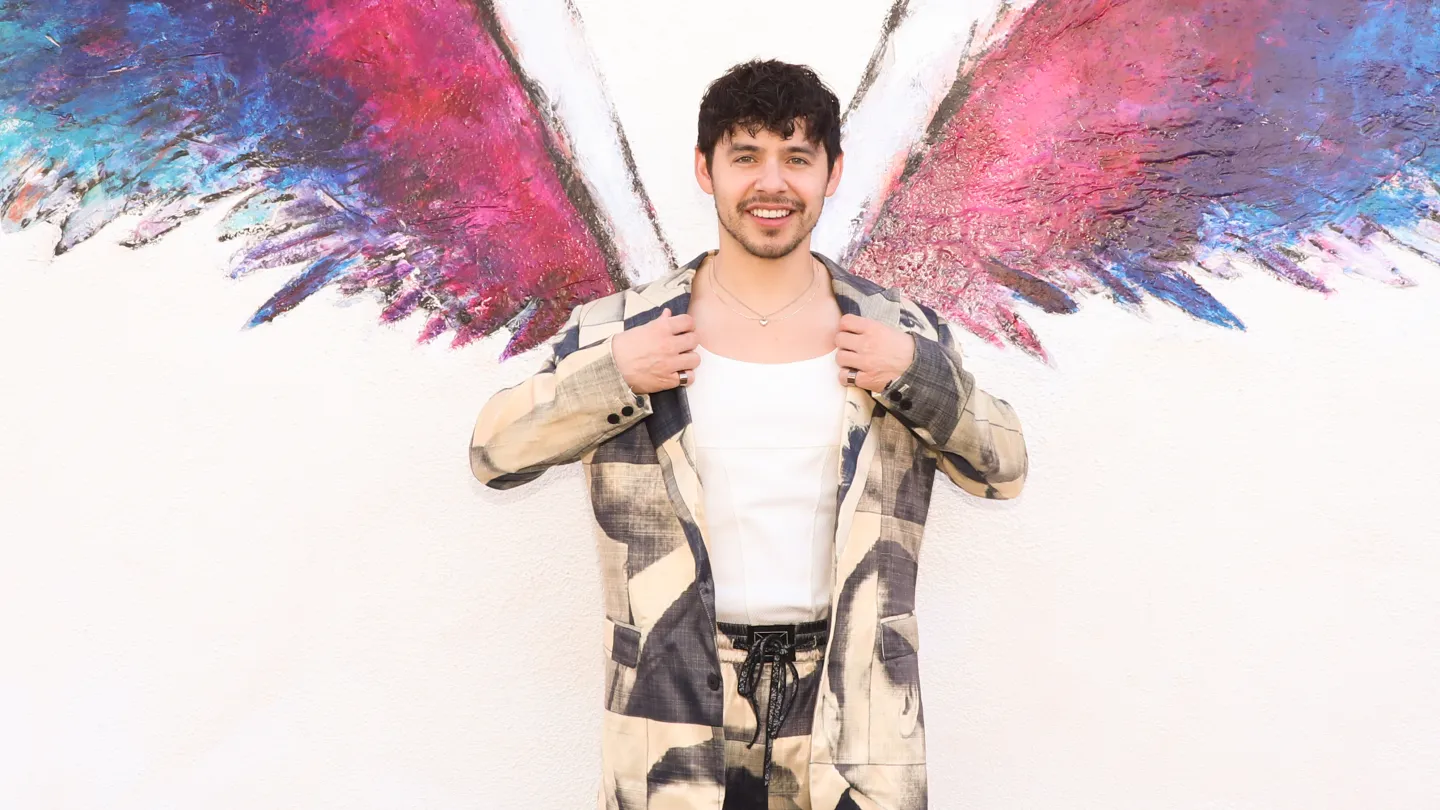
David Archuleta is running late for this interview. When the 35-year-old’s face appears on Zoom, he apologizes and offers an unprompted explanation for the slight five-minute delay. Turns out People magazine had promoted an interview on Instagram about Archuleta’s revelatory new memoir Devout, and a user did what users always do on social media. “Can we just get over this already? He’s been out for years,” they hissed.
It’s been nearly five years since Archuleta came out as a member of the LGBTQ community and four since he parted ways with Mormon church. By now, he’s read and heard all the nasty comments but that doesn’t mean he’s ready to let the latest slide by. He’s still in possession of the manners drilled in over decades as a devoted member of the Church of Latter-day Saints, but he’s learned how to take a stand and let go of the people pleasing that defined his youth.
Say hello to a new and more confident David Archuleta. “I wanted to post something on my Stories very quickly to address the comment because it’s valid,” he says. “Why am I still talking about this? It’s because I’m releasing a book to help other people who haven’t come out yet.” Devout, from Simon & Schuster/Gallery Books, came out Tuesday and it’s bound to help countless closeted folks in and out of the church. There are other reasons to turn its 304 pages.
Courtesy of Publishers
Archuleta digs deep into a troubled family history, writing at length about his overbearing father who, at times, operated like an out-of-control stage parent at the peak of his American Idol fame, and how he struggled to make sense of a false accusation planted on him at age 9 by a family friend that his father molested his sisters. He also details all the behind-the-scenes intrigue and excitement of his run on Idol’s season seven, which found him finishing second to winner David Cook. And he reveals how he eventually loosened a grip on strict Mormon beliefs and traditions to accept his sexuality, and how the process of learning to accept himself got him shunned by Mormon elders.
While that all may seem relatively heavy, Devout has lighter moments, too. Archuleta writes about how he once considered a Maroon 5 video to be pornography, tackling dating apps and a general distaste for male and female genitalia. (“Private parts seemed like staring at pictures of those weird looking deep-sea creatures you see posted on the internet that look so foreign and odd. You’re not sure what you’re looking at and whether to be in awe or disgusted,” he writes.) Below, he speaks to The Hollywood Reporter about life in the open, why he’s intent on staying single right now and what his father thinks of the memoir.
How did you respond to the comment?
I first wrote, “This is not to drag this person, but to respond since I think it’s valid and it gets brought up occasionally.” Then my comment was this: “I have been out for several years now, and while the headline doesn’t always capture what the reason for the story is, it is to help people who are in the same place as me.” I still receive messages every week from people asking what I would recommend to come out in a safe way because it’s scary for a lot of people, which it is. I just got another one last night. I’m releasing a memoir talking about my experience and how I did it coming from a very devout religious upbringing. I feel so much gusto for life, confidence and determination, and I’m elated to get to share and hopefully encourage others to get to that same place too. The book isn’t just about coming out. It’s about family dynamics, life transitions, being a teenager in the spotlight and trying to learn not to be a people pleaser. I hope there’s something you could find useful for you as I feel there is.
That’s beautiful, thank you for sharing. The book is coming out at fractured time, politically, socially, culturally. How do you feel about releasing Devout now?
My goal isn’t just “look at me, I came out.” It’s not about the attention. I don’t want to keep talking about coming out. I’ve already moved on from coming out. I’m living my life as a 35-year-old David Archuleta. The purpose of writing this book is more than coming out; it’s about life transitions, about the struggle of being forced to conform to one way of life or trying to fit into that, and then having a shift as you get older and get to know yourself more and realizing that it doesn’t feel right to you. That could be religion. But there are a lot of beautiful things about a religious upbringing and being a part of a community.
But there are other issues that I feel are important for people to challenge. In my book, I challenge some of the stances on the queer community. It’s not just about sexuality. I am trying to help people understand that the queer community is about who we feel a connection with and what works for a relationship dynamic or partnership and having a companion in your life that happens to be the same sex. Intimacy is beautiful. Physical intimacy like sex, yes, but also just holding hands, enjoying a meal together or sitting next to each other on a couch to watch TV. There’s a deeper form of intimacy and connection relationship than what the surface conversation allows within religious communities of fear-mongering by saying sexuality. They want to talk about their sexuality, and that’s all they focus on. And it’s like, it is so much more than that. And I hope to elaborate on that.
What else was important to you?
I write about family dynamics, family trauma, difficulties with my parents — my dad in particular — and how I learned to set healthier boundaries to have a better relationship. It doesn’t work for everyone. Sometimes you need to get away from an unhealthy person. For me, it was helpful to set boundaries and start over. After I came out, I was able to say, “Dad, no, I’m not going to let you take over my life.” By setting that boundary, we were able to get along.
I’ll admit that it’s hard to think of what a headline would be for your book or this interview. You cover so much in the book, from a childhood in the church to American Idol to coming to terms with your sexuality and how you handled your family history, trauma, fame and money. I’ll ask you: What would you write as a headline?
My headline — and this is not as dramatic or what usually works for headlines — but something about how someone found their authentic self after giving themselves away to everyone for most of their life. What it feels like to give power back to yourself. That’s a long headline, and probably won’t work, to be honest.
I’ll take it. What is your relationship with your dad today? Have you shared a copy of the book?
I just sent copies to my family of all the books I had. I know my dad won’t be happy. I was on a call with him a few days ago to give him a heads up because People asked if they could reach out for comment and he said yes. I told him at the time that he was painted in an ugly light in the book, and he was frustrated. He told me that he felt like I was always judging him. He was right, though, because I did judge him. When I was a kid, I always thought he was going to sexually molest me because that belief had been instilled in me by a close family friend in my mom’s circle. Someone took me aside and said, “Don’t even tell your mom that I’m telling you this but your dad needs to go to prison, and you’re going to help us because he touched your sisters.” I never knew how to process that information because I was too young to know what any of it meant.
But I knew that if my dad touched me, it was bad. Whenever he put a hand on my shoulder or was even standing near me, I would flinch. He didn’t know why. It wasn’t until I was in my late 20s that I finally explained a little bit of this to him, and it made a lot more sense then. I don’t think he even remembered the conversation. But there was a reason I was always judging him. But separately, I tried to express my frustrations that there was never a space to disagree with him. We still don’t agree on everything but it’s nice to know now that I don’t have to agree with him to be on good terms with him. I don’t have to be best friends with him just because we’re on better terms. I don’t have to let him in completely in my life.
It works now for the dynamic I have with him. But looking back on it, a lot of the drama on America Idol was because of my dad. He was intense. He was bossy. He can be rude. He didn’t recognize it but I also don’t think American Idol producers realized that the dynamic I had with my dad was so bad and that I was constantly trying to get away from him. They knew something was going on, and they decided to exploit it, which was frustrating.
Speaking of American Idol, another person who probably won’t be very happy about what’s written about them in Devout is Nigel Lythgoe. You share a story about how he allegedly threatened you physically when you were a minor. Why did you include it and did you reach out to him?
I have not reached out to him. I’ve been worried about it. Aside from that moment, Nigel has always been nice to me. He’s always liked me. He wanted me to do well on the show. He basically was in charge of how contestants were portrayed on the show, and he portrayed me in a good light. I don’t look at it as physical abuse. I just felt like it was a moment where if you want something to get done your way, you’re going to talk to someone and say, “If you don’t do this, I’m going to kick your ass.” It wasn’t a literal threat. It was more just like, “I’m going to be so pissed off at you if you don’t do this.”
But he knew the influence he had on the show’s outcomes, so I took it to mean that if I didn’t do what he said, there would be a certain outcome. I didn’t really take time to explain that, and I probably would have because I don’t ever like to show people in a light that would mislead people. Maybe it can come across as if he were physically threatening me, and I didn’t explain it as clearly as I could have. But in the end, Nigel liking me, helping me do well on the show and wanting me to success was like my dad. My dad wanted me to succeed. My dad looked out for me but he still got a bad rap. I mean, if anything, my dad never said he was going to kick my ass. Nigel did.
Nigel was intense but he was very supportive. There were times when it was very confusing. It messed with a lot of the contestants’ minds because he would congratulate us on doing so well and coming so far, but then would rant and yell at us by saying, “You’re nothing.” One time when we were back for an Idol reunion — the farewell to Simon Cowell with Ruben Studdard, Tamyra Gray, David Cook, myself and others — Nigel got on the microphone and screamed at us, saying, “You are nothing. You are nothing.” A bunch of us responded, like, “OK, there goes Nigel again.” Afterward, my manager at the time said they couldn’t believe he would speak to us like that. But we were so used to it.
Archuleta and Lythgoe on April 24, 2008.
(Photo by Neilson Barnard/Getty Images)
You are also used to being out. How are you navigating this chapter? Are you in a relationship?
The book is so relationship heavy and it brought up a lot of emotions. I’m not in a place to be in a relationship right now. I’m in a great place in life, and I feel really good. I’m so happy that I don’t feel like I need to be in a relationship, to be honest, because I’ve always been so codependent. This is the first time in my life when I feel like I don’t need to have someone. If anything, I need this time to process all of this, and I know it will take a while because I’m doing interviews and talking about everything that’s written in the book. It brings all the memories back, and I’m having flashbacks of being in those places, emotionally. It’s not the best time to bring someone into that with me because I really want to sit with it, breathe through it and process it so I can remind myself that I’m not in that place anymore. It doesn’t serve me anymore. It served me at the time, but it doesn’t serve me now.
Archuleta performs during a taping of iHeartMedia’s Can’t Cancel Pride on May 1, 2024.
(Photo by Kevin Winter/Getty Images for iHeartRadio)
You write about struggling with thoughts of suicide. Were you hesitant about addressing such a sensitive topic?
I was at first until I knew that it I had to go there to fully realize how serious my beliefs were affecting me. It was also what helped people like my mom and Elder Ballard, one of the church leaders, realize the gravity of the situation. I processed it. Because of getting to a certain word count, I had to take out a lot of what I had written about it. It was more detailed before. I didn’t realize I was suicidal until I was speaking to my insurance company trying to get referrals to a psychiatrist because I thought my problem was something else. It wasn’t until a phone call where they said, “Just so you know, this is a safe phone call,” that I realized how bad it had gotten. When they asked if I had any suicidal thoughts, it was the first time I had confessed to myself that I did. Tears literally started streaming down my face. I didn’t want the other person on the line to know because I didn’t want them to think it was a big deal. But I also felt that if I felt that way about myself, I deserved it. It’s something that still isn’t talked about enough in the church or they make excuses for it by saying that the high elevation [in Utah] is the reason for the correlation with suicide. But it wasn’t the elevation that got me there. It’s the culture I grew up in. Again, there are a lot of beautiful things about the culture but it’s something that must be addressed, just as it should be in the queer community.
Archuleta performs during Idol Gives Back at Hollywood’s Kodak Theatre on April 6, 2008.
(Photo by Kevin Winter/Getty Images)
It was interesting to read about all of your relationships, the engagements, your first boyfriend whom you met in church and seemed really sweet. The book also features a lot of the heroes in your life, people who encouraged you or helped you along the way. Jennette McCurdy had an impact on your life and inspired you to write the book. Selena Gomez said something to you about Taylor Swift that meant a lot to you. Adore Delano was the first person to really address your sexuality in a real way. Is there anyone else that has meant a lot to you as you reflected on your journey?
Jennette was the catalyst to make the book happen. I think she could tell that I wanted to share my story on a larger scale, especially because I wanted to talk about the points I made with my church leaders and how that felt incomplete. Jennette knew that I wasn’t the most assertive person and that I could use a little help from a friend to help realize that my voice and my story was important enough to share. I’m really grateful for her. We don’t hang out all the time, but we still value our conversations. Since we’ve had deep conversations since we were teenagers, I think she could sense where I could use a little boost and encouragement. For her to say, “Hey, if it’s all right with you, I’m going to make the introduction email with my team.” And she did. I probably wouldn’t have done that on my own. I’ve grown so much since then, and gained so much confidence in the story I have to share.
Yes, and thinking of that comment again, the book is so much more than a coming out story. In some ways, it’s a real challenge to the church and people who hold their beliefs so tightly that they are unwilling to see the humanity in others. On a lighter note, I got a real kick out of reading about David Archuleta navigating dating apps and reading about your views on genitalia. It’s not often that people write about how they feel about penises or vaginas in the way that you did. Can you talk about that and your view of genitalia as deep sea creatures?
Oh my God. (Laughs.) Yeah. I know. I was, like, should I talk about this? I really wanted the Mormon community to pick up this book and not be disgusted. But at the same time, it’s a part of my story. This is part of my journey. Intimacy is something I was always afraid of, and it’s still something I’ve tried to figure out. I wondered if anyone else felt the way that I did. Because a lot of the conversations I have when I hang out with friends or other people, they always want to talk about dick. I always thought it was a joke. Then I realized that people actually really do love [dick]. I was, like, oh?
I would tell them that I was just not really into it the way they were, and they would say, “What? You don’t like it?” I didn’t know that it was a universal thing for queer men and gay men. I just love someone’s eyes and, of course, their facial features. I really love someone’s silhouette. For me, if I like someone, it’s usually because I looked in their eyes. But I feel like body shape is more attractive than body parts but I don’t know. It’s not something I thought about very often or noticed. Everyone has their thing.
Archuleta and McCurdy at Nickelodeon’s Fred: The Movie premiere in Los Angeles on Sept. 11, 2010.
(Photo by Jordan Strauss/Getty Images for Nickelodeon)
It makes a lot more sense after reading the book and learning that you had absolutely no exposure to penises or pornography. You thought music videos were pornography and you got turned out by a Maroon 5 video with Adam Levine.
I need to clear this up because people have thought I had a crush on Adam Levine but it wasn’t Adam Levine himself. It was the act. It was seeing the act done for the first time ever in their music video. That was my porn, and it was the first time I had seen in in their music video.
I’m happy to help clear the air — you did not have a crush on Adam Levine.
He’s a good looking guy but I was not fantasizing about Adam Levine. I did have a crush on Elijah Wood. I will say that.
You did?
Yes. Again, his eyes, he had such beautiful eyes. It’s not like I wanted to be with him anymore. I was maybe 11 years old or something at that time and I had no idea what a crush was, not that I would’ve admitted that to myself at the time. But I liked looking at Elijah Wood.
He was very stunning to look at in The Lord of the Rings trilogy. He still is very handsome.
Still is. I would love to meet him just because I’m a fan. I don’t want anything from him. I still think he’s a beautiful person and I would love to meet him because those are still some of my favorite movies to this day.
What is the David Archuleta happy ending?
To know that I don’t have to give my life away to someone else in order to be happy, and I don’t have to seek their approval. I’m still learning that, but I don’t need a church telling me. I don’t need leaders. I don’t need my dad telling me. I don’t need producers. I don’t need a manager telling me that I need to be this way in order to be happy. I’ve learned that I can figure it out myself through trial and error, but I’m so glad that I’m in the space where I am now. I still have a lot to learn, but I’m happy where I am.
Archuleta at MusiCares Persons of the Year honoring the Grateful Dead on Jan. 31, 2025.
(Photo by Matt Winkelmeyer/Getty Images for The Recording Academy)
Archuleta at New York’s 92NY with his co-author Valerie Frankel on Feb. 17, 2026.
Josh Lobel/Michael Priest Photography/Courtesy of 92Y
