


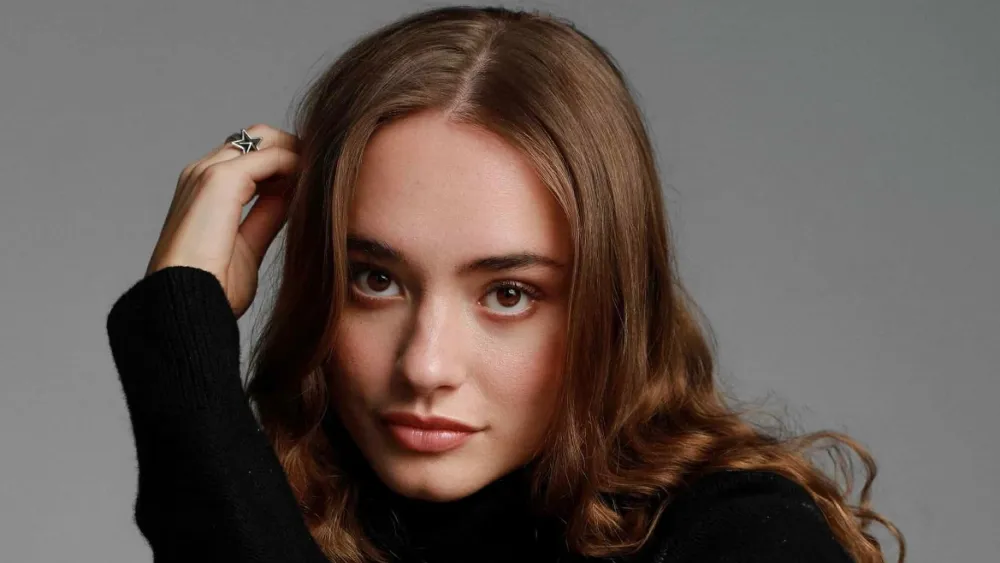
Never work with kids or animals, the Hollywood cliche goes. Thankfully, actor Johnny Sequoyah didn’t pay attention.
As the lead of last weekend’s buzzy horror debut “Primate,” Sequoyah heads a cast of young stars in a battle for survival against a killer chimp – worse, one that was raised as a sibling to Sequoyah’s character. The film held its own at the box office against juggernaut “Avatar: Fire and Ash” and the sleeper hit “The Housemaid,” in part thanks to Sequoyah’s sensitive (but still terrifying) work under director Johannes Roberts (“47 Meters Down,” “The First Omen”).
At 23, Sequoyah is something of a veteran. She began acting at age 8, eventually landing the lead of the NBC series “Believe,” created by Alfonso Cuarón and Mark Friedman and executive produced by J.J. Abrams. As she enters a new chapter and looks toward adult roles, Sequoyah caught up with Variety to discuss her academic approach to the craft and the surprising way she used the late Jane Goodall to inform her performance.
Your director, Johannes, has a very specific POV. How familiar were you with his work before you read for this part?
I had always been too afraid to watch his films. I struggled to make it through “47 Meters Down” once I got this role. He is such a brilliant director in building suspense that it honestly was hard to watch his stuff in preparation. It’s that scary.
He said before that he originally imagined your character, Lucy, as a “nerd,” but you brought an interesting take in your audition that made him change his mind. What was it?
I grounded myself in my relationship with the chimpanzee, Ben. I think that wasn’t the expected route to go, because it’s a horror movie, and you have to be scared. For me, what I thought was scariest was the thing you love most turning against you. I also took a big risk in my audition. I threw a very big “horror girl” scream in there. It wasn’t scripted. I watched the producers, Johannes and our casting director jump out of their seats and land back in them. The casting director told me she peed a little.
You nailed it.
It was also in person, which I was so grateful for. I got to own this space and feed off their energy. I’m glad it worked out.
It’s probably so rare for an actor of your generation to get an in-person audition.
Old school approach!
It’s also a big deal to be number one on the call sheet – on a theatrical movie, no less – at your age.
I thought about my younger self a lot taking on this role. I was first on the call sheet as a kid, when I was about 10 years old. I was the lead of a television show called “Believe,” created by Alfonso Caron and J.J. Abrams. I hadn’t been since this movie. When it comes to leading a set, I think the most important thing is just being kind. You can let go of the expectations and the pressure if you come with kindness.
What did you learn in between those “number one” experiences?
Growing up in the industry isn’t easy for anyone, and I also had some challenges. I was cast in the pilot for “American Housewife” but wasn’t attached to the rest of the series. I was only in the pilot. I’ve taken experiences that have maybe made me feel ashamed — or even made me think, ”Oh, well, am I supposed to quit now?” — and I used them to work way harder. It’s almost like my war paint. I’m grateful for all of it. It’s made me take my craft more seriously.
You’re 23, I think you’re doing just fine. One of the impressive things about “Primate” is that there’s no CGI. There’s a performer in the chimp suit. Do you ever get used to that? Is it not terrifying every take?
I felt like a kid in a candy shop. They don’t really make movies like this anymore. Ben was practical, our wounds were practical. We used a projector for the stars in the sky, our crew painted 1,000-foot murals for palm trees. There was so much love and craftsmanship and care in this film. Ben comprises a 50-person “chimp team,” and he was really scary. When he’s on top of you, your body doesn’t know what’s real or not. I walked off some takes uncontrollably shaking.
Without giving anything away, it seems like the big scene of the film is you hiding in a closet from Ben – a rickety old thing with slats you can barely see through.
That was the first day of filming. Victoria Wynat, who plays Kate, and I were thrown into the deep end. Neither of us had ever done a horror film, and I’m grateful that we started off there. It set the bar for what was expected from us. Walter Hamada, our producer, gave me an interesting piece of advice before we started. He said, “The audience will only ever be as scared as you are, so you have to be terrified.”
Your director has said “Cujo” was a major inspiration point for this film. Did he show you any films or give you any reference points for your character?
I love to prepare. I’m in a conservatory and I approach it like a student. I watched every monkey horror movie I could find. The top one is definitely “Monkey Shines.” It’s early ‘80s, and I really loved it. I also listened to a lot of Jane Goodall, her clips and biographies, to understand her research around chimps. I framed my character’s mom on Jane. In the film, my mother was a linguistics professor who was studying chimp and human connections. Who else better to learn from than Jane, the queen? I also did stunt training and learned ASL for this film.
You have Oscar winner Troy Kotsur in this movie. Talk about your dynamic.
He’s the best scene partner you could ever ask for. I was a little intimidated going into working with him, especially learning a new language. I wanted to show up accurately for the role and to work with him. He could not have been more kind. He really took so much time to sit down with me and work on the role and look at the script as a whole, and find moments that I could possibly bring in ASL
What’s next for you? I hear you’re producing your own stuff now.
I am focused on developing and producing my own content. I sold a show that I’m in development on. I can’t say anything more specific at the moment. But doing “Primate” has significantly helped me on my future projects, and I’m passionate about being on the other side of the camera, too.
