


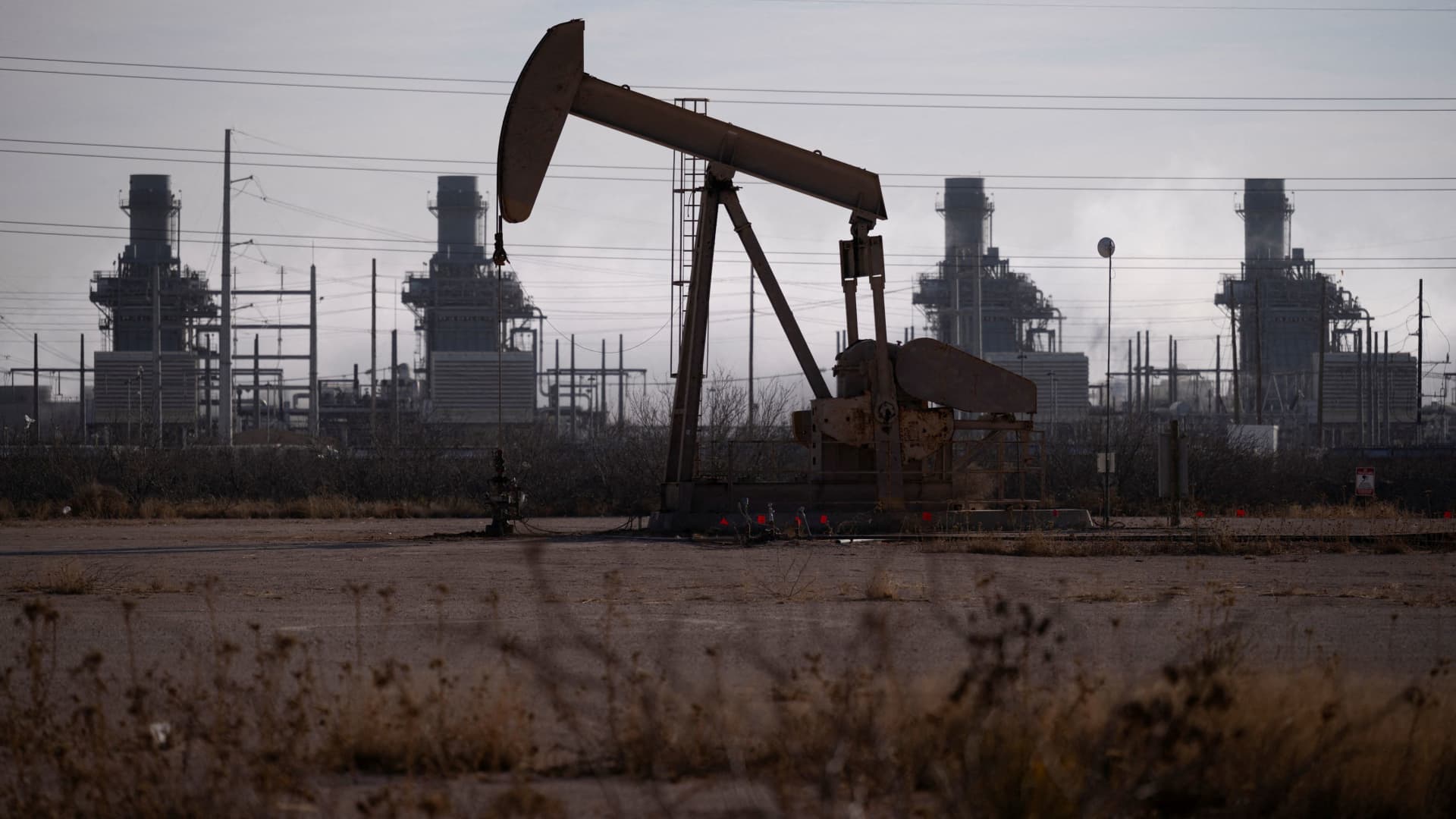
Oil prices jumped to their highest levels in months on Monday as Iran and Israel escalated attacks in the Middle East, disrupting shipments from the region.
Bloomberg Creative Photos | Bloomberg Creative Photos | Getty Images
Global benchmark Brent broke $90 per barrel Friday after President Donald Trump demanded unconditional surrender from Iran.
Global benchmark Brent crude futures added 5.41% to trade at $90.03 a barrel. U.S. West Texas Intermediate crude futures were last seen 8.02% higher at $87.51.
“There will be no deal with Iran except UNCONDITIONAL SURRENDER! After that, and the selection of a GREAT & ACCEPTABLE Leader(s),” Trump said in a social media post.
The U.S.-Iran conflict has spread across the Middle East, disrupting energy production and bringing traffic in the Strait of Hormuz, a critical shipping route, to a near standstill.
Qatar’s energy minister Saad al-Kaabi told The Financial Times Friday that crude prices could reach $150 a barrel in the coming weeks if oil tankers were unable to pass through the Strait of Hormuz. This could “bring down the economies of the world,” Kaabi said.
“Everybody that has not called for force majeure we expect will do so in the next few days that this continues,” Kaabi told the FT. “All exporters in the Gulf region will have to call force majeure. If they don’t, they are at some point going to pay the liability for that legally, and that’s their choice.”
Stock Chart IconStock chart icon
Crude oil prices
Prices briefly dipped overnight after the U.S. issued a 30-day waiver to India — the world’s third-largest oil importer — to resume purchases of Russian oil. Washington had earlier imposed 25% “penalty” tariffs on India for buying Russian crude, which were revoked last month.
The retreat in prices also came after news agency Reuters, citing an unnamed White House official, reported that the U.S. Treasury is planning to announce measures to curb energy price spikes, including potential interventions in the oil futures market.
The average price for a gallon of regular gasoline jumped nearly 27 cents since in the week to Thursday to $3.25, according to data from U.S. travel organization AAA.
The war between Iran and the U.S. entered its seventh day on Friday. In a press conference on Thursday, U.S. Defense Secretary Pete Hegseth said the U.S. had “only just begun to fight.”
“Iran is hoping that we cannot sustain this, which is a really bad miscalculation,” he told reporters.
Zoom In IconArrows pointing outwards
Inflation boost?
“Contrary to what consensus thinks, I think higher energy prices could actually be deflationary for the U.S.,” Atakan Bakiskan, chief U.S. economist at Berenberg, told CNBC’s “Squawk Box Europe” on Friday.
“I mean obviously the higher energy price is going to push up headline CPI inflation mechanically. But when you think about it, it also reduces consumer purchasing power, it’s bad for consumer sentiment. I mean to pay for higher gasoline prices, consumers have to cut demand for other goods, right?” Bakiskan said.
“So, it could actually reduce core inflation in that sense and the Fed’s own macro model is actually saying that as well,” he added.
