


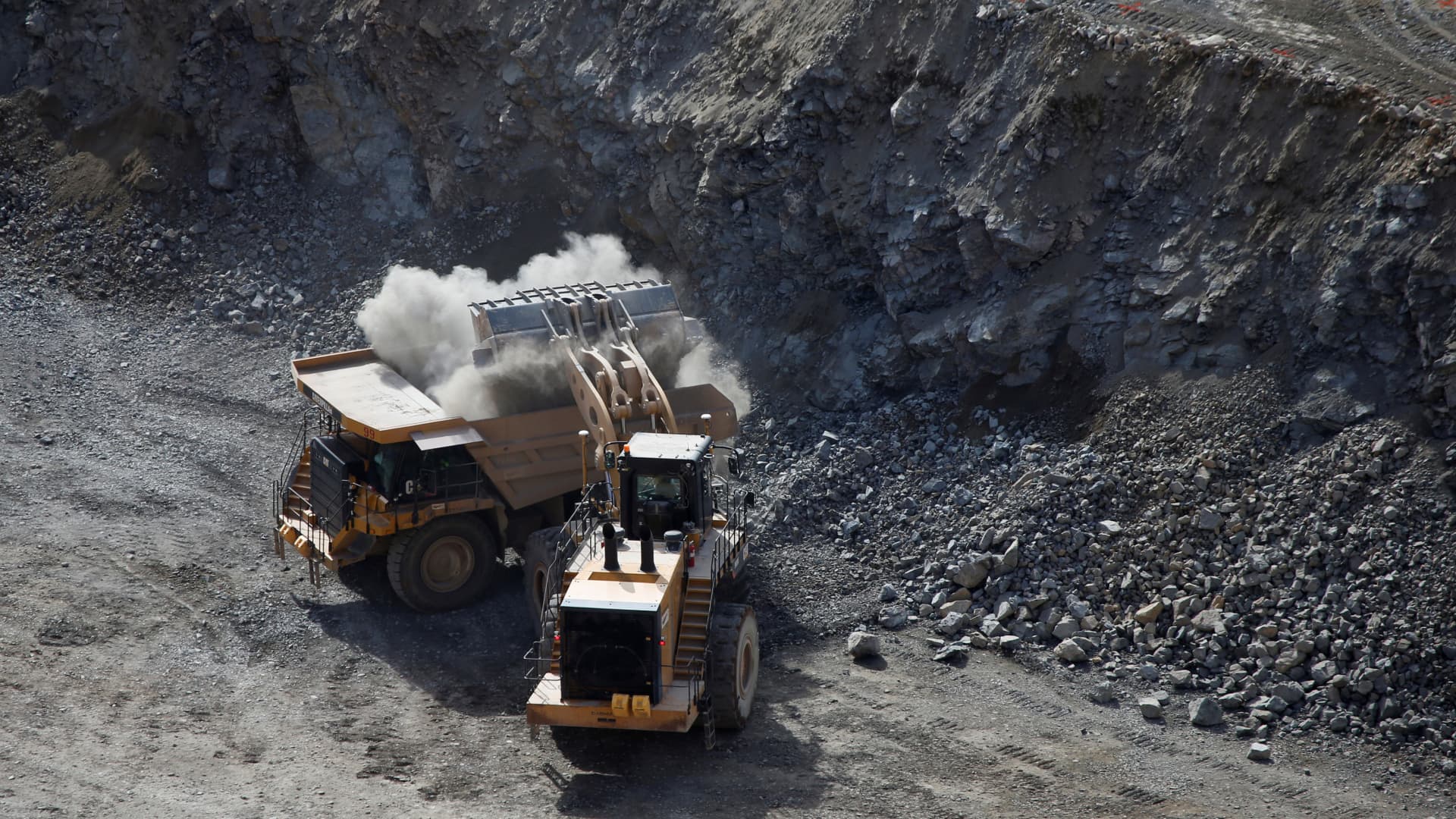
A wheel loader operator fills a truck with ore at the MP Materials rare earth mine in Mountain Pass, California, U.S. January 30, 2020.
Steve Marcus | Reuters
A new race to secure critical minerals is unfolding across the global economy.
From Washington’s proposed $12 billion Project Vault stockpile to expanding buffers in Asia and the European Union, governments are moving to secure access to metals increasingly viewed as essential to national security and industrial policy.
“In metals and minerals is where the newest wave of stockpiling is most visible,” said Patrick Schröder, senior research fellow at Chatham House. Governments are seeking to reduce exposure to concentrated supply chains and export controls, he said.
In the U.S., officials recently outlined a roughly $12 billion strategic mineral reserve dubbed Project Vault. The initiative aims to bolster supply-chain resilience for American industry by building stockpiles of rare earths and other essential metals for electrification, defense and advanced manufacturing.
Project Vault complements other initiatives such as the “Forum on Resource Geostrategic Engagement (FORGE),” a partnership to coordinate critical mineral policy pricing and projects, as well as Pax Silica, which centers on safeguarding the AI-related supply chain.
There has been a significant shift in the approach to stockpiling strategic commodities in the last year, with a focus on metals in particular.
Australia in January announced plans to formalize a state-backed stockpiling strategy through an $800 million strategic critical minerals reserve, prioritizing antimony, gallium and rare earth elements.
The European Union is also advancing plans to build a joint reserve of critical raw materials under its RESourceEU strategy. Italy, France and Germany are expected to lead the effort, Reuters reported earlier this month, citing sources familiar with the matter.
As recently as last weekend, India and Brazil agreed to deepen cooperation on critical minerals and rare earths, as New Delhi seeks to diversify supply sources and reduce reliance on China. The pact is aimed at strengthening bilateral trade and building more resilient supply chains for materials critical to clean energy, technology and defense industries.
South Korea earlier this year rolled out a comprehensive critical minerals strategy backed by about $172 million in state support. Under this strategy, the government plans to expand stockpile volumes and infrastructure.
“We certainly see a shift to a more resource nationalist mindset amongst many countries,” said Schröder. “At this point, it’s a slippery slope and strategic stockpiling could become hoarding when measures become coercive, lack transparency and become weaponized.”
‘Resource nationalism’ in the works?
The strategic pivot marks what several analysts describe as a structural shift in commodity policy.
“Metal supply chains are fragile,” said Ewa Manthey at ING, pointing to years of underinvestment, long timelines for permits, and geographic concentration. In earlier cycles, high prices typically spurred faster mine supply and reduced the need for strategic inventories, she said.
“Today, even with high prices, new supply is slow and uncertain, so inventories themselves are becoming part of the supply strategy,” Manthey added, characterizing the move to harbor clearly “nationalist elements.”
Natalie Scott-Gray, senior metals analyst at StoneX, described the trend as “resource nationalism and catching up time,” referring to China’s long-standing practice of building strategic stockpiles of metals, releasing them when supply is scarce or to cool domestic prices.
China dominates rare-earth processing and controls a large share of global refining capacity for industrial metals. Even where reserves are geographically dispersed, processing often remains concentrated.
The International Energy Agency has repeatedly cautioned that the heavy concentration of critical mineral supply chains poses security vulnerabilities.
China’s rare-earth export controls announced last year created substantial national and economic security risks worldwide, with potentially serious consequences for key sectors such as energy, autos, defense, aerospace, artificial intelligence and semiconductors, said the agency body.
Historically, stockpiles were largely emergency buffers against temporary disruptions or price spikes, said industry watchers. Today’s initiatives are more explicitly driven by a need to buffer against geopolitical factors, Schröder said, reflecting a broader shift in how resource security is framed as industrial strategy and national security, rather than just crisis management.
“This commodities stock building cycle is different from past episodes,” Anushree Ganeriwala, global analyst at the Economist Intelligence Unit, said.
“Previous commodity cycles were largely driven by traditional supply-demand imbalances or weather shocks. What is different now is that policy and geopolitical risks are shaping market outcomes directly.”
Goldman Sachs in February characterized the recent surge in commodity demand for gold and industrial metals as “insurance-type demand.”
Analysts expect government stockpiling to accelerate, particularly for energy-transition and defense-related metals.
“We are still in the early stages of it,” Scott-Gray said. “Governments now treat supply chains as national security infrastructure, not purely commercial flows.”
