


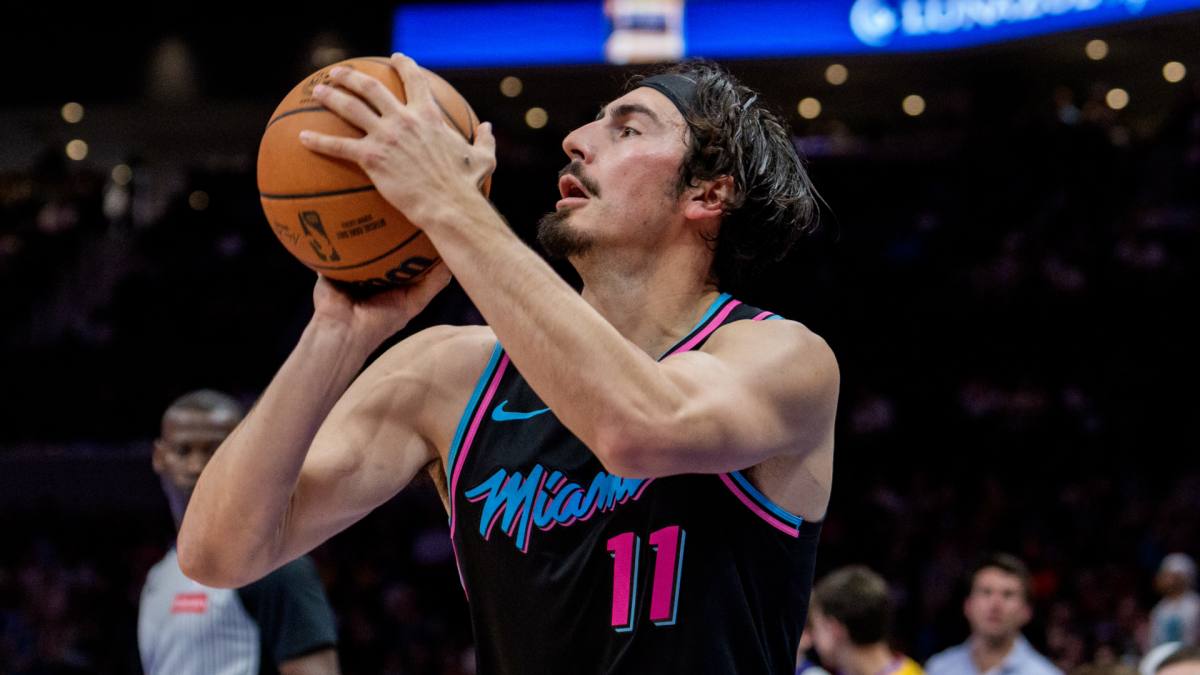
When the 2024-25 season ended and Jaime Jaquez Jr. reviewed the film, he didn’t like what he saw. The Miami Heat forward has always been known as a heady player, but he was making “a lot of mistakes that I know I shouldn’t be making,” he said. He clocked errors on both ends, little things he needed to clean up.
The whole season had been frustrating. Jaquez dealt with ankle sprains and a stomach illness that he described as “really weird.” It was difficult to establish any rhythm, and he found himself “trying to do too much” and “trying to get it all back at once,” he said. Jaquez got DNP-CDs down the stretch and played only garbage-time minutes in the Heat’s ugly first-round series against the Cleveland Cavaliers, a precipitous decline for a player who, the previous year, had made First Team All-Rookie and looked like the steal of the draft.
As fast as he fell, though, he bounced back. The 2025-26 version of Jaquez is a Sixth Man of the Year candidate and a crucial part of a sixth-place Miami team that has won six consecutive games and nine of its last 11. He’s not the player most responsible for the Heat’s fourth-ranked defense — that’s the guy who scored 83 points on Tuesday — and he’s not their most prolific scorer either, but he might be the best embodiment of their style: fast, versatile, unselfish, physical, obsessed with getting downhill.
Jaquez has been “very instrumental to our success,” Miami coach Erik Spoelstra said. On the season, he has averaged 15.1 points, 5.3 rebounds and 4.7 assists in 28.7 minutes, and he’s sixth in the NBA in total drives. Last week, he made four 3s in a 128-120 win against the Charlotte Hornets, but, when asked about Jaquez’s shooting, Spoelstra chose instead to praise him for being vocal and bringing toughness at the top of the Heat’s zone.
“We need his X-factorness,” Spoelstra said.
To explain Jaquez’s resurgence, both he and Spoelstra pointed to the summer that preceded it. “I went back home to California, was training there for a while,” Jaquez said. “It was good to just kind of get my mind away from things, get out of Miami and be back home and just kind of reset.” After a disappointing season, Spoelstra said he wanted Jaquez to know “that we still believe in him” and that he was “a key part to our team moving forward.”
Jaquez is “going to get after it,” Spoelstra said. “He has a perfect work ethic. But I didn’t want it to feel like a grind.” Last season was difficult not just for Jaquez but for the organization. Between then-franchise player Jimmy Butler’s trade request, three suspensions and eventual exit, the Heat — usually the picture of stability — were often in tumult, which didn’t make it any easier for Jaquez to find his place. “Every time he’d come back, it was a different team, so that was a challenge unto itself,” Spoelstra said. In the offseason, it was time to move on from all of that. “I didn’t want him to lose any confidence,” Spoelstra said. He needed to “clear his mind” and “get back to work with joy.”
Russ Rasuch, a mental performance coach who has worked with the team for years, helped Jaquez do just that. “We worked on focus exercises, getting me to the best mental place I could be in,” Jaquez said. He realized he had to stop putting so much pressure on himself to knock down 3s. He had to trust that he’d have a clean slate the next season and that his training would pay off. It was all about “leaning into my strengths,” Jaquez said, and “trying to remember who the best version of me was or is.”
The best version of Jaquez is the one who is in attack mode, hitting defenders with spin moves and putting pressure on the rim. It’s the one who will find a way to put his fingerprints on the game regardless of whether or not his jumper is falling. And in Miami’s new offense, the same one that last year’s Grizzlies borrowed from a Division III college in Maine, this version of Jaquez has come out naturally. The previously plodding Heat are now the league’s fastest team. They count on Jaquez to push the pace, create advantages one-on-one and maintain advantages by attacking closeouts.
Jaquez could tell right away that the system suited him. “Being able to attack downhill in open space, I think that helps anybody,” he said. He’s learning directly from the mastermind, Noah LaRoche, who brought the offense from that D-III school to Miami, where he now serves as a consultant for the Heat.
“He’s got a great offensive mind,” Jaquez said. “I’m just constantly picking at his mind and trying to see what he sees and how we can improve every single day and get better.”
At his end-of-season press conference last May, Jaquez repeatedly described his struggles as “humbling.” It is one thing to say something like that, though, and another entirely to take an honest look at what went wrong and do everything you can to improve. Jaquez is healthier this season, and he’s in a healthier environment. He has also simply come back stronger and sharper, exactly like he said he would.
