


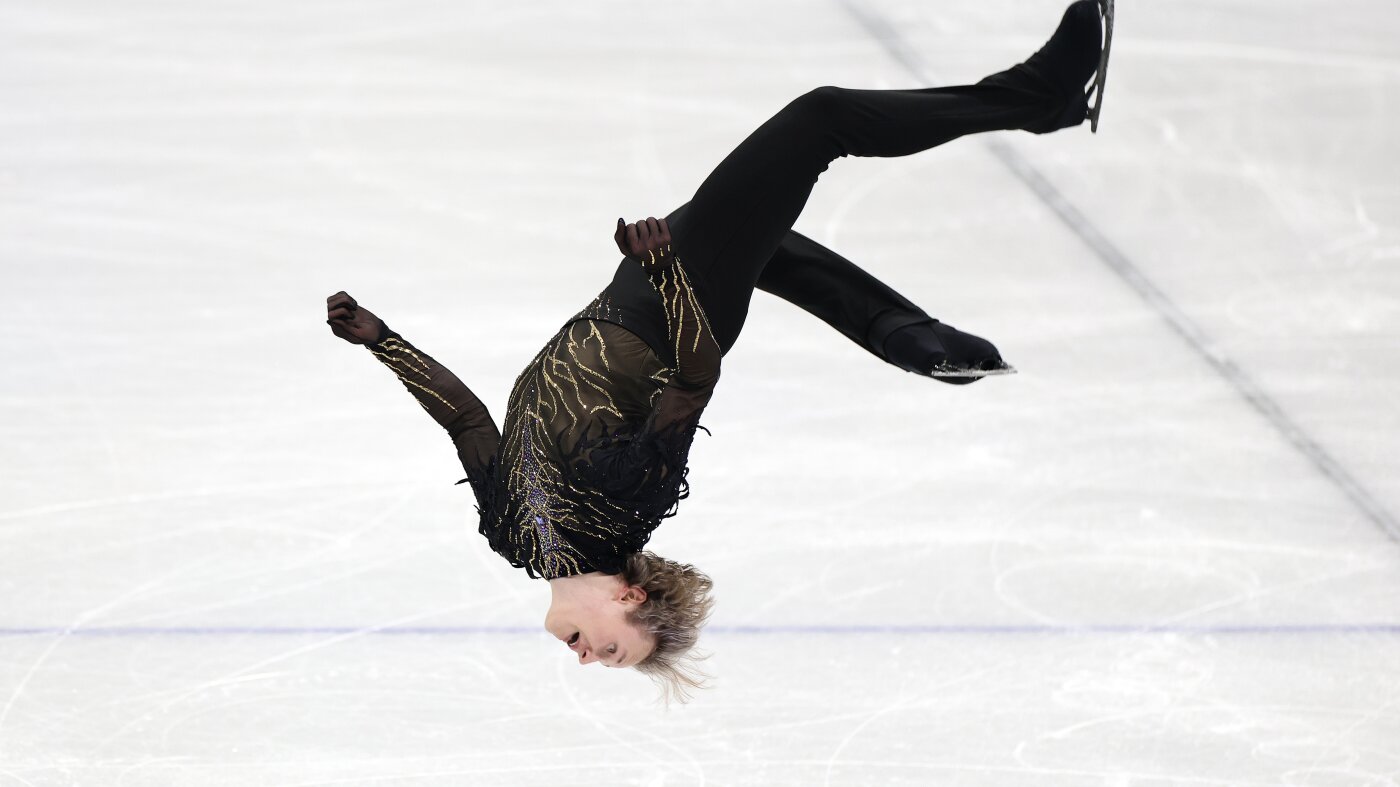
Ilia Malinin lands a backflip in his free skate in the team event on Sunday. His high score pushed Team USA to the top of the podium.
Andreas Rentz/Getty Images Europe
hide caption
toggle caption
Andreas Rentz/Getty Images Europe
Want more Olympics updates? Subscribe here to get our newsletter, Rachel Goes to the Games, delivered to your inbox for a behind-the-scenes look at the 2026 Milan Cortina Winter Olympics.
MILAN, Italy – Ilia Malinin’s skyward jumps have earned him the nickname the “Quad God,” but it’s his backflip that everyone seems to be talking about.
The U.S. figure skater performed the move in his first two programs on Olympic ice, landing the latter on a single blade and sending the arena into a frenzy.
“It’s honestly such an incredible roar-feeling in the environment — once I do that backflip everyone is like screaming for joy and they’re just out of control,” Malinin said. “The backflip is something that I’m sure a lot of people know the basics of … so I think just having that really can bring in the non-figure skating crowd as well.”
Malinin, who trained in gymnastics when he was younger, first debuted his backflip in competition in 2024 — the year the sport’s governing body lifted its ban on the move.
His moves in Milan aren’t just awe-inspiring, but historic: Malinin is the first person to legally land a backflip at the Olympics in five decades.
It was controversial from the start
Terry Kubicka, also an American, became the first skater to land a backflip in international competition at the 1976 Innsbruck Olympics.
“There was a lot of controversy leading up to the Olympics, because I did it for the first time a month before at the U.S. Championships,” Kubicka told U.S. Figure Skating decades later. “At the time, there was no ruling on as how it would be [scored] and the feedback that I got was that judges did not really see it as a pro or con because they didn’t know how to judge it.”
The International Skating Union, the sport’s governing body, banned the backflip the following year, in part because of the level of danger and in part because it violated the principle of jumps landing on one skate.
But the backflip didn’t totally disappear. Some elite skaters — including 1984 gold medalist Scott Hamilton — continued landing the move in non-competitive settings, like exhibition shows.
And one skater even dared to bring a banned backflip on to Olympic ice.
Surya Bonaly of France performed an illegal backflip at the 1998 Olympics, figuring if she wasn’t going to medal she could at least make history.
Eric Feferberg/AFP via Getty Images
hide caption
toggle caption
Eric Feferberg/AFP via Getty Images
France’s Surya Bonaly landed a backflip on one blade at the 1998 Nagano Games, even while injured, in what is widely considered a brave act of defiance.
She knew she couldn’t get the scores she needed to win, but was determined to make her mark on history anyway. It did cost her points but it also cemented her trailblazing legacy, especially as a Black athlete in sport with a relative lack of diversity.
“I appreciate more and I feel more proud of myself now, today, than years ago for when I did it,” Bonaly said in 2020.
The backflip comes back
In recent years, a handful of skaters — including U.S. defending Olympic champion Nathan Chen — have backflipped at exhibition galas, much to viewers’ delight.
France’s Adam Siao Him Fa pictured in October 2025, once the backflip was legal. He performed it in competition the year before, when it was not.
Jean-Francois Monier/AFP via Getty Images
hide caption
toggle caption
Jean-Francois Monier/AFP via Getty Images
The move reached an even bigger crowd at European Championships in 2024, when French skater Adam Siao Him Fa landed one in his free skate program, enjoying such a comfortable lead that the deduction wouldn’t matter. He did it again at the World Championships the same year, and still walked away with a bronze medal.
In a full-circle twist, Kubicka — the first to land an Olympic backflip — was a member of the technical panel that watched Siao Him Fa do it at worlds, and gave him the requisite two-point deduction, almost exactly 50 years later.
Later that year, the International Skating Union officially reversed its backflip ban starting in the 2024-2025 season, explaining on its meeting agenda that “somersault type jumps are very spectacular and nowadays it is not logical anymore to include them as illegal movements.”
The backflip can no longer lose a skater points, but it doesn’t count toward their technical score either (it’s not a required move). It could, however, boost a skater’s artistic score and confidence.
“Oh, that’s my favorite part,” U.S. competitive skater Will Annis, 21, said after landing a backflip at the U.S. Figure Skating Championships in January. “Every time the crowd goes crazy for it, and it’s actually easier than everything else I do, so it’s really fun.”
His definition of “easier” is that “you can be a little off and still land it” on two feet.
Annis told NPR he had long been able to do a backflip on the ground, but didn’t bother learning how to bring it to the ice until he saw Siao Him Fa do it. He was inspired by that protest but didn’t have time to rebel himself: He says the ban was lifted just days before his first competition.
