


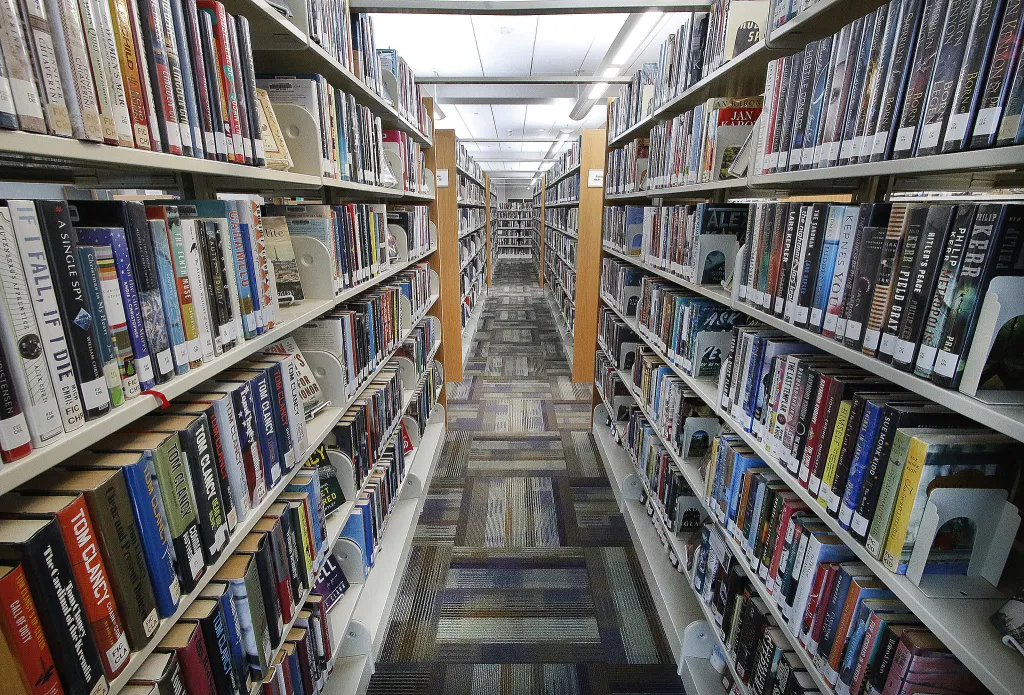
An Indiana Senate bill that would shift how library budgets are approved has passed and moved to the House.
State senators passed Senate Bill 8 — authored by state Sen. Gary Byrne, R-Byrnesville — on its third reading Monday. The bill applies to libraries that don’t elect the majority of their board members, and would require a county, city or town fiscal body to review the proposed budget and property tax levy of a public library.
“Libraries are one of the only taxing units that can have a board containing a majority of unelected board members and impose a tax,” Byrne said during Monday’s session. “I believe that all units with power should be made by elected officials. This bill doesn’t get there all the way, but it puts some parameters in place.”
Byrne’s bill passed in a 31-13 vote, and state Rep. J.D. Prescott, R-Union City, will be the House sponsor. Senate Bill 8 passed with no discussion.
The bill would shift the review and approval of a library’s proposed budget and tax levies to the city, town or county council if the budget has an increase that is equal to or more than 50% of the maximum growth quotient for the upcoming year, Byrne said.
Byrne previously claimed that, as of Jan. 1, 2025, public libraries had an outstanding debt of $367.6 million and $59 million in debt payments due that year, according to Post-Tribune archives.
Julie Wendorf, director of the Crown Point Community Library and past president of the Indiana Library Foundation, previously testified against the bill, saying the changes are concerning and could lead to insufficient funding in a shorter period of time.
“Public libraries are not abstract budget lines,” Wendorf said. “They are community anchors. When funding becomes unstable, services are reduced, hours are cut and access is lost. (Senate Bill 8) does not strengthen libraries — it introduces instability.”
Lake County Public Library Executive Director Carol Daumer Gutjahr responded to Senate Bill 8 in a previous statement, saying the current budget adoption process for the library system works well.
“…there is existing oversight from the county council as, in addition to appointing library board members, the council has the ability to review and interrogate our annual budget recommendation,” Daumer Gutjahr said. “The Department of Local Government Finance has additional oversight and the State Board of Accounts conducts regular audits to ensure accountability, maintain internal controls, and confirm that the tax dollars entrusted to LCPL are used appropriately.”
mwilkins@chicagotribune.com
