


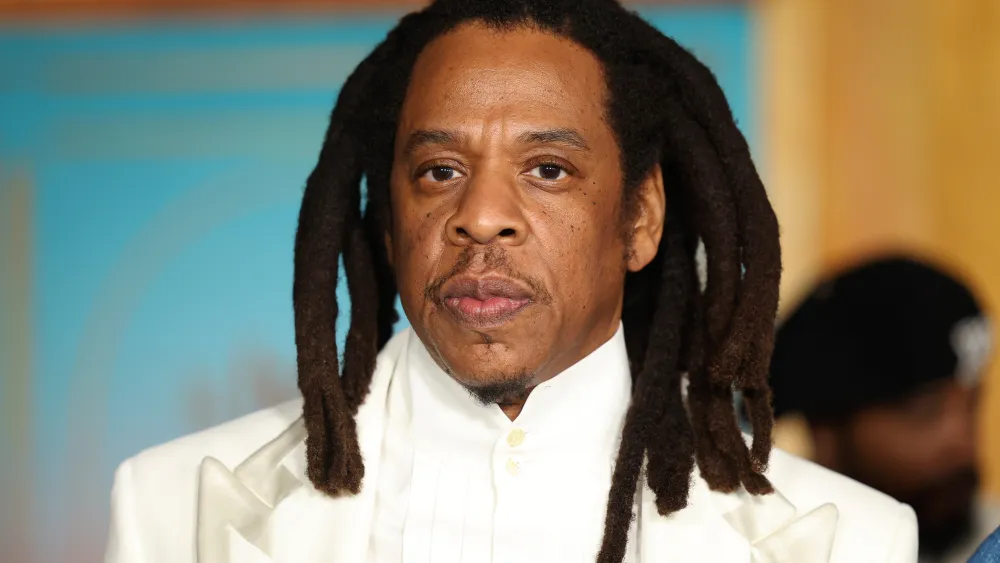
The past decade has taught us to wake up to surprises, but it’s probably safe to say Jay-Z’s first interview in many years — let alone a sprawling conversation drawn from four hours of interviews — was not very high on the list of possibilities.
In a long, long interview with GQ senior editor Frazier Tharpe tapping out at nearly 8,000 words — and in advance of his concerts at Yankee Stadium and the Roots Picnic this summer — Jay talked about a wide range of topics, from his early career to being a billionaire, being a father, being a Black businessman, the painful sexual-assault lawsuit he refused to settle last year, and much more.
Yet the item the streets — both today’s and the ones he came up in 40 years ago — are most hungry for is probably his thoughts on the Kendrick Lamar–Drake beef and Lamar’s Super Bowl performance.
That part of the conversation begins with Jay’s thoughts his Roc Nation company overseeing Super Bowl’s Halftime talent. “For a lot of years, it was only one side of music that was being represented for whatever reason,” he says, clearing noting that most of the talent before he took the helm in 2019 was white and male. “We got the opportunity to create a more balanced idea of what popular music is today. I’m not going out on a limb. These are the most famous people in the world. I didn’t pick the indie artist that I really like from Portland. [This was] the number one streamed artist in the world. ‘I got an idea, let’s let him [Bad Bunny] play.’ [Laughs.] It’s Rihanna!”
The interviewer then suggests how much Jay must have enjoyed Lamar’s performance last year because it was a solo rap headliner.
“Yeah, for sure,” Jay replied. “[Lamar] could have made it a little easier on himself. The artistic choice to play the new album was brave in front of that big of an audience. Because even if 10 million people know some of these songs, there’s 120 million people that’re like, ‘What is he doing?’ As an artist, to stand up there and do it and complete your vision — I had to tip my hat. I had high respect for him already, but, like, even more my respect was like: He’s really about what he says he’s about.”
The interviewer then references Jay’s early ‘00s beef with Nas, saying, “As someone who was part of the genre’s biggest rap beef —” before Jay interjects, “Well, until now.” — the interviewer completes the thought, “As a spectator, what did you think of the 2024 back-and-forth between Kendrick and Drake?”
Jay then takes a long route to getting to what he describes as, “an answer you’re not going to like. Well, I don’t know if you’re going to like it. That’s presumptuous. There are four pillars of hip-hop. There’s breakdancing, graffiti, there’s DJ’ing and battling. Breakdance is not at the forefront of rap anymore. It’s actually an Olympic sport. So that’s dead [laughs]. Graffiti, beautiful in certain places. It’s not part of hip-hop. The DJ was in the forefront. It was Jazzy Jeff and the Fresh Prince. Eric B. and Rakim. You don’t even know the DJ for half of the artists anymore. And the last pillar is battling. We love the excitement and I love the sparring, but in this day and age there’s so much negative stuff that comes with it that you almost wish it didn’t happen.”
He continues, “Now, people that like Kendrick hate Drake, no matter what he makes. It’s like an attack on his character. I don’t know if I love that. I don’t know if it’s helpful to our growth where the fallout lands, especially on social media.
“It’s too far. It’s bringing people’s kids in it. I don’t like that. I sound like the old guy wagging his finger, but I think we can achieve the same thing, as far as sparring with music, with collaborations more so than breaking the whole thing apart. It could stand it before because there was no social media. You had the battle and it was fun and then you moved on. Right now, I don’t know if it could stand it with the technology that we have.
He concludes, It’s like trying to tear down people’s lives. I don’t know if it’s worth it at this point. I love the idea that we got so much music in such a short period of time. Just everything around it was like, ‘Man, this is taking us a couple steps back.’ We’ve just grown so much that — I guess I’m going to say it — I don’t know if battling needs to be part of the culture anymore. We grew from breakdancing. We love graffiti. Before, the MC’s job was to bring attention to the DJ…. I want to hear what the rapper is saying.
“Now the last pillar is battling, and these are all the things that come with it. I hate that I have this point of view on it. I do. Because I know what it sounds like. It’s just how I feel about it.”
Jay later added to his comment, saying, “There is clearly an agenda to silence voices in our community, a heavy right wing agenda. And the culture is happily playing along in the name of this insane thirst of Stan culture to have something on the other side. We are in a strange time. I’m curious as to how this plays out!”
The interviewer then noted that Jay’s choice of Lamar for the Super Bowl made it seem like he was choosing side.
“I chose the guy that was having a monster year,” he replied. “I think it was the right choice. What do I care about them two guys battling? What’s that got to do with me? Have at it. They drag everybody in it, like everyone’s part of this conspiracy to undermine Drake, I guess. But, it’s like, what the fuck? I’m fucking Jay-Z! [Laughs.] All due respect to him. I’m fucking Hov. Respectfully. It doesn’t make any sense. It couldn’t be that these guys just don’t like each other. I think this has been brewing, just like me and Nas was brewing. It didn’t happen at the Summer Jam — that happened with ‘Lex with TV sets, the minimum.’ It was a whole bunch of stuff leading up to that point. I actually regret that because I really like Nas. He’s a really nice guy.
Jay later added, “I realize it’s a bit hypocritical because of how many battles I’ve been in, and given the nature of ‘Super Ugly.’ It takes growth to arrive at this place, because I’ve done the bullshit too!”
Yet he ends on a positive note, saying, “I’m careful because I always hear that person talking about the new culture of folks. And I always was like, “Shut the fuck up. You had your time.” So I’m really careful to let people just do their thing… I accept it all. I trust that you guys are going to take it in a proper direction.”
Surprisingly, the interview starts with the sexual-assault lawsuit, the gravity of which becomes apparent because it’s Jay’s answer to the interviewer’s question, “How was your 2025?”
“It was hard,” Jay replies. “Really hard. I was heartbroken. I’m glad we got right to that so we could just get that out the way. Like I was really heartbroken by everything that occurred. We’re in a space now where it’s almost like consequence is not thought about enough. Because everything is so instant, you know what I’m saying?
“That whole [lawsuit thing], that shit took a lot out of me,” he continues. “I was angry. I haven’t been that angry in a long time, uncontrollable anger. You don’t put that on someone — that’s a thing that you better be super sure. It used to be like that. You had to be super sure before you put those kind of things on a person. Especially a person like me. Even when we were doing the worst things, we had those kind of rules. There was a line: no women, no kids. You hear those sayings, but those are the things that I took from the street. We lived and died by that. So it’s strict for me, like it meant a lot to me.
“I took that really hard. I knew that we were going to walk through that because, first of all, it’s not true. And the truth, at the end of the day, still reigns supreme.”
He then explained why he chose to fight the lawsuit rather than the arguably simpler course of settling. “I can’t take a settlement — it ain’t in my DNA,” he said. “First of all, first I had to tell my wife. Let’s back up. I know the weight that this is going to bring on our family. I can’t do it. I would die.
“If I settled — make that thing go away. And for me, it would’ve been cheaper? Yes. Cheaper, quicker, move on with your life. I knew what was coming. I wasn’t naive. I called — again, after my family — my partners. They were like, ‘What do you need to help? Don’t even worry.’ In a phone call. Not even a: ‘I got to go to the board with this.’ It was like a testament because people know me. Like: ‘I know who you are and that’s impossible. Not only are we standing by you, but what do you need?’
Asked how he’s been recovering, he said, “I’m still dealing with that. Because that’s a horrible thing to put on someone. It was like released the night of my daughter’s [movie] premiere,” for “The Lion King.”
He even said he briefly considered the possibility of not attending, “because this is her moment,” he said. “But our family, we are a tight unit. Blue has this jersey with ‘Jay-Z’ on the back. She put it on one day. She went to school with the “Jay” [points to his back]. I was just in the corner, like tears coming down. Seriously. To have that, it’s priceless. People can say that [they’ll always be there for you], but it’s very rare that you’re going to have to exercise it. And in the darkest moment for me, I got to see those sorts of things.”
Read the full interview here.
