


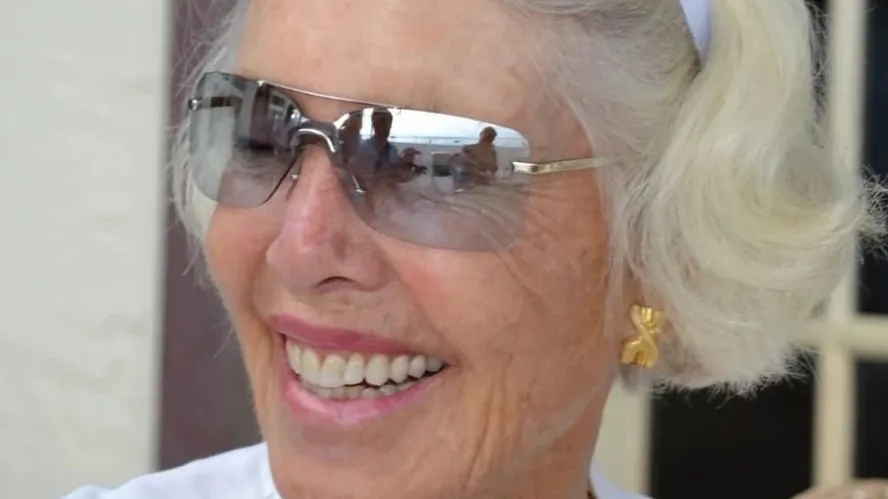
Jorie Butler Kent, the businesswoman, polo expert, photographer and philanthropist whose father, Paul Butler, incorporated the west suburban village of Oak Brook in 1958, died on Jan. 16 of natural causes at a hospital in Palm Beach, Florida. She was 95.
An expert equestrian, Jorie Butler Kent oversaw operations in the 1960s and ’70s at the Oak Brook Polo Club, which had been formed by her father, Village of Oak Brook founder Paul Butler.(Reute Butler)
Kent, a Palm Beach resident, formerly lived in Oak Brook for many years.
Kent’s daughter, Reute Butler, was with her mother when she died. “She had a strong sense of responsibility and a desire to give back,” Butler wrote in Kent’s 2023 memoir, “Jorie: The Extraordinary Life of Jorie Butler Kent: Visionary and Philanthropist.” The two had coauthored the memoir.
Kent spent many years managing Oak Brook’s Bath and Tennis Club, and from 1963 until 1979, she oversaw the legendary, now-shuttered Oak Brook Polo Club, which her grandfather and father had established in 1922. She was later the co-owner of a luxury safari company and founded Friends of Conservation, a group aimed at helping people in Kenya preserve their local ecology and further sustainable tourism.
Born Marjorie Butler in Chicago in 1930, Kent was part of a storied family whose fortune had been built by the Butler Paper Company that her ancestors had formed after coming to the U.S. from Yorkshire in the 1700s. In 1945, her father founded Butler Aviation, a firm providing service facilities for private aircraft at major airports in the East and Midwest, and he also began buying large swaths of family farms and cow pastures in eastern DuPage County, north of Hinsdale.
Kent attended the Latin School in the Gold Coast and graduated from Choate Rosemary Hall in Connecticut. She then earned a degree in commercial art from the now-closed Finch College in New York.
In the 1950s, Kent worked closely with her brother, Frank O. Butler II (who died in 2014), in running Butler Aviation at the Palm Beach International Airport.
“We had a wonderful time together,” she told the Tribune in 2014. “Frank was the general manager and I was the controller.”
In a 1975 interview with the Tribune, Kent said she learned polo not in Oak Brook but during her student days in a Colorado ranch school, noting that “we’d play a boys’ team from a neighboring school, and often we’d win — because we were bigger than boys our own age at that point.” As a teen, Kent competed at the Oak Brook Polo Club, regularly winning awards and ribbons.
After incorporating Oak Brook in 1958, Paul Butler continued building out recreational facilities to go along with the Oak Brook Polo Club, including Butler National Golf Club, which opened in 1972. In total, some 1,600 acres were designated as the Oak Brook Sports Core, including the Oak Brook Bath & Tennis Club, and Kent, a vice president in her father’s Butler Company, took over leadership of the Sports Core in the 1960s. That included overseeing both the Oak Brook Bath & Tennis Club and the Oak Brook Polo Club — a role she took on, she told the Tribune in 1972, after her older brother, Michael, “went off to do this thing,” which included producing the Broadway performance of the rock musical “Hair.”
Kent also oversaw the operations of Sun Ranch, her father’s cattle spread in Montana. And in the mid-1980s, she, along with her brothers, teamed up with a unit of Carson Pirie Scott to build the Oak Brook Hills hotel project at the corner of 35th Street and Cass Avenue in Oak Brook.
Kent’s many years as an equestrian made her a natural to run the Oak Brook Polo Club. The Tribune’s Margaret Carroll in 1975 called Kent an “impresario of the summer Sunday polo matches,” adding that the work entailed complicated arrangements for polo players and ponies to be on the right field at the right time.
“Every year the polo clubs in the United States Polo Association request the tournaments they would like to have played on their fields,” Kent told the Tribune in 1975. “But the planning is a year-round project.”
Kent’s efforts with polo extended beyond Oak Brook. She nurtured the establishment and growth of the Museum of Polo in Lake Worth, Florida, and she helped guide the launch of new polo operations in Palm Beach, Florida, Greenwich, Connecticut and in Vero Beach, Florida.
In stages from 1970 until 1973, Kent’s father laid out the four-lane roadway Jorie Boulevard — which he named for her — on the north and west sides of the Oak Brook Sports Core.
Kent and a future husband, polo-playing former British Dragoon Guard Geoffrey Kent, met in the early 1970s and by 1972 had gone into business together, leading the safari company that had been founded by his parents, Col. John and Valerie Kent. The company, Abercrombie & Kent, provided photographic safaris by Land Rover, in tented luxury. It eventually expanded to South Africa and Zimbabwe in 1980, Egypt in 1981 and then India, and today has offices in 55 countries.
A professional photographer, Kent shot most of the photographs for Abercrombie & Kent along with her daughter — also a professional photographer — and Kent led the design and decor of the company’s properties, including sustainably responsible designs. She wound up co-owning Abercrombie & Kent for more than four decades.
“My father was a super photographer. That’s where my interest came from,” Kent told the Tribune in 1987. “I had a darkroom in my house and developed all black-and-white pictures. My interest goes toward the wildlife, the outdoors and more exotic places because that’s where my husband and I travel.”
In an effort to help prevent poaching in Kenya, Kent in 1982 founded Friends of Conservation, a group supporting wildlife conservation and education projects in East Africa. One of her friends, England’s now-King Charles III, knew Kent through polo and became an avid supporter of Friends of Conservation.
Kent and her brother, Michael, invited Charles in 1986 to bring an English team to play an international match at the Oak Brook Polo Club, and she later hosted Charles at the Windsor Polo Club in Vero Beach.
Friends of Conservation partnered with the Maasai people of Kenya, and Kent worked closely with her daughter, who later became the group’s president and international director. The organization wound up establishing dozens of schools in the Masai Mara Reserve in Kenya, created a scout program to fight poaching and increased the population of black rhinos there.
“She truly was a visionary,” said Norma Cooke, a close friend and longtime colleague who is executive director of Friends of Conservation. “No one worked any harder than Jorie did. She was gracious, elegant and a lady in every sense of the word.”
Outside of work and philanthropy, one of Kent’s pastimes was painting and firing china plates, using a kiln at her home.
“Anyone can learn, all it takes is time,” she told the Tribune in 1971. “It’s easy to get colors, but hard to work with them and fire them.”
After Paul Butler’s death in 1981, disagreements over the division of their father’s estate, estimated at $100 million, ended up in court, with Kent and brothers Michael and Frank waging a five-year legal battle. The case was settled in 1986, with the terms of the resolution kept private.
In 2025, the Museum of Polo inducted Kent into the Museum of Polo Hall of Fame.
Four marriages ended in divorce, but Kent maintained friendships with all her former husbands, Cooke said. Kent is survived by her daughter, Reute; her daughter’s wife, Manuela Hung; and a half-sister, Wendy Mathias Dunaway.
A celebration of life service will take place on Feb. 28 in Palm Beach.
Bob Goldsborough is a freelance reporter.
