


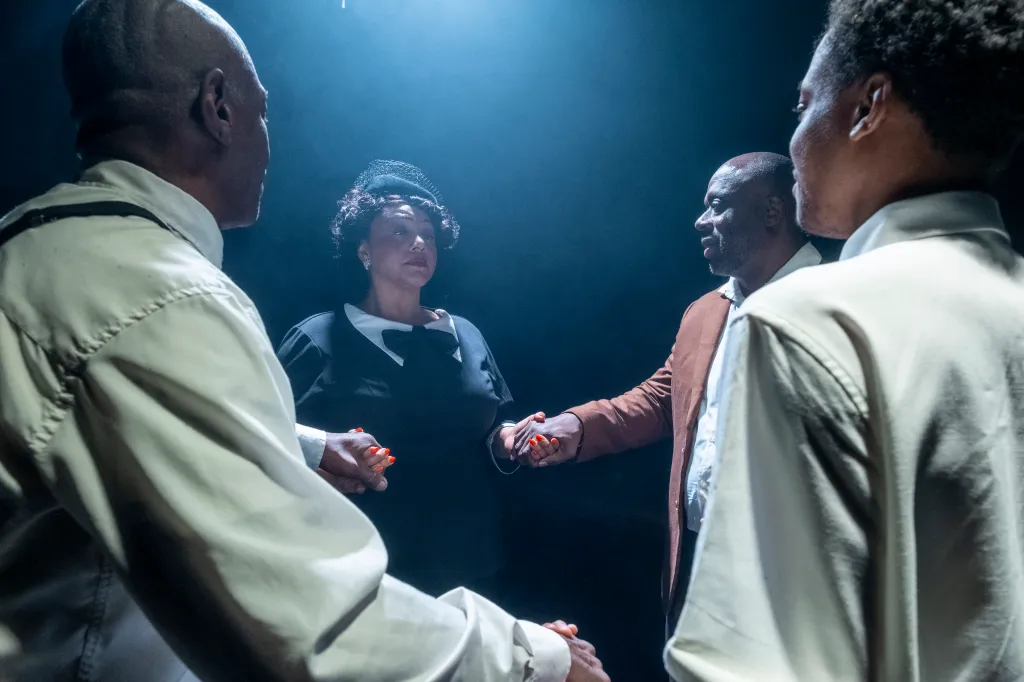
Collaboraction has opened a new, 99-seat black-box theater in the Kimball Arts Center in Chicago’s Humboldt Park neighborhood, a flexible venue with a spiffy attached cafe and lounge, ideal for stimulating pre- and post-show gatherings around the work of a progressive theater company with an explicit mission of confronting “Chicago’s most critical social issues” and seeking political change. Collaboraction refers to its theater as a House of Belonging — so you get the vibe.
The first show in the new space, which I caught last weekend, is called “Trial in the Delta: The Murder of Emmett Till,” and it is a re-creation of the 1955 trial of J.W. Milam and Roy Bryant for the murder of 14-year-old Emmett Till in Mississippi. As most Chicagoans aware of the history of the civil rights movement know all too well, an all-white, all-male jury acquitted the two men of killing the Black teenager from Chicago and dumping his body in the river. The trial, and the subsequent revelation of how only injustice was served, was extensively covered in the seminal documentary “Eyes on the Prize” and, of course, Till’s astonishingly courageous mother, Mamie Elizabeth Till-Mobley (then known as Mamie Till Bradley), sparked social change of her own by insisting on an open-casket funeral in Chicago for her boy, thus showing the world the violence that was done to his body.
Brave Pullman porters carried the Chicago Defender with coverage of the funeral on trains headed south from Chicago, sparking outrage and igniting a movement.
This immersive re-creation (some members of the audience sit in the jury box) was penned from the trial transcript by G. Riley Mills and Willie Round, and it’s only a little more than an hour. There was a lot more said in that trial, and the simply staged but impressively acted show, which is co-directed by Anthony Moseley and Dana N. Anderson, makes an excellent case for its own expansion, especially one that added outside-the-courtroom context and emphasized Till-Mobley’s actions beyond the trial. Even at this length, it is a very uncomfortable experience, which is of course the intent, although I should note that the theater also goes out of its way to welcome everyone and to use the piece as part of a broader conversation that follows the show. This is not so much a traditional talkback as a constituent part of the experience and you really have to stay, short of walking out in the middle of the artistic intent.
Vintage Chicago Tribune: The death of Emmett Till and his legacy, as reported by the Tribune
I once got to spend the day with Till-Mobley before her death in 2003. (At the time, her memory did not get the local attention it deserved.) I regard that day, which is etched on my memory, as the great gift to my life from my job, as I listened to Till-Mobley, who was far more gracious and kind to me than history suggests should have been the case, talk about her boy and her life. She was at pains to say that the story of him whistling at a white woman in Money, Mississippi, was a lie; her Emmet, she told me, had a stutter and would always whistle as he spoke. She also said he visited her often in the form of a dove, and if I have ever had an experience when I saw something being described to me, that was the experience.
Such was this woman’s moral authority and grace.
This piece, which readers will of course come to based on their own history, was enough to rekindle all of that.
I feel ambivalent about whether this is a piece for young Chicagoans; on the one hand, it is a crucial part of our city’s history, on the other it is inestimably painful, even now.
This hardly was the only such trial of its era, but there is something about the arrogance of everyone involved in the defense of the clearly guilty that crystallized injustice like none other. This cast certainly makes that clear, especially a very striking young performer named Mysun Aja Wade; I hope Mills and Brown build on what they have begun here.
Chris Jones is a Tribune critic
cjones5@chicagotribune.com
Review: “Trial in the Delta: The Murder of Emmett Till” (3.5 stars)
When: Through March 1
Where: Collaboraction, 1757 N. Kimball Ave
Running time: 1 hour, 45 minutes (includes post-show conversation)
Tickets: $25-55 at 312-226-9633 and collaboraction.org
