


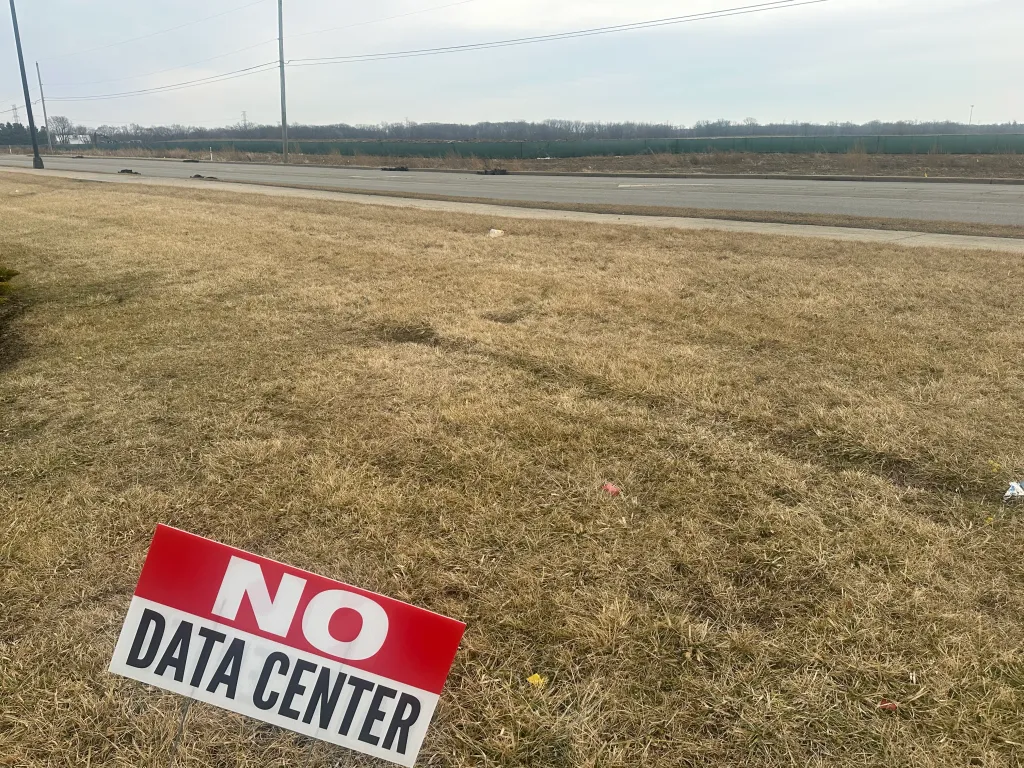
Proposed plans for an Amazon data center at 61st Avenue and Colorado Street in Hobart have already hurt home sales in that area, Hobart Realtor Sophia Mason testified.
Mason, a Hobart resident and a Realtor with 23 years experience, said she has already seen a noticeable slow down on homes correctly priced but not moving, especially in the new subdivision of Eagle Creek, located directly north of the data center site.
“People will not want to wake up and see a data center across the street,” Mason said.
Mason was one of about eight people who testified in a hearing held Tuesday in the Lake Superior Court Civil Division of Judge Kristina Kantar in Gary.
Following the hearing, which lasted more than two hours, Kantar took all evidence under advisement and said she would render a ruling on Friday.
The court hearing was held in response to a lawsuit filed last month by four homeowners challenging the city of Hobart’s designation of 725 acres at 61st Avenue and Colorado Street as an Economic Revitalization Area (ERA) and the city’s approval of property tax abatements connected to the proposed Amazon data center development.
The proposed Hobart data center site is located off 61st Avenue, south of Eagle Creek subdivision. (Deborah Laverty/for Post-Tribune)
The four homeowners, including Angelita Soriano, Albina Venegas-Roman, Barbara Koteles and Joseph Conn, are seeking to vacate two city council resolutions awarding real property tax abatements and a council resolution approving an enterprise information technology exemption for entities that have said they intend to develop data centers on property within the ERA.
The plaintiffs, in their complaint, said the Hobart City Council’s grant of a personal property tax exemption to Amazon Data Services was “arbitrary, capricious, not in accordance with law and not supported by substantial evidence because the council did not validly declare the subject property an ERA.”
The plaintiffs are seeking a declaratory judgment that the tax exemptions granted to the Amazon Data Services are null and void and that the resolutions passed by the Hobart City Council be declared null and void.
The four residents are being represented by attorney David E. Dearing of Dearing Law Firm.
Hobart City Councilman Matt Claussen, under questioning by attorney Mark Crandley, who represented Hobart, explained that the area being proposed for the data center is in Ross Township and was annexed by Hobart in the early 1990s.
Claussen explained the use of Tax Increment Financing (TIF) designation, particularly on parcels like that for the data center.
“It’s a tool cities and towns use to develop land that doesn’t seem to be developed,” Claussen said.
When asked by Dearing if any physical impediments would prevent the property from being used as a residential subdivision, Claussen answered: “Not that I’m aware of.”
Conn, one of the plaintiffs, said there had been interest in the property by Munster developer Don Powers, before his death 10 years ago.
He said Powers had taken an interest in the property and wanted to develop it as a residential subdivision.
Gordon Todd, an attorney for Amazon, objected to Conn’s comments, which he said couldn’t be verified.
The judge agreed to strike the comments from the record.
Brandy Schaeffer, an economic land development principal for Amazon, testified that the Northwest Indiana Forum was responsible for directing her company to the Hobart location.
She said Amazon is investing $11 billion in the business site.
Dearing asked Schaeffer whether her research into the data center site had involved consideration of residents living in subdivisions right across from the site.
“Did Amazon consider the wishes of residents? Did Amazon contact any neighbors?” Dearing asked.
“Not to my knowledge,” Schaeffer answered.
Digging has started at the future site of the Amazon data center in Hobart. (Deborah Laverty/for Post-Tribune)
Dearing, in his final summation, said the Hobart City Council rushed their vote approving the data center ERA designation.
He pointed out that the vote by city officials was taken before comments made by the public, which followed.
“It was just done to reward someone for developing farmland. This area was suitable for residential,” Dearing said.
Hobart Mayor Josh Huddlestun, who did not attend the hearing, has called the $47 million upfront cash payment Hobart received in late January “record-breaking.”
“Hobart secured the largest publicly known upfront cash payment ever for a private development on private land in the country. The developer (Amazon) will pay $47 million in community enhancement payments. These dollars are not part of the levy and not part of any TIF (Tax Increment Finance) district. They go straight to the city and can be used to serve the whole community,” Huddlestun has said.
Conn, who was a member of No Re-Zone and ran for Hobart City Council under the Green Party on two occasions, said that thousands of Hobart residents have been vocal in their opposition to the city imposing an industrial development zone on the city.
The protestors say the land where the data center is being proposed is nearly at the geographical center of Hobart. And it has no place for industry, with wetlands adjacent to Deep River, which flows past the Hobart Prairie Grove section of the Indiana Dunes National Park, into Lake George, past downtown Hobart and its lakefront park, and eventually into Burns Ditch and Lake Michigan.
Most directly affected adversely by the proposed industrial development would be the owners of 220 adjacent homes in three subdivisions north of 61st Avenue and individual homes dotted along 61st Avenue and Colorado Street.
Roughly 80 of those homes rely on well water, Conn said.
Nancy Winkiewicz, who has lived in Hobart for six years, came to the hearing Tuesday because she is concerned about how the data center will affect her health, the environment and the wildlife on her property.
Winkiewicz, a breast and lung cancer survivor, worries most about the birds that migrate through her property.
“I don’t know if the data center will scare them off,” Winkiewicz said.
Deborah Laverty is a freelance reporter for the Post-Tribune.
