


When the final envelope was opened at the 98th Academy Awards, it served as a fitting end to an Oscar season that spent months reminding everyone of a simple truth: even the most dominant narrative can shift by the time the votes are counted.
In the end, a record-breaking 16 Oscar nominations were not enough to push “Sinners” across the finish line. Instead, the season concluded with the long-anticipated coronation of Paul Thomas Anderson, whose sweeping epic “One Battle After Another” emerged as the Academy’s top choice. The victory capped a months-long campaign that began quietly taking shape as early as September, when industry enthusiasm began to coalesce around the filmmaker finally receiving his long overdue moment in the Oscar spotlight.
For Anderson, the director behind “Boogie Nights,” “Magnolia” and “There Will Be Blood,” the night delivered one of the most triumphant moments of his career. “One Battle After Another” collected six Oscars from its 13 nominations, including best picture, director and adapted screenplay. The film also won for editing and brought a third acting Oscar to Sean Penn. Perhaps the evening’s most unexpected milestone came with the Academy’s inaugural casting Oscar, awarded to Cassandra Kulukundis.
And yet the final outcome was far from inevitable.
Heading into the last category of the night, the best picture race still felt uncertain. Warner Bros. controlled the two defining titles of the season — “One Battle After Another” and “Sinners” — and the outcome genuinely felt like a coin toss. Ultimately, the film that accumulated the strongest precursor momentum across the season carried the night.
But like most Oscar seasons, the story was never about a single winner. One of the ceremony’s most powerful moments came when Michael B. Jordan won best actor for “Sinners.” With the victory, he became just the sixth Black man to win the award, joining Sidney Poitier, Denzel Washington, Jamie Foxx, Forest Whitaker and Will Smith — all of whom Jordan acknowledged in a heartfelt speech.
For much of the evening, however, the mood inside the Dolby Theatre was one of cautious anticipation. As category after category passed without a win for “Sinners,” phones across the industry lit up with text messages from voters and observers wondering if the season’s most nominated film might walk away with less than expected.
In retrospect, that arc may define the season as much as any single win.
“Sinners” ultimately fell short of best picture, and the Academy now enters its 99th year without a Black winner in the best director category. But the film’s place in Oscars history remains secure. The closing images of the night — Michael B. Jordan, Ryan Coogler and Autumn Durald Arkapaw standing together with their statuettes — represented something larger than a single category.
Arkapaw’s victory for “Sinners” was historic. She became the first woman — as well as the first Black person and first Filipina — to win best cinematography, and the 22nd Black woman to win an Oscar overall. With this winning moment, a woman has now won in every single non-gendered Oscar category.
Placed in context, the moment reflected a broader shift unfolding across the industry. In recent years, Black women have broken barriers in production design through Hannah Beachler and in costume design through Ruth E. Carter. Now cinematography joins that list. Each of those milestones came through films directed by Ryan Coogler, underscoring how the filmmaker’s influence extends beyond storytelling into reshaping opportunities behind the camera.
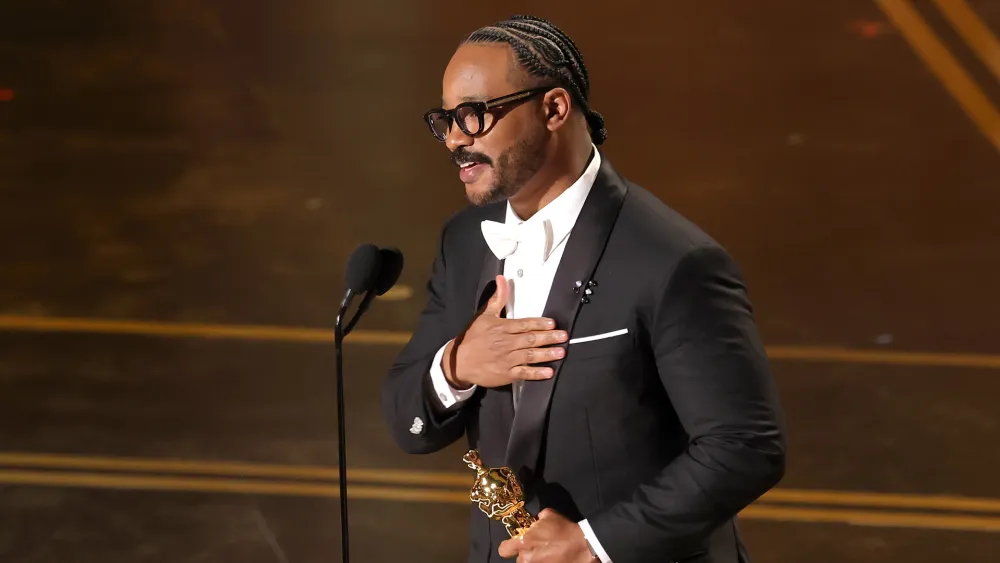
There was something particularly poignant when Coogler won original screenplay, asking his cast to stand up and allow him to pay his respects. It was as if he knew how the evening would ultimately end, and this would be his one and only opportunity to share his admiration and love with the team that shattered records across the Oscar stage. Coogler himself became only the second Black screenwriter to win original screenplay after Jordan Peele for “Get Out” (2017).
The acting races delivered additional firsts.
Jessie Buckley became the first Irish winner of best actress for her performance in Chloé Zhao’s “Hamnet,” closing out a season in which literary adaptations once again proved fertile ground for Oscar recognition. This marks the seventh best actress-winning performance directed by a woman, and Zhao is the first female director to do it twice following Frances McDormand for “Nomadland” (2020).
Like every awards year, the race also produced its share of heartbreaks.
Earlier in the season, many observers believed Timothée Chalamet was on a clear path to victory for his performance in “Marty Supreme.” By the time the final ballots were counted, however, the 30-year-old star left the ceremony without a win. His film also went home empty-handed, including for its four-time nominated creative force Josh Safdie, cited for producing, directing, writing and editing.
Awards campaigns have always been part art and part personality. As Oscar watchers often say — only half-jokingly — the race can sometimes feel like 51% performance and 49% prom king or queen.
That balance doesn’t always apply evenly.
Penn, already an Oscar winner for “Mystic River” and “Milk,” did not attend the ceremony as he became only the fourth male performer to win three acting Oscars, joining Daniel Day-Lewis, Jack Nicholson and Walter Brennan. While his work in “One Battle After Another” drew admiration throughout the industry, the result also reignited discussion about long overdue recognition for veterans such as Delroy Lindo and Stellan Skarsgård, both first-time nominees in their 70s still awaiting their first Oscar.
If one win captured the unpredictable spirit of the Academy, it belonged to Amy Madigan. Her supporting actress victory for the horror film “Weapons” instantly entered the pantheon of delightful Oscar surprises — perhaps the most unexpected since Marisa Tomei won for “My Cousin Vinny” (1992). Madigan was the film’s sole nominee, missed key BAFTA nom (when eligible) and logged the least screen time among the contenders. That she ultimately prevailed speaks to the Academy’s occasional willingness to embrace instinct over momentum.
The documentary race offered another late-season twist. “Mr. Nobody Against Putin,” examining how Vladimir Putin has cracked down on free expression during the Russo-Ukrainian war, won best documentary feature over the widely favored “The Perfect Neighbor,” which had been acquired by Netflix out of Sundance but struggled to dominate the major precursor circuit.
Elsewhere, “KPop Demon Hunters” made its own bit of history by winning both animated feature and original song. The double victory helped Netflix tie its personal record of seven Oscars in a single year, matching its 2021 haul that included wins for “Mank” and “Ma Rainey’s Black Bottom.”
Craft categories also had a clear winner, with “Frankenstein” picking up three Oscars for production design, costume design and makeup and hairstyling. One moment not seen on television came when director Guillermo del Toro stood up to enthusiastically encourage the crowd to applaud the “KPop Demon Hunters” team. The Oscar-winning filmmaker behind “Pinocchio,” long a champion of animation, delivered a small but telling reminder of the camaraderie that still defines the industry.
Even the ceremony’s statistics reflected the unpredictable nature of the season. For only the seventh time in Academy history, a category ended in a tie when “The Singers” and “Two People Exchanging Saliva” both won best live-action short film.
One studio executive joked to Variety in the lobby, “If you needed any other proof that only 200 people vote in the shorts, there you go.”The last Oscar tie occurred in 2013 when “Zero Dark Thirty” and “Skyfall” shared the award for sound editing. The most famous tie remains the 1968 best actress race, when Katharine Hepburn for “The Lion in Winter” and Barbra Streisand for “Funny Girl” shared the trophy.
Looking back, the 2025–26 awards season played out much like the Oscars themselves: a little unpredictable, a bit more emotional and occasionally contradictory.
The 2026 Oscars marked a record-breaking night for horror films, with the genre collecting eight Academy Awards. “Sinners” led the way with four wins, while “Frankenstein” claimed three craft prizes, and Madigan for “Weapons.” The total surpasses the previous record of five wins, all earned by “The Silence of the Lambs” (1991).
Variety’s final predictions correctly called 18 of the 24 categories — a respectable 75% success rate — but the larger lesson of the season may be simpler.
For all the statistics, precursors and narratives that shape the race, the Academy still has a way of reminding everyone that the story isn’t finished until the final envelope is opened.
But the season is over. We can rest up now and look to newer, greater cinematic endeavors down the road.
