


It’s not always easy for Christians who are deaf or hard of hearing to find services and Masses that can accommodate their needs, but some churches are finding a way to do just that.
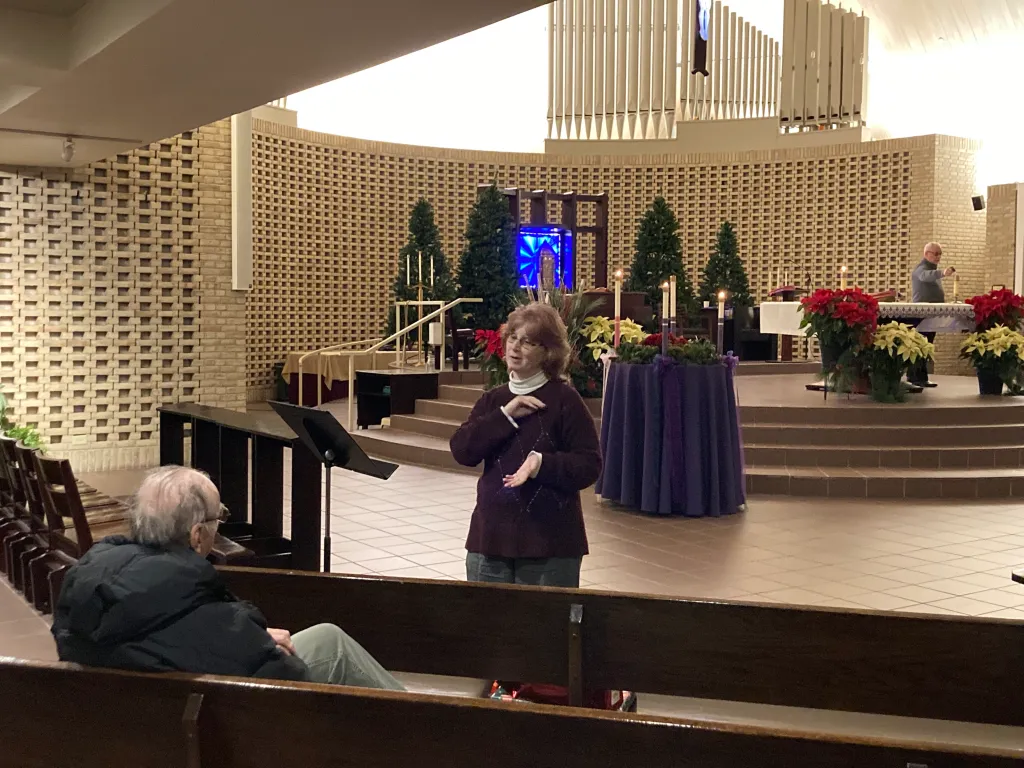
Our Lady of the Woods Catholic Church in Orland Park provides an American Sign Language interpreter at 5 p.m. every Saturday: Kathleen Ericksen, an interpreter, a leader of the parish’s special religions development program and lifelong faith formation coordinator. She’ll also interpret for the 8 a.m. Mass on Christmas Day.
But Ericksen says her work encompasses much more than Masses.
“As far as interpreting for people who are deaf and hard of hearing, it is a ministry rooted in the present, compassion and relationships. So the sign language interpreting extends beyond the walls of the church,” she said, although she also provides her services for wakes, funerals and sacraments.
She recently interpreted for someone who took a driving test at 82 years old, a person who is looking into a residential facility and someone who was in the hospital for eye surgery. “You build relationships – not just interpreting here – but get to know their families,” Ericksen shared. “In all of these moments, I strive to walk with them, ensuring they are seen, heard and fully included in the life of the Catholic church community.”
Ericksen, who began offering the service at Our Lady of the Woods 19 years ago, said she began by teaching religious education for the deaf and hard of hearing in Lemont. A parent asked if she could interpret at Our Lady of the Woods because it didn’t have an interpreter.
She was originally inspired to learn American Sign Language because of a neighbor who is deaf. She took community college classes and her skills “flourished” because of the Rev. Joe Mulcrone and his deaf community at St. Francis Borgia Catholic Church on Chicago’s North Side.
The Mass doesn’t differ from a traditional version. “I’m interpreting to get them to understand what’s happening in the Mass,” she said. “People who are deaf and hard of hearing have the right to have the same services that hearing people have.”
Two deaf adults typically attend the 5 p.m. Mass. Deaf parishioner Robert Lenart, who has been attending that service for about eight years, “appreciates being able to understand Mass,” he said via Ericksen.
The Metropolitan Chicago Synod’s Lutheran Deaf Ministry has faced some challenges in the last few years because of the COVID-19 pandemic, but a few churches in the area have services, including Gloria Dei Lutheran Church in Downers Grove, which offers interpreted worship services at its traditional service at 8:30 a.m. most Sundays. Its pastor, the Rev. Tim Robertson, also provides assistance at hospital visits, funerals, emergency services and other pastoral care, alongside an interpreter.
A deaf interpreter uses American Sign Language during an 8:30 a.m. Sunday traditional service at Gloria Dei Lutheran Church, 4501 Main St. in Downers Grove, that also features wide screens and Wi-Fi-assisted listening devices for deaf and hard-of-hearing members. The church streams this early service online, offering a picture-in-picture window for people at home or elsewhere. (Gloria Dei Lutheran Church)
Just one deaf person typically attends Gloria Dei’s in-person service, but it also provides large screens behind the altar and Wi-Fi-assistive devices for worshippers who are hard of hearing. “We have online worship, so we try to isolate (the interpreter) in a picture-in-picture window so no matter where they are worshipping, they can also worship with our deaf interpreter,” Robertson explained.
Gloria Dei doesn’t provide an interpreter on Christmas Eve because the deaf member typically spends the holiday with family. “We’ve had three or four people who have been deaf folk,” he added. “But more often than not, that one person …. She loves it and we love her. She can hear a little bit and she reads lips really well. We’re able to, with her beautiful ability to read lips, have some dialogue.”
Robertson knows a few signs such as please and thank-you, and he helped when three kids on his son’s baseball team were deaf. He also keeps in mind his time as an admission developer in Sioux Falls, South Dakota, which has a large deaf community because of a school there. “That church had 30 or 40 (deaf) people for a service, but there’s nothing like that here,” he said.
“I have a huge passion for those who are not in a faith community and remembering my friend Jason, who was part of the deaf community in Sioux Falls, telling me that one of the largest populations of unchurched people in our community is the deaf and hard of hearing. They’ll at least know a church does this.”
Among special Masses for people with special needs is an Advent Mass at the McDonough Chapel at St. Xavier University, 3700 W. 103rd St. in Chicago, led by the Rev. Adam MacDonald and coordinated by Joe Quane, executive director of Special Religious Development for the Archdiocese of Chicago.This year’s was Dec. 14. The Masses also take place during Lent.
“We purposely do it during Advent because a lot of our friends and families don’t go to service during Christmas. It’s chaotic, hard to park and sometimes their families don’t always feel welcome. Some people might make a comment to them or look at them and so they might not feel comfortable,” Quane shared.
He said the Mass is popular, drawing about 150 or 200 people. “For a lot of our families, it might be the only one they attend. Also, after each of our Masses, we have a social. We try to make it as sociable as possible, especially for our adult friends. They don’t have a chance to get out of the house” especially if they live in a group home. “One of the reasons we have these masses is to help our friends become more familiar with the liturgy so maybe they will come to their regular parish Masses.”
The Masses are adapted to encourage participation in a sensory-friendly environment with quieter music, such as a guitar, and no incense. Participants also prepare the altar, bring up flowers to the altar and light the candles.
In addition, gestures accompany the readings. “It’s called symbolic movement – not liturgical dancing – just to help them with the readings and give them a focus point. A lot of them had ADHD, so the movement is a way to focus and listen,” Quane explained.
Sermons are kept simple. “We usually have a very short homily that is message-based so the priest does a one- or two-sentence message and repeats it several times so it sets in. … They just want ‘What is Jesus telling us to do?’ repeated and in a very reverent way,” he said.
Special Mass details are available on the website, www.spred-chicago.org, or via 312-842-1039 or emailing SPRED@archchicago.org.
Our Lady of the Woods Catholic Church in Orland Park offers a hearing assistive device to parishioners who are deaf or hard of hearing. (Melinda Moore/Daily Southtown)
Quane often works with Mulcrone, director of the Catholic Office of the Deaf at the Archdiocese of Chicago. The priest leads a Mass for the deaf at 10:30 a.m. every Sunday at St. Francis Borgia as well as a Mass at 4 p.m. the third Sunday of the month (except December) at St. Julie Billiart Catholic Church, 7399 W. 159th St. in Tinley Park. He’ll also preside at a Mass at 8 p.m. Christmas Eve at St. Julie.
“He’s a wonderful individual and has done amazing things, especially with the deaf community,” Quane said. “It’s great to collaborate with him. … Our worlds collide a lot, especially in the world of disabilities.”
The Mass for the deaf at St. Julie began about 20 years ago and takes place in the church’s chapel, but the Christmas Eve Mass, which was first offered about 15 years ago, has moved into the sanctuary because it keeps growing.
“The first time we had 15 people. Last year we had about 100,” Mulcrone said. “If deaf people can come, we do the whole Christmas Mass. We do it in voice and sign. … It’s wonderful because people bring their hearing relatives who are in town and you see deaf people you don’t see the rest of the year. It’s a good celebration.”
One difference from a traditional Christmas Eve Mass is having deaf people give the readings and singing fewer hymns, including not singing the Glory.”
“They’ll do one or two that we sign and we sign ‘Silent Night,’” said Mulcrone, who is fluent in Sign Language. “It’s a really beautiful song itself. We have people who go with relatives and their families say ‘Why don’t we go?’ And we start signing at the end of the night and people are crying. Then we have doughnuts and coffee.”
Another difference is the deaf community has a custom at Christmastime of working with the Chicago Children’s Advocacy Center to collect new warm clothes for children who have been abused. “We donate to the advocacy center to these children who in most cases cannot go home. That has been part of our community for years,” he said.
The Rev. Tirso Villaverde of St. Julie Billiart is grateful Mulcrone, who turned 80 this year, celebrates a Mass for the deaf once a month as well as the 6 p.m. Sunday Mass and the Christmas Eve Mass, calling it “truly a gift.” He added, “I appreciate that he takes the time out to do so, especially on a special day like Christmas. It is an opportunity for the deaf community in the area to be able to celebrate and practice the faith.”
He said the church’s deaf ministry has done well because “this is one of the few places where the deaf Catholic community can go and be ministered to in a way that they can understand.”
Villaverde also worries about missed opportunities in other areas.
“I have long believed that the deaf Catholic community is one that we can lose because most diocese do not dedicated too many resources – or none at all – in developing a ministry to deaf Catholics,” Vallaverde said, adding that his nephew and wife are hard of hearing and depend on ASL to communicate and understand. “They have told me on occasion that it is hard for them to be able to participate at Mass when they cannot understand everything that is being spoken or sung. I am sure that other deaf Catholics feel the same way, and we can lose them to other denominations that provide ministry in ASL.”
Mulcrone said working with the deaf comes naturally to him, thanks to having deaf maternal grandparents. “It’s been my world since I was a little kid,” he said. “Christmas is great and wonderful, but I can’t even think about not celebrating Christmas with the deaf. I wouldn’t know what that was like. I’ve been working with the deaf in the archdiocese for 48 years, but for me this is Christmas and what it’s about and to be with these people and to share with these families to give them the opportunity to celebrate the Lord’s birth in their language, in their way.”
Melinda Moore is a freelance reporter for Pioneer Press.
