


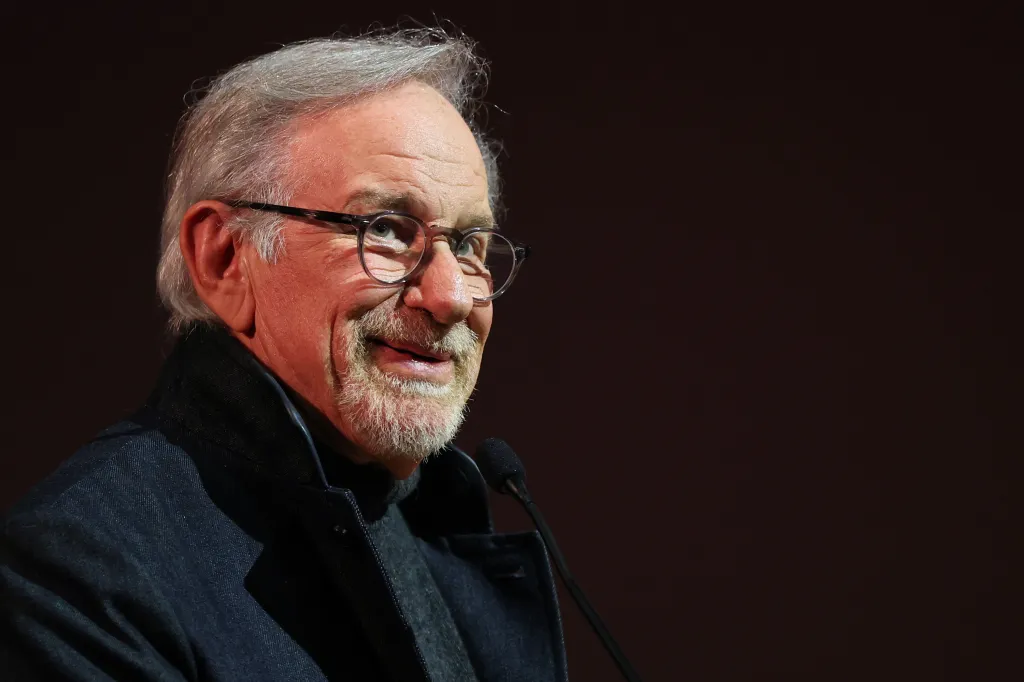
Steven Spielberg took a bit of a jab at Timothée Chalamet’s recent comments alluding to the cultural irrelevance of art forms like ballet and opera, during an appearance today at SXSW.
Asked about the future of the moviegoing experience, Spielberg said, “It’s an important topic to talk about, and I look out at this auditorium with everybody here, and I just think that we’re all together. We don’t know each other, and we probably agree with each other more than we disagree with each other. But the one thing I know is when we’re all watching something, it’s going to hit us all independently, individually, in different ways. But there is a collective impulse from a good story that hits all of us at the same time, in exactly the same way.”
There’s something in the theatrical experience, he says, “that is about community and communication and getting along with each other, and that happens in movie theaters, not sitting around living rooms watching on television something that is up there on the screen to watch.”
Spielberg clarified that he doesn’t “decry” films made for streaming.
“I mean, we make Netflix movies, and I like working with Netflix. They’re a great company to work with. But it’s just for me, the real experience comes when we can influence a community to congregate in a strange, dark space,” he said. “All of us are strangers, and at the end of a really good movie experience, we are all united, with a whole bunch of feelings that we walk into the daylight with, or into the nighttime with, and there is nothing like that. I mean, it happens in movies, it happens at concerts — and it happens in ballet and opera. And we want that to be sustained.”
Spielberg’s remarks came during a Hilton Austin panel, where he discussed his upcoming film Disclosure Day and highlights from his 60+ year career, in conversation with The Big Picture podcast’s Sean Fennessey.
Over the course of the hour, he also teased a Western he has in development that “kicks ass” — and his feelings on the existence of alien life, as someone who has dabbled frequently in the extraterrestrial sci-fi subgenre, including with his latest film.
“My feeling right now is this… I don’t know any more than any of you do, but I have a very strong sneaking suspicion that we are not alone here on Earth right now,” he said. “And I made a movie about that.”
Marking Spielberg’s return to extraterrestrial sci-fi for the first time in more than two decades — on the heels of War of the Worlds, Close Encounters, and E.T. — Disclosure Day finds humanity confronting undeniable proof that extraterrestrial life exists, picking up on a real-world theme amid recent disclosures from U.S. government whistleblowers.
Spielberg told the Austin crowd today, “I’ve always believed, even as a kid, that we weren’t alone. That just goes without saying. The big question is, are we alone now? And have we been alone over the last 80 years? And really, have we been alone over the last 3,000 years?”
He clarified that he has “no fears…whatsoever” about aliens, as someone who grew up with many fears. His film does consider, though, “the social dislocation that could occur, theologically, if it would be announced that there’s not only evidence, there’s interaction that has been going on for decades that we are just now finding out about.”
The filmmaker says the disclosure of alien life — as recently highlighted in New York Times reporting, by a U.S. House Oversight Committee, and in remarks by former President Barack Obama — is “going to cause a disruption in a lot of belief systems, but I don’t think it is a lethal disruption at all.”
Coming off his Oscar-nominated semi-autobiographical film The Fabelmans, also for Universal, Spielberg conceived of the original idea for Disclosure Day, which stars Emily Blunt, Josh O’Connor, Colin Firth, Colman Domingo and more, enlisting longtime collaborator David Koepp to pen the script. He and Kristie Macosko Krieger produced under their Amblin Entertainment banner. The film releases in theaters in June 12.
Elsewhere in his panel, Spielberg expressed a joking frustration at never having seen an alien, as someone who has spent a great deal of time thinking about them. He also marveled about how much has changed, in terms of how the public thinks about the possibility of alien life, noting that he wanted to make his landmark film Close Encounters of the Third Kind before his breakthrough with Jaws, but studios had zero interest.
“Nobody would let me make Close Encounters because it was on the fringes of science and mythology. So no one really got it,” he recalled. “When I said, ‘I want to make a UFO movie,’ everybody thought, well, you want to make a movie about the National Enquirer. You want to make a movie about crackpot reporting of things that aren’t really occurring, a completely crazy fantasy film about something that isn’t happening.”
After Jaws, of course, “everybody came to me and said, ‘You have an old diary? We’ll shoot anything you have.’ I mean, it was great.”
Earlier in the hour, Spielberg discussed coming to filmmaking as a “talisman to protect” himself from his own overactive imagination and the fears that resulted in his adolescence. The director also talked AI — noting he hasn’t yet used it on any of his films but isn’t totally averse to it — mentioned Daniel Day-Lewis’ nickname for him (Skipper), urged audience members to watch TCM, and explained why he’s not on social media.
It’s not, he said, for “any kind of personal [reason], it’s just that it eats up the clock. I mean, I put Instagram on my phone for two weeks, and I had missing time. [I felt like] I had been abducted by an alien.”
