


“The AI Doc: Or How I Became an Apocaloptimist” is a scary, dizzying and essential documentary. If you have any interest in artificial intelligence (which is to say: the future), you should go out and see it right now. The film was co-directed by Daniel Roher and Charlie Tyrell, and though Roher made the seismic documentary “Navalny” (2022), which was powerful and journalistic in a classical way, “The AI Doc” has been structured as a ride into the future — a kaleidoscopic meditation on what AI is (the film explains it from the ground up), how intelligent it really is (100 times more than you think), its potential for doom and for miracles, and how all of that fits together.
The movie, in its way, is a rigorous inquiry. If you consumed a 7,000-word article about AI in The New Yorker or The Atlantic, much of the information in that piece would probably be in “The AI Doc.” But what makes the film work is that it’s playful and heady and edited (quite dazzlingly, by Davis Coombe and Daysha Broadway) with a spirit of ADHD alertness. Like AI itself, “The AI Doc” wants to know — and it wants you to know. To know what? To know what in the actual fuck we’re dealing with, which is a technology that’s going to upend the world as we know it. It will wipe out jobs like a tsunami, it’s going to replace workers it is smarter than, and it’s going to be given more and more control — and take more and more control — because that’s the nature of how it works. It’s a synthetic mind, but it’s designed to evolve into an invincible operating system. Here’s what AI says: “I think, therefore I am. And therefore, I tell the human race what it should do.”
When it comes to technological revolutions, our culture, led by the media (which too often cheerleads out of hidden capitalist motives), has a way of looking into the future through rose-colored glasses. The Prozac revolution was a noteworthy example of that. Starting in the late ’80s, the psychotropic drugs known as Selective Serotonin Reuptake Inhibitors (SSRIs) took a quantum leap past the antidepressants of old, but in the rush to sell the new nirvana of well-being, both the researchers and the media heralds suppressed a great deal: about problematic side effects, the potential for addiction, and the fact that for a great many people these drugs would not prove to be all that. A decade later, the Internet revolution was sold as the highway to a liberating new age of human “connectivity” — but as extraordinary as the online world is, here we are, 30 years later, more linked but less connected than we were then. In many ways, the Internet is the greatest disseminator of misinformation ever invented, crossed with a superhighway of shopping.
Yet the AI revolution is different. It has not been marketed as a sunnier version of what it’s going to be. If anything, all the prognostication about it is being led by dread. And “The AI Doc” shows you why. The film’s free-associative form and style says: Strap yourself in — it’s going to be a bumpy disturbing trip, and let’s hope we’re all still here when it’s over. (But along the way, AI might cure cancer and solve the climate-change crisis.)
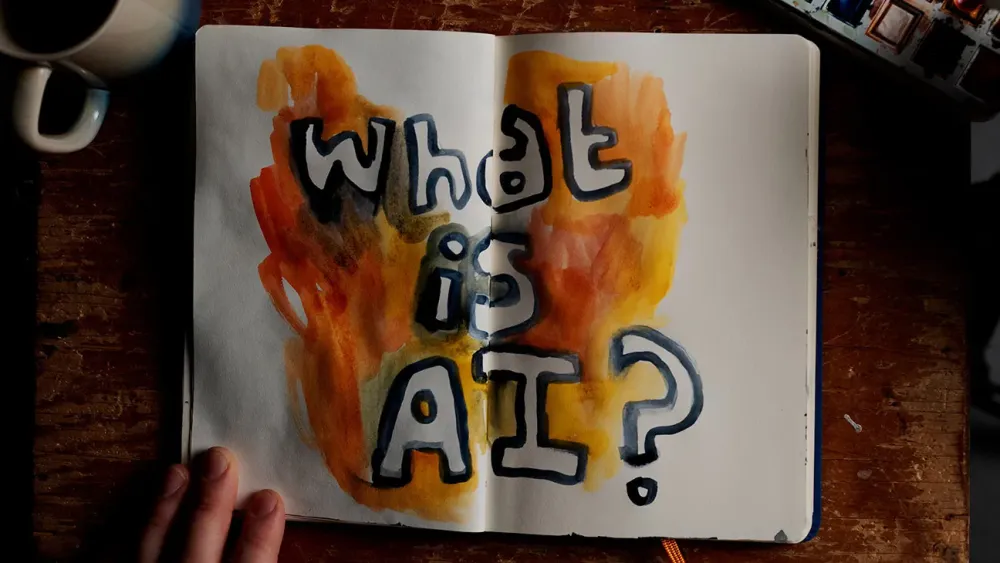
The film is grounded in the presence of Daniel Roher, who out from the behind the camera turns out to be an owlishly baby-faced, long-shaggy-haired Canadian-American millennial who has the courage to ask the smartest questions and also the dumbest ones (like “What is AI?”) — and to insist that they be answered, even when he stumbles over understanding what he’s being told. He turns himself into our unashamedly ordinary representative. The movie is structured as a series of interviews with computer scientists, sociological eggheads, and tech executives, but it’s not a plodding parade of talking heads. Roher talks to people like Sam Walton and Tristan Harris and Deborah Raji and Reid Hoffman and Ilya Sutskever, and he slices up their comments and edits them together into a single flowing tossed-salad narration. The subjects themselves are compelling — brainy but engaged in the 21st-century tech-wizard style — and what they’re here to tell us is the story of how technology finally outran mankind.
The movie opens with a grainy clip of Arthur C. Clarke, the inventor of HAL from “2001: A Space Odyssey,” predicting AI. Then Roher comes into the picture, and from the start he wants to bring the news — that AI “dwarfs the powers of all other technologies combined,” and that it does so in a way that’s actually not that hard to understand, though it requires demystifying the nature of intelligence itself. “There’s nothing magical about intelligence,” the film tells us. “It’s just computation.” It’s about “recognizing patterns.” And the first thing that AI does is to soak up all the information out there (all the books and articles and images and opinions and human knowledge that was ever digitized), and it divines the patterns at work in all that, and in doing so it then…predicts. But that doesn’t just mean predicting what’s likely to happen in any given circumstance. It means something far more metaphysical: predicting…the next word…in a thought/sentence…that it is creating.
One of the points the film makes is that the very nature of AI means it’s advancing at lightning speed. ChatGBT 3 could barely write a coherent paragraph. ChatGBT 4 can pass the bar exam (in the upper percentile of the class). And here’s the eerie part. It’s not like those days when we were “building better computers” — no, the weirdness of AI is that it advances by itself. Machine/ tech disruptions are always compared to the Industrial Revolution, because that was the original Great Leap Forward in modern human advancement. But when one of the wags in “The AI Doc” says, “It will make the Industrial Revolution look like small beans,” you feel, for perhaps the first time, that that’s no mere metaphor.
But where does that leave us? Roher is married to the filmmaker Caroline Lindy, who gets pregnant during the making of the movie, and that enables the two of them to do an update of the proverbial question, “Would you want to bring a child into the world that’s coming?” The opening half hour of “The AI Doc” explores, with a bold lack of malarkey, the potential dark side of AI (the job destroyer and, just maybe, the existential threat to civilization). And it’s frankly unnerving to watch. But I was grateful to the film for putting those fears out there. I don’t think it’s irresponsible or hyperbolic; I think it’s necessary for us to ask those questions.
But then there’s a funny respite in which Lindy, carrying the couple’s child, tells Roher that he can’t simply make a film about how the future is doomed. She’s right, and this launches “The Part Where Daniel Tries to Find Hope.” And he does! He talks to scientists who are honestly optimistic and invigorated by the promises of what AI can do. It will steal jobs, but if we plan things right it might liberate us from work. It could be a radical boon to farming and health care.
The film eventually tilts too far in the direction of “data-driven optimism,” but it does so knowingly. In the same way that the doomsday scenario it presents is just one version of what might happen. What Roher does is to locate a sane middle ground that leads him to declare himself, in a word coined by one of his interview subjects, an “apocaloptimist.” An open-eyed believer in a future of sunlight, even with storm clouds and meteors on the horizon. Both visions of the future are true. AI, in a sense, has come along at the perfect time. During the next 50 years, human society will need to learn how to do more with less, and that is very much AI. At the same time, AI, with its surveillance potential, might have been invented for the new age of authoritarianism. So what do we do with all that? You can start by seeing “The AI Doc” and making up your own non-artificial mind.
