


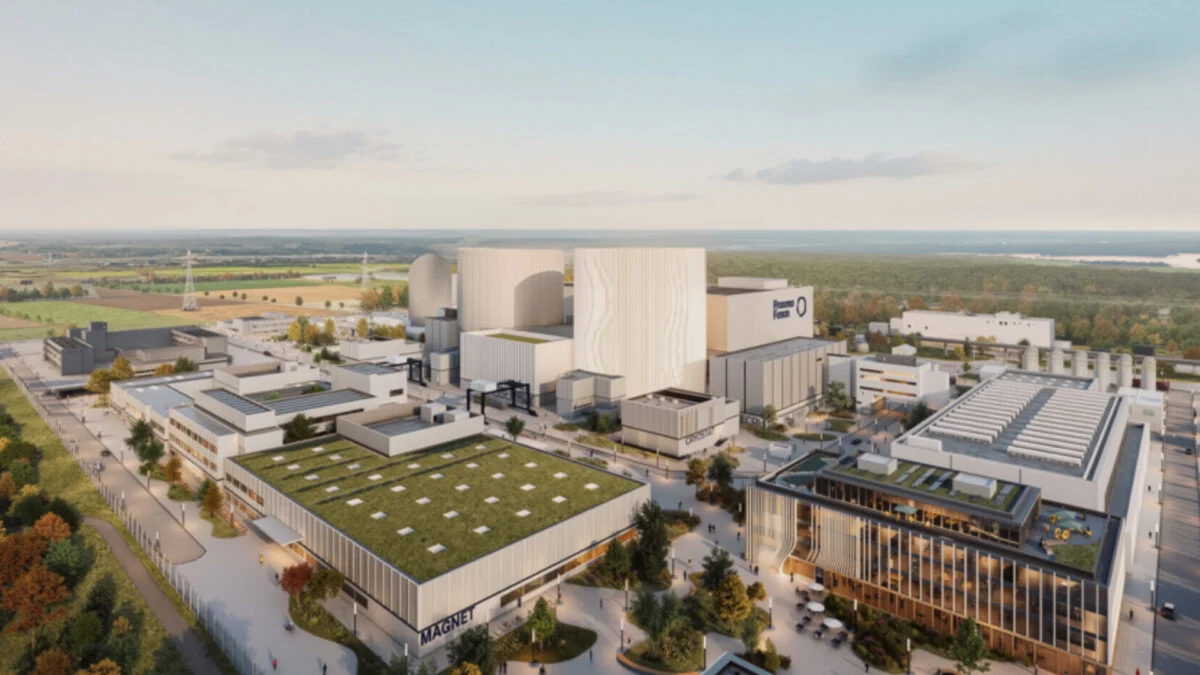
Achieving stable fusion reactions is one thing. Bringing the technology to commercial markets is another challenge—and the race is slated to heat up even more, as Germany has now entered the scene.
In a recent press release, Munich-based company Proxima Fusion announced that it will partner with the Free State of Bavaria, the energy company RWE, and the Max Planck Institute for Plasma Physics (IPP) to bring an operational fusion plant to the European grid by the 2030s. If things proceed as planned, the power plant, Stellaris, would be the first of its kind to generate net energy gain for both commercial and research purposes.
“Nuclear fusion represents an entirely new technology capable of delivering baseload, carbon dioxide-free, clean electricity in virtually unlimited quantities,” Markus Söder, Minister-President of Bavaria, said in the release. “It has the potential to meet the exponential growth in power demand driven by electric mobility, AI, and data centers.”
A big “if” with big rewards
Nuclear fusion combines two lightweight particles to generate an enormous amount of energy. All commercial nuclear plants as of now run on nuclear fission, which splits heavyweight atoms to produce energy. Compared to fission, fusion doesn’t produce greenhouse gases or long-lived radioactive waste, making it the end goal for sustainable nuclear power. Progress on bringing fusion plants to practical use has been steady but slow.
Germany is not the first to pursue commercial fusion plants. In the United States, several private companies have expressed interest in realizing commercial fusion plants. For example, Helion intends to complete a fusion plant to power Microsoft buildings as early as 2028, whereas Type One Energy has partnered with the Tennessee Valley Authority and Oak Ridge National Laboratory for its project. The U.S. Department of Energy (DOE) has also explicitly stated it aims to bring fusion power to commercial grids by the mid-2030s.
In that sense, Proxima’s new contract—involving government interests, the country’s most prestigious research institute, and sizable private firms—reflects Germany’s keen interest in getting ahead of the competition. Or at least, to keep up.
“The scientific achievements of recent years have paved the way for this unique public-private partnership that represents tangible progress along the roadmap to a fusion power plant,” said IPP director Sibylle Günter.
Progress so far
The pending reactor would be a stellarator called Alpha. Stellarators confine plasma used for fusion reactions inside a donut-shaped torus, then subject the device to powerful electromagnetic fields. Compared to tokamaks, stellarators are trickier to design but make other aspects simpler in terms of plasma management, according to the DOE.
Proxima said it will first install an Alpha demonstration stellarator in Garching, a region north of Munich. The bigger plant, Stellaris, is slated to be located farther south, in Gundremmingen. RWE has been clearing up the premises, which used to be home to a decommissioned fission plant, according to the statement.
Proxima added that around 20% of the project’s costs will come from private, international investors. The project has yet to procure funding from federal government initiatives.
“Boldness and momentum are essential when developing future technologies and transferring them from science into commercial application,” Söder said. “Only by investing decisively in technology can we secure our future prosperity.”
