


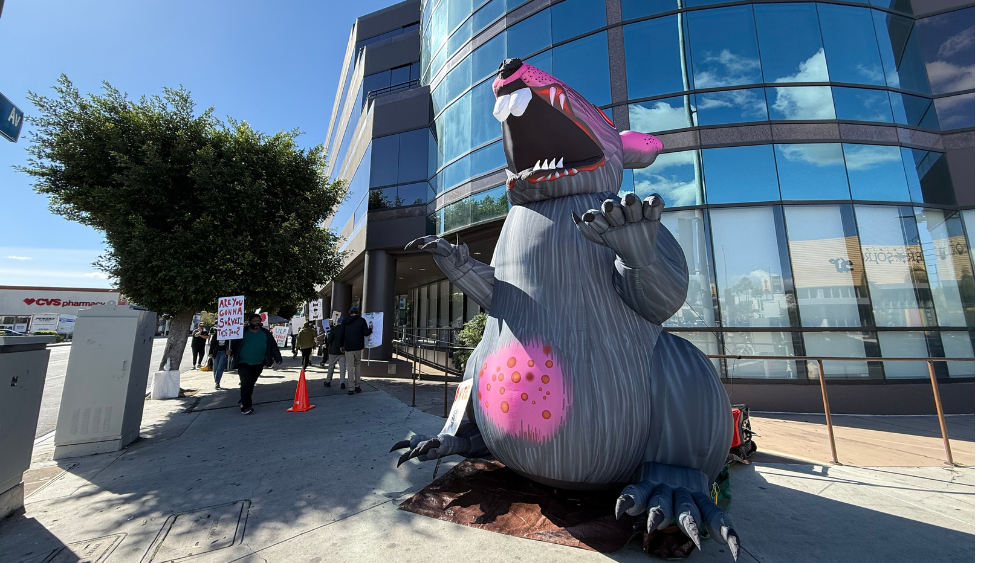
Scabby the Rat appeared in an unusual place on Wednesday.
With dozens of union staff picketing, the inflatable rodent — a near-universal symbol used by trade unions across the U.S. to call out employers for union-busting practices — was swaying in the wind on the corner of 3rd St. and Fairfax Ave. in L.A., right outside the Writers Guild of America West headquarters.
The Writers Guild Staff Union, which represents about 115 of the 160 guild employees, went on strike this week after repeatedly accusing WGAW management of unfair labor practices as the group sought to negotiate its first contract, including unlawfully firing a member of the organizing committee. The union staff organized last spring and have been bargaining their first contract with management intermittently since September.
“Our last bargaining session was February 2, and there just wasn’t any movement from [management],” Missy Brown, a co-chair of the WGSU bargaining committee, said from the picket line on Wednesday, which marked the first full day of the work stoppage after staff walked out at 12 p.m. on Tuesday. “[Staff union leadership] had a little sidebar meeting with management…and they just basically were like, ‘We’re not willing to do anything else.’”
Brown adds that the picketing began as soon as they walked out the door on Tuesday, telling Deadline: “We were out here last night, because our management was leaving, and we consider them scabs.”
WGA management closed the building to members and to the public once the strike was called. Spirits were high Wednesday, though most of the staff who spoke with Deadline remained bewildered that they were out there in the first place.
The WGSU first publicly threatened a strike about three weeks ago, signaling a bit of turmoil inside the guild just weeks ahead of the WGA West‘s own scheduled negotiations with the major Hollywood studios on a new multi-year TV/Theatrical contract. All eyes have been on the three above-the-line unions, coming out of a contentious 2023 bargaining cycle that resulted in historically long writers and actors strikes, as they seek to get through this round of talks relatively unscathed.
After the staff called their strike, the WGAW once again released an updated side-by-side comparison of both parties’ proposals and counterproposals and denied any wrongdoing.
“They did what any large corporation would do in that situation. They shut out the workers,” Dylan Holmes, co-chair of the WGSU bargaining committee, told Deadline during the staff’s recent informational picket.
In a memo to members, WGAW leadership also assured the rank-and-file that preparations for the guild’s upcoming MBA negotiations with the major Hollywood studios would continue on without a hitch.
“WGAW Executive Director Ellen Stutzman and the Guild staff leadership have kept the Board well-informed throughout the entire unionization and negotiating process and have answered any and all questions from the Board, giving us the confidence that staff leadership is acting in good faith as they seek to address the PNWSU’s demands while also safeguarding the Guild’s core mission of representing writers,” the memo read.
Sources with knowledge of the meetings between union staff and WGAW management tell Deadline that Stutzman has only been present for a few of the bargaining sessions, which so far have totaled more than 150 hours over 19 meetings.
Holmes says the guild’s version of the story is “full of mischaracterizations.”
“They are characterizing us as both crazy and irrational, but also so useless to the process of guild operations that essentially no one will feel it if we go out on strike,” he said. The latter half of that message, he believes, is “maybe not so much meant to assure WGA members as demoralize us, which has not been successful.”
By all accounts, it hasn’t appeared to assure WGA members, either.
WGSU staff were pounding pavement well before they officially went on strike, hosting an informational picket at last week’s WGA West member meeting at the Sheraton Universal Hotel to discuss MBA priorities.
They were also picketing at last Saturday’s WGA captains meeting, where Deadline hears they received an outpouring of support from writers in the room when management brought up the ongoing strife. Sources with knowledge of the meeting tell Deadline that multiple captains stood to press leadership about how they would seek to come to a fair resolution with the staff union.
Multiple members of the WGSU negotiating committee say that WGAW leadership has declined to provide explanations for many of its refusals. In its public messaging, the guild’s management has largely framed its concerns as economic, reminding writers that staff paychecks come out of their dues and pointing to provisions that the staff already have or are currently seeking in their own contract that writers do not have under the MBA, like a 401k with an employer match.
In addition to wage and benefit provisions, the staff union is also seeking just cause protections, as well as uniform standards for disciplinary action and guidance on the guild’s future use of artificial intelligence, among other worker safeguards.
“They’re not being as collaborative as they say they are,” WGA staffer Shelly Guzman told Deadline at last week’s informational picket. “There is retaliation happening when we walk in the door…They’re not being fair. They’re not being forthright. They’re going over every little thing that we want to accomplish. ‘Well, why do you need this? Is there a precedent? Why’re you asking for this? For just cause, has there been a reason?’ And there shouldn’t need to be a reason for wanting basic protections.”
The contract that the union staff is seeking is somewhat different from the minimum basic agreement negotiated on behalf of writers by the WGA, because the MBA is a complicated contract that covers thousands of writers, who are considered gig workers, and sets industry-standard minimum floors for terms of employment across hundreds of studios. A general collective bargaining agreement, particularly one covering a smaller group of salaried employees like those at the guild, is usually much less convoluted.
“They have continued to insist on terms that are designed to basically make it feel like there’s not a union in the workplace,” Holmes said outside the Sheraton last week. “It is very clear that their two options for us are either, ‘You accept a contract that is designed to destroy itself and designed to create resentment down the road, or you don’t get a contract, and we continue to union bust until, eventually, there’s a decertification campaign.’”
The WGA West is not the only Hollywood-adjacent union with staffers who are a part of unions themselves. In fact, the WGA East’s staff is represented by United Steelworkers. Also, Workers at SAG-AFTRA, Actors’ Equity and multiple IATSE locals are represented by OPEIU Local 537.
In a statement Wednesday, the WGAE staff union issued its support for its western counterpart’s employees: “The WGAE United Steelworkers Staff Union stands in solidarity with our union siblings at the Writers Guild of America West staff union as they strike over unfair labor practices. Every worker deserves fair pay, just cause, and respect at work — including union staff. We urge WGAW management to come to the table and bargain in good faith.”
