


Multiple Authors
Who will decide the next two-plus months of NBA basketball?
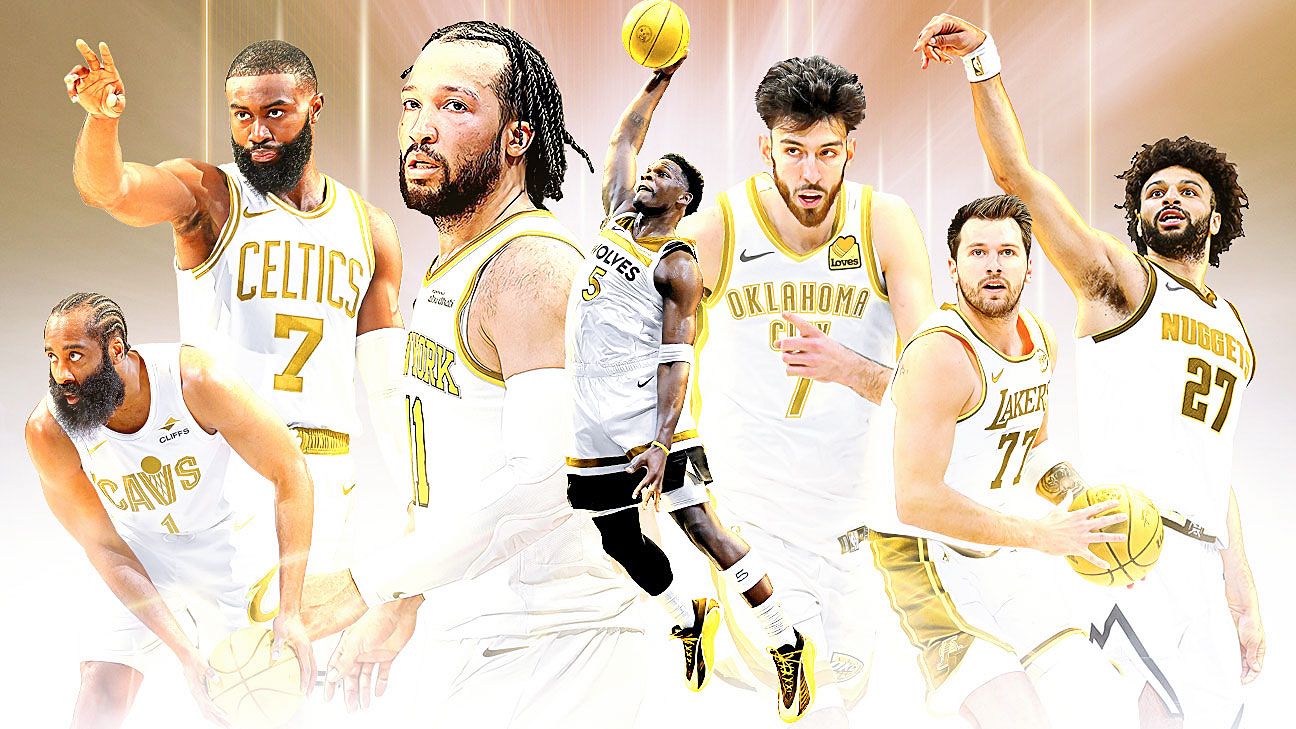
Welcome to NBA Rank: 2026 playoffs edition, where we’re counting down the 50 most impactful players ahead of the league’s postseason gauntlet.
Can reigning Finals MVP Shai Gilgeous-Alexander add another trophy to his mantel? Will Victor Wembanyama make a splash in his first trip to the postseason? Do veterans LeBron James, Kevin Durant and Stephen Curry have a chance to make some playoff noise?
All those players will feature prominently in their respective teams’ postseason runs, as will a host of young stars, role players and defensive specialists built for the playoffs. That’s why our countdown runs the gamut, with a special focus on players likely to advance multiple rounds; we’re judging “impact” as a measure of both quality and quantity of play between now and June.
That last line is worth repeating: We’re judging based on projected quality and quantity of play. This is not a pure talent ranking.
So players in the play-in tournament, such as Curry, rank lower on this list than they would otherwise. They could be eliminated as early as this week, and even if they’re not, they’ll face long odds against a top seed just to reach the second round. Injured players also generally didn’t make the list, because it’s unclear how much the likes of Austin Reaves, Joel Embiid and Peyton Watson will play this spring.
But the top of the list is filled with Finals MVP favorites — the brightest stars from the best teams in the league. So let’s begin the countdown from 50, broken into 10 tiers, and make our way to the top.
Jump to a tier:
Play-in Stars | The Big Injury Question Mark
Positional Specialists | Role Players
Hoping to Pull an Upset or Two
Too Good to Be Role Players
Elite Young Bigs | Star Sidekicks
Top-Tier Guards | Finals MVP Favorites
Tier 10: Play-in stars
Playoff experience: 26.8 PTS | 5.3 REB | 6.1 AST (155 games)
In 43 games, Curry averaged 26.6 points and a league-best 4.4 3-pointers per game. More importantly, the Warriors were 24-19 when Curry played this season, versus 13-26 without him. In other words: The 37-45 Warriors have the toughest path to the playoffs of any play-in team — but while they would be doomed to lose their first play-in game without Curry, they at least have a puncher’s chance to advance now that he has returned from a knee injury that kept him out for more than two months.
Playoff experience: None
Knueppel’s 63% true shooting was the second-highest ever for a rookie with an above-average usage rate. And he didn’t just smash the rookie record for 3-pointers; he led the whole league in 3s, while making them at a 43% clip. Even after a late-season slump and being benched in crunch time of Charlotte’s play-in win on Tuesday, Knueppel should be at the top of every opponent’s game plan — because he’ll make them pay if they give him even the tiniest sliver of space around the arc.
Playoff experience: 28.0 PTS | 8.5 REB | 4.1 AST (12 games)
Banchero has been incredible in his playoff career, and after a midseason swoon, he was much better toward the end of the season, with more production and efficiency after the All-Star break. Yet for the fourth consecutive season, the Magic had a better net rating with Banchero off the floor, raising more questions about his ultimate place on a winning team.
Playoff experience: None
Ball’s surface stats haven’t changed much, but he has reined in some of the most adventurous — and sloppy — plays he was known for before this season. He made the game-winning layup in overtime against Miami on Tuesday. And for as exciting as some of the Hornets’ younger players are, Ball remains the beating heart of their offense: Charlotte scored 123.2 points per 100 possessions with Ball on the floor, a figure that would’ve led the league, but just 110.6 without him.
Playoff experience: 28.0 PTS | 5.1 REB | 5.3 AST (47 games)
Following a disastrous 2024-25 season and a breakup of the Suns’ not-so-big three, Booker led Phoenix back to relevance with a typically starworthy performance this season. He averaged 26.1 PPG while battling through injuries and sharing point guard duties, and Phoenix’s offense fell apart without him on the court.
Playoff experience: 17.8 PTS | 3.6 REB | 3.1 AST (41 games)
Maxey continues to improve — he averaged career highs in points and assists per 36 minutes this season — while serving as 76ers coach Nick Nurse’s ultimate security blanket. Maxey’s 38.0 minutes per game were the highest single-season average since James Harden’s 38.1 in 2015-16. And with Embiid’s availability in question this postseason, the 76ers will need every last minute they can get out of their remaining star.
Playoff experience: 21.5 PTS | 7.8 REB | 3.0 AST (146 games)
Leonard is a two-time Finals MVP and a member of the NBA’s 75th Anniversary Team, yet he waited until his age-34 season for the best campaign of his career. Leonard averaged a career-high 27.9 PPG on 50-39-89 shooting splits, and he demonstrated with his All-Star Game takeover that, even among the best players in the league, Leonard is special. On a talent-depleted Clippers squad, Leonard is the only realistic hope for a long playoff run.
Playoff experience: None
The Trail Blazers’ offense collapsed so severely without Avdija that the team would have ranked worse than every tanking team were it not for the breakout All-Star’s 24.2 points, 6.9 rebounds and 6.7 assists per game. Avdija thrives by slashing into the lane — he narrowly led Jaylen Brown and Shai Gilgeous-Alexander for the most drives per 100 possessions — and drawing contact, as he ranked third (behind Rudy Gobert and Zion Williamson) among rotation players in free throw attempt rate. Avdija led all scorers with 41 points, including the game winner, as Portland advanced in the play-in round on Tuesday.
Tier 9: The big injury question
Playoff experience: 30.9 PTS | 9.2 REB | 7.8 AST (55 games)
There are few players in NBA history as talented as Doncic, who averaged 33.5 PPG to win his second scoring title this season and seemed to be peaking at the right time — only to be sidelined for the last couple of weeks due to a Grade 2 hamstring strain. So it’s impossible to place Doncic properly in this ranking: Either he won’t play at all in these playoffs, due to his injury, or he’ll make an improbably speedy return and be one of the best scorers and creators in the entire playoff field.
Tier 8: Positional specialists
Playoff experience: 4.9 PTS | 7.7 REB | 0.5 AST (35 games)
Robinson is a backup who averages 5.7 PPG, so on the surface, he seems like a strange fit for this list. But on a team that can struggle with Karl-Anthony Towns at center, Robinson provides a crucial change of pace. He’s a much better rim protector than Towns, and if he had enough minutes to qualify, Robinson would have set the NBA record for offensive rebound percentage this season. He could flip multiple playoff games in the Knicks’ favor this spring, just as he did a year ago.
Playoff experience: None
What a rise for an undrafted player who began this season on a two-way deal. Jenkins averaged only 9.3 PPG this season, but he excelled in spots and took a huge leap during Cade Cunningham’s absence down the stretch, going for 18.9 PPG and 7.6 APG and making 43% of his 3-pointers in 11 games as Detroit’s de facto lead guard. At long last, the Pistons might have found the No. 2 playmaking option they need behind Cunningham.
Playoff experience: None
As the Spurs’ roster has improved around Vassell, he has transitioned from a lead role more to the periphery. This season, he posted his lowest usage rate since he was a rookie. But if the Spurs’ greatest weakness is questionable 3-point shooting from its stars, then the spacing Vassell provides will be especially valuable this spring. He led San Antonio with 2.5 3-point makes per game on 38% accuracy.
Playoff experience: 13.9 PTS | 4.5 REB | 2.5 AST (57 games)
Bridges is the subject of much angst in New York, but if you look past the exorbitant cost the Knicks paid to acquire him in trade, he’s still a solid 3-and-D role player who literally never misses games. Bridges is still feeling out his place on the Knicks’ roster, as he posted his lowest usage rate since he left Phoenix this season. But the Knicks need Bridges’ best self, with top-notch perimeter defense and efficient supplementary creation, if they hope to return to the conference finals — and more — in the months ahead.
Playoff experience: 9.3 PTS | 4.0 REB | 1.2 AST (39 games)
He might commit a flagrant foul, and he might start a fight — but Dort is also guaranteed to harass the opponent’s best player all game long as a core player for the NBA’s best defensive team. The hinge point for Dort’s game comes on the other end, where defenses leave him open to launch his moonball 3-pointers. When he’s hitting them at a 41% clip, as he did last season, the Thunder are nearly unbeatable; when he’s down at 34%, as he was in the 2025 postseason and 2025-26 regular season, Oklahoma City’s offense is more vulnerable to schemes that help against its stars.
Playoff experience: 11.5 PTS | 5.2 REB | 1.0 AST (six games)
Thompson won the steals title this year, averaging 2.0 thefts per game, and that stat only scratches the surface of his superb lockdown defense. The Pistons ranked second as a team in defensive rating in large part due to Thompson’s ability to stymie opposing lead guards. Whether Thompson can stay on the court throughout the playoffs, or whether his offensive shortcomings — he was just 6-for-24 (25%) from 3-point range this year — play him off the floor, could determine how far Detroit goes this spring.
Playoff experience: 15.7 PTS | 6.9 REB | 3.3 AST (seven games)
The league leader in total minutes improved his stats across the board this year, averaging 18.3 points, 7.8 rebounds and 5.3 assists per game. Like his brother, he’s one of the NBA’s best defenders, and like his brother, his unreliable jump shot (22% on 3-pointers) could limit his team’s ultimate ceiling this spring.
Playoff experience: 12.3 PTS | 10.6 REB | 1.1 AST (84 games)
Now 33 years old, Gobert is no longer the league’s premier defensive force. (He’s no longer the premier defensive force among French centers.) But even a B-plus version of Gobert remains one of the best rim protectors in the league, and Minnesota’s defensive rating was 9.5 ticks better with Gobert on the court this year, per databallr. The Timberwolves’ defense was about as good as the Pistons’ with Gobert, but below average without him.
Playoff experience: 2.0 PTS | 0.7 REB | 0.3 AST (seven games)
Before this season, Queta was a little-used backup who had never averaged more than 5.5 PPG in a season. But he has blossomed into a crucial contributor to a Finals favorite, nearly doubling his previous career best to 10.2 PPG and capably filling in after big men Al Horford, Kristaps Porzingis and Luke Kornet all left Boston last summer. By the advanced stat expected regularized adjusted plus-minus (RAPM), which is largely based on on/off data, Queta is tied with Rudy Gobert for the third-best defensive impact in the league. And he’ll need that sort of showing this spring, as the rest of the East’s elite all have star centers to throw at the Celtics.
Tier 7: Role players
Playoff experience: 21.9 PTS | 5.5 REB | 5.0 AST (10 games)
Ingram fit in well in his first season in Toronto, leading the team with 21.5 PPG. The fit with Scottie Barnes is awkward at times — the Raptors had only a plus-1.5 net rating with both players on the court, per databallr — but Ingram makes enough 3-pointers at a 38% clip to space the floor, and his late-clock jumpers are a necessary component for an offensively challenged team without any top-tier creators.
Playoff experience: 12.3 PTS | 9.7 REB | 1.8 AST (27 games)
Allen has been a different player since joining forces with James Harden, rediscovering his All-Star form after the Cavaliers’ midseason trade. When he played without Harden, Allen averaged 18.9 points per 75 possessions with 65% true shooting, per databallr, but when he was with Harden, Allen scored 25.2 points per 75 on 71% true shooting.
Playoff experience: 7.8 PTS | 1.8 REB | 2.2 AST (37 games)
In the span of a few months, Alexander-Walker rose from defensively stout sixth man to two-way force starring for the hottest team in the East. He nearly doubled his previous career high in scoring (11.0 to 20.8 PPG), made 40% of his 8.1 3-point attempts per game and was by far the best guard on a team that included Trae Young and Defensive Player of the Year runner-up Dyson Daniels. The Timberwolves surely miss him, while the Hawks are thrilled they added him last summer.
Playoff experience: 6.8 PTS | 6.7 REB | 2.3 AST (49 games)
On a per-minute basis, Hartenstein was almost exactly the same player in 2025-26 as he was in his first season in Oklahoma City: In both years, he averaged 14 points, 14 rebounds and five assists per 36 minutes, with solid scoring efficiency and rim protection. And after battling Nikola Jokic, among others, en route to the title last season, Hartenstein should be a vital contributor once more given the stellar centers that the Thunder will likely have to defeat if they want to win another championship.
Playoff experience: 7.6 PTS | 2.4 REB | 2.4 AST (54 games)
The other addition who joined the Thunder before their title run, Caruso is a role player suited for the postseason. Oklahoma City manages his minutes throughout the regular season to let him conserve his energy for the most important games; last year, nine of his 10 games with the most playing time came in the playoffs. Expect more of the same this season, as Caruso never played more than 26 minutes in a non-overtime game. His 3-point shooting can come and go — after making 41% last spring, he’s down to 29% this season — but there’s no doubting Caruso’s winning impact. According to xRAPM, Caruso is the second-most-impactful defender in the league, behind only Victor Wembanyama, and he led all rotation players this year with a plus-17.6 net rating.
Playoff experience: 13.3 PTS | 3.5 REB | 2.9 AST (83 games)
The reigning Sixth Man of the Year was even more productive this season, taking on some of the extra offensive responsibility with Jayson Tatum out to average a career-high 17 PPG. Pritchard has returned to a reserve role with Tatum back, but he’s still scoring in double figures almost every game. He also has a special skill that could prove particularly valuable as the game slows in the playoffs: Pritchard led all players this season with 146 made shots in the final six seconds of the shot clock. The only players within 30 makes of him were superstars Jalen Brunson and Kevin Durant.
Playoff experience: 13.5 PTS | 4.8 REB | 1.3 AST (54 games)
At the moment, Anunoby might be the NBA’s archetypal 3-and-D wing. Want 3s? Check — he nailed 2.3 per game on a 39% clip. Want defense? Check again — Anunoby is an indefatigable All-Defense-level hound on the perimeter, averaging 1.6 steals per game. That latter aspect of his game could be vital as the Knicks go up against Jalen Johnson in the first round, then potentially Jayson Tatum and Jaylen Brown in the second.
Tier 6: Hoping to pull an upset or two
Playoff experience: 12.8 PTS | 9.0 REB | 4.3 AST (four games)
The Raptors’ do-it-all forward might be the NBA’s best defender not named Wembanyama, capable of guarding across the positional spectrum and collecting blocks and steals at an absurd rate: Barnes is the first player this decade with at least 100 blocks and 100 steals in the same season. Despite a backslide on offense in which he posted his lowest usage rate in three years and stopped taking as many 3-pointers, Barnes’ versatility makes him Toronto’s most valuable player.
Playoff experience: 20.9 PTS | 11.9 REB | 5.3 AST (seven games)
Sengun’s long-awaited 3-point improvement didn’t arrive this season, as he made just 31% of his long-range attempts. His overall efficiency leaves something to be desired. But that’s picking nits for a player who still averaged 20.4 points, 8.9 rebounds and 6.2 assists and presents a distinctive challenge for opponents. A hot streak over the past six weeks, following a midseason slump, could set Sengun up for more playoff success.
Playoff experience: 28.4 PTS | 9.0 REB | 7.2 AST (292 games)
Can the 41-year-old James turn back the clock and lead his team to postseason glory again? He wasn’t supposed to carry such a burden this season. But just as James was becoming comfortable as the Lakers’ No. 3 option, the two players ahead of him (Doncic and Austin Reaves) sustained injuries. So now James — whose 20.9 PPG represented both a career low for him, and by far the most points in NBA history for a player at his age — will have to dig deep to keep the Lakers alive long enough for Doncic and Reaves to return.
Playoff experience: 3.3 PTS | 1.9 REB | 1.0 AST (8 games)
Johnson delivered on all of his vast promise this season, remaining healthy for the first time in years and more than picking up the Hawks’ offensive slack after Trae Young was traded. Johnson averaged a career-best 22.5 points and ranked fifth in the league in assists (7.9) and seventh in rebounds (10.3). He’d never received a single All-NBA vote before this season, but he’s a near-lock to land on one of the prestigious teams this spring.
Playoff experience: 26.9 PTS | 6.6 REB | 5.5 AST (42 games)
On one hand, Edwards averaged a career-high 28.8 points this season with by far the best efficiency of his career. His level of superstardom has never been higher. Yet on the other hand, Edwards played a career-low 61 games, rendering him ineligible for postseason awards, and he hasn’t reached 30 minutes in a game since mid-March because of a knee injury. Suffice it to say, facing a brutal playoff bracket starting with a matchup against Denver, Minnesota needs a fully healthy version of its leader if it wants to reach its third consecutive conference finals.
Playoff experience: 29.3 PTS | 7.8 REB | 4.2 AST (170 games)
Injuries and an up-and-down season for his team masked another scintillating individual campaign from Durant: 26.0 PPG on 52-41-87 shooting splits. At least on offense, the 16-time All-Star has scarcely lost a step, even at 37 years old. He’s the Rockets’ best offensive engine, and thus their greatest chance to make some noise this spring.
Tier 5: Too good to be role players
Playoff experience: None
Castle proved that his Rookie of the Year win in 2024-25 wasn’t a fluke but rather a stepping stone to bigger and better things. The 21-year-old is a tenacious defender and savvy (if turnover-prone) playmaker. And his 3-point improvement, if sustained through the playoffs, could be a game-changer for the Spurs’ title quest, as opponents surely will leave Castle open to prove he can beat them from deep. After making just 28.5% of his 3s as a rookie and 27.9% in his first 41 games this season, Castle has shot 42.2% from distance since.
Playoff experience: 13.9 PTS | 6.7 REB | 2.9 AST (66 games)
Gordon played a career-low 36 games this season because of recurring leg injuries, but the Nuggets have a chance to win another title as long as he can stay on the court. Denver had a plus-19.8 net rating when Gordon shared the court with Nikola Jokic this season, per databallr; for context, when Jokic played without Gordon, the Nuggets were only plus-7.7.
Playoff experience: 13.3 PTS | 3.5 REB | 2.9 AST (83 games)
Forced into the highest usage rate of his Celtics tenure, White’s efficiency plummeted (39% from the field, 33% from distance). But he remains tremendously valuable because of his all-around play — especially his superlative rim protection for a guard. White tallied 98 blocks this season, while no other guard had more than 55. And when he was the closest defender at the rim, he allowed opponents to shoot just 56%. For context, Evan Mobley and Mitchell Robinson were in the 57% to 58% range.
Tier 4: Elite young bigs
Playoff experience: 15.1 PTS | 9.0 REB | 2.0 AST (25 games)
Mobley didn’t take any meaningful steps forward in his age-24 season, but he didn’t decline much, either: His statistics were nearly identical across the board this season and last, with the exception of a marked decline in 3-point accuracy (37% to 30%). But stability is nothing to be ashamed of, given that Mobley was the Defensive Player of the Year and a second team All-NBA honoree a year ago.
Playoff experience: 11.8 PTS | 10.7 REB | 3.5 AST (six games)
Duren is a top Most Improved Player contender because of his development into a two-way force for Detroit. His scoring increased from 11.8 to 19.5 PPG, he’s now much more comfortable creating his own shot and he led all qualified players with 69% true shooting. Several advanced stats now rate him as one of the best players in the NBA.
Playoff experience: 15.3 PTS | 8.2 REB | 1.3 AST (33 games)
Opposing players shot just 48% against Holmgren at the basket this season; only Isaiah Stewart was a better rim protector by this metric. So the young Thunder big would be immensely valuable even if he didn’t contribute anything on offense — and on that end, he scored a career-high 17.1 PPG on career-best efficiency while spreading the floor with a 36% mark from deep.
Tier 3: Star sidekicks
Playoff experience: 27.4 PTS | 5.4 REB | 7.7 AST (seven games)
Fox is a perfect fit for the sidekick tier, as he ranked second on his team in points, assists and clutch usage rate this season. Perhaps more importantly, he’s the only member of the Spurs’ starting five with any playoff experience. Though even he has only seven postseason games under his belt, Fox was great in Sacramento’s seven-game loss against Golden State in 2023 (at least, until he broke a finger on his shooting hand), and he’ll need to recapture that sense of the moment if the young Spurs are to make a deep run this spring.
Playoff experience: 19.8 PTS | 10.7 REB | 2.0 AST (50 games)
Towns has drifted in and out of the Knicks’ offense this season, and his 20.1 PPG were his fewest since he was a rookie. It’s clear that New York’s stars haven’t jelled as smoothly as expected under new coach Mike Brown. And yet, Towns remains one of the NBA’s most talented offensive big men, capable of efficient, explosive performances — 40 points on 24 shots against Minnesota, 36 points on 15 shots against Atlanta — when he gets more involved. The Knicks need that more assertive version of Towns in the playoffs.
Playoff experience: 20.6 PTS | 5.9 REB | 5.0 AST (33 games)
Williams is a strong two-way player who made both the All-NBA and All-Defensive teams last season. But he played only 33 games this season because of various injuries, and he didn’t look quite like himself when he was available. Most notably, his 3-point accuracy fell to 30% while his 3-point volume fell by half. That’s a concern for the Thunder, given how vital Williams’ secondary scoring was to their title run last season. Oklahoma City must hope his cautious ramp-up in the second half will lead to more consistent production in the postseason.
Playoff experience: 11.5 PTS | 5.5 REB | 6.5 AST (173 games)
The Cavaliers ranked fourth in offensive rating after they traded for Harden, who has taken on a facilitator role in Cleveland; his usage rate dropped from 31% with the Clippers to 24% with the Cavs. That extra selectivity boosted Harden’s efficiency — he’s up to 43% on 3-pointers in Cleveland — and helped set up Donovan Mitchell, Jarrett Allen and others for easy buckets of their own. The big question is if Harden can sustain that production into the postseason, or if his checkered playoff history will rear its ugly head once more.
Playoff experience: 23.7 PTS | 4.9 REB | 6.0 AST (79 games)
Murray has always raised his game in the playoffs, and in 2025-26, he also finally lifted it for a whole regular season, in the process cementing his reputation as one of the NBA’s elite guards. A deserving first-time All-Star, Murray averaged career highs in points (25.4) and assists (7.1) while nailing 44% of his 3-pointers and generating free throws at a high rate. When he shared the court with Nikola Jokic, the Nuggets had a whopping 127.8 offensive rating.
Tier 2: Top-tier guards
Playoff experience: 25.4 PTS | 3.9 REB | 5.4 AST (67 games)
Last season, Brunson averaged 26 points and seven assists in 35 minutes while making 38% of his 3s. This season, despite playing for a new coach in a new system, Brunson averaged 26 points and seven assists in 35 minutes while making 37% of his 3s. His 2-point percentage and free throw rate declined a bit, but this is basically the same player who’s a perennial All-NBA honoree and has excelled in the postseason every spring. Brunson has averaged 29.9 points in his playoff career with the Knicks, and they’re hoping for yet more of the same this year.
Playoff experience: 28.3 PTS | 5.0 REB | 4.8 AST (63 games)
Mitchell is one of the NBA’s most consistent players. Only four players have been All-Stars every year this decade: Giannis Antetokounmpo, LeBron James, Nikola Jokic and Mitchell. But another part of Mitchell’s consistency, unfortunately for him, is his annual early playoff exit: Despite superlative individual numbers — 28.3 career playoff PPG, which ranks seventh all time — Mitchell has never reached the conference finals, with four losses in the first round and four in the conference semis. Could this finally be the year? The Cavaliers were worse in this regular season, compared with the team that went 64-18 in 2024-25, but the addition of Harden and better wing depth means they might now be better suited for the playoffs.
Playoff experience: 25.0 PTS | 8.3 REB | 8.7 AST (six games)
Cunningham would have received downballot MVP consideration and put on his second All-NBA team if only he’d played enough games to qualify, as he posted similarly impressive stats to last season while leading the Pistons to a surprise No. 1 seed in the East. Whether Cunningham has enough help to reach the Finals remains an open question, but he returned from a collapsed lung to no ill effects last week, so Cunningham looks ready and raring to go as Detroit seeks its first playoff run since 2008.
Tier 1: Finals MVP favorites
Playoff experience: 24.3 PTS | 8.2 REB | 4.9 AST (121 games)
Tatum’s return less than a year after he tore his Achilles has exceeded even the most wildly optimistic projections. Compared with last season, when he was a first-team All-NBA selection, Tatum averaged more rebounds, more steals and fewer turnovers per 36 minutes, just as many assists, and only 2.5 less points. His conditioning after so much time away doesn’t seem like a problem, either, as he exceeded 30 minutes in each of his past 13 games. Tatum is Tatum again — and that means the one-time champion is a leading contender to win Finals MVP.
Playoff experience: 19.3 PTS | 5.7 REB | 2.6 AST (135 games)
Brown was a Finals MVP just two years ago, but he had only one All-NBA award on his player page; nobody expected this from him. But with Tatum out for most of the season, Brown took a major and necessary leap. He finished second in the league in usage rate (36%) and set career highs in points, rebounds, assists, free throw rate and a host of advanced stats, all while helping Boston defy expectations of a supposed “gap year.” Before this season, Brown had never received a single downballot MVP vote. This year, he’ll probably place on a majority of ballots.
Playoff experience: 27.4 PTS | 12.3 REB | 7.6 AST (94 games)
Jokic became the first player in NBA history to lead the league in assists and rebounds per game in the same season, and he also ranked eighth in points, for good measure. He had as many triple-doubles (34) as the next three players combined (Jalen Johnson, Josh Giddey and Luka Doncic). And now the one-time Finals MVP enters the playoffs, where he is just as historically impressive: Jokic is second in career box plus/minus in the postseason, per Basketball Reference, sandwiched between Michael Jordan and LeBron James.
Playoff experience: None
Wembanyama is a lock to win Defensive Player of the Year, and the Spurs had a plus-17.0 net rating with him on the court this season. Sure, he’s only 22 years old, with no previous playoff experience. But that doesn’t stop the all-time greats. When LeBron James was 22, he famously scored 25 consecutive points against the Pistons to lead an outmanned Cavaliers team to the Finals. When Michael Jordan was in his age-22 season, he scored 63 points against the champion Celtics, in the “God disguised as Michael Jordan” game. When Tim Duncan and Kawhi Leonard were in their age-22 seasons, both Spurs won Finals MVP. With Wembanyama, all options are possible.
Playoff experience: 25.8 PTS | 5.4 REB | 5.7 AST (46 games)
What else is there to say about the reigning Finals MVP, who’s on track to win his second consecutive regular-season MVP award? Gilgeous-Alexander scored at least 20 points in every game this season. He led the league in clutch points. He made 39% of his 3-pointers, his best mark since he became a star, and 60% of his 2-pointers, an NBA record for guards (minimum 10 attempts per game). And his 66.5% true shooting mark was the second best in NBA history for a 30 PPG scorer, behind only Stephen Curry’s 66.9% mark from 2015-16. Gilgeous-Alexander won every award he could have last postseason, and he’s even better this season. He’s hoping to join LeBron James and Michael Jordan as the only players to win regular-season MVP and Finals MVP in consecutive years.
